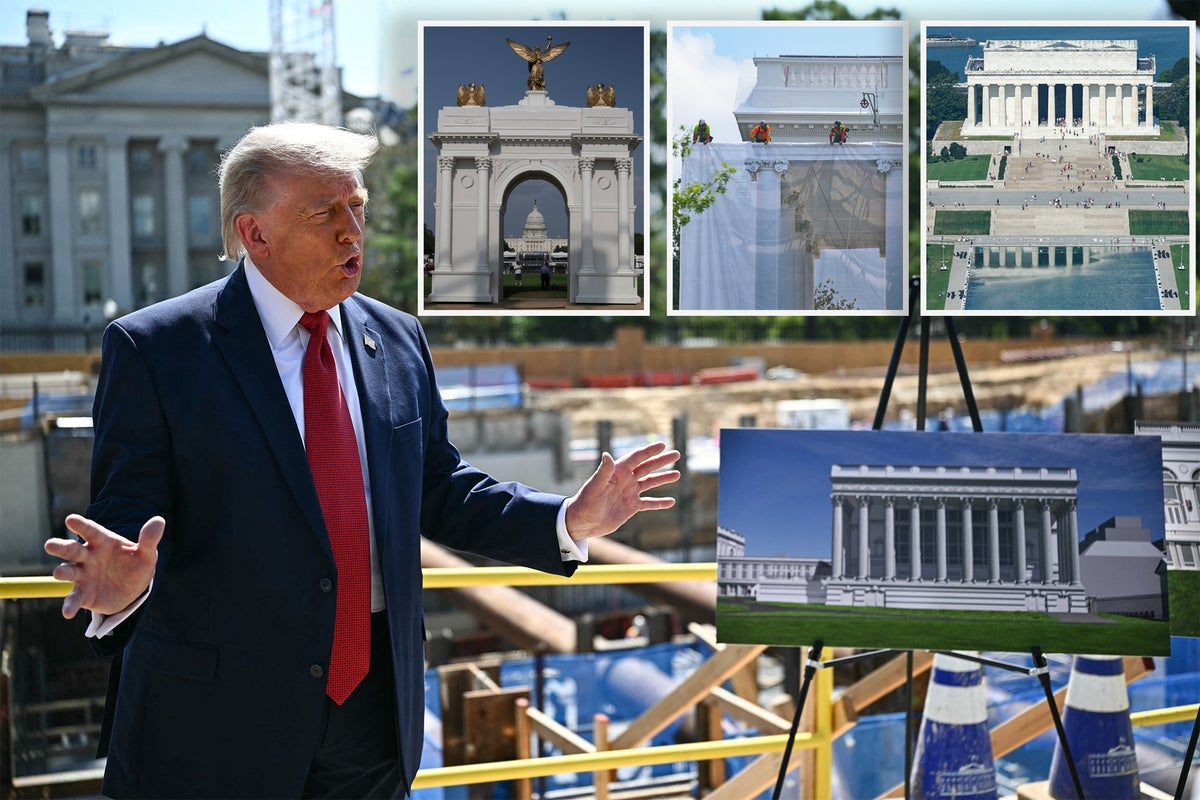
АНУ-ын Ерөнхийлөгч Дональд Трампын санаачилсан Вашингтон дахь архитектурын томоохон өөрчлөлтүүд нь татвар төлөгчдийн хөрөнгөөр санхүүжиж, төсөвт тооцоолсноос даруй давсан зардал гаргаж байгааг албан ёсны баримт бичиг болон гэрээнүүд харуулж байна.
Цагаан ордны Зүүн жигүүрт баригдаж буй танхим, Линкольны дурсгалын цогцолборын усан сангийн засвар, үндэсний хэмжээний хөшөө дурсгалын цэцэрлэгт хүрээлэн зэрэг төслүүдэд нийт нэг тэрбум гаруй доллар зарцуулагдсан байна. Ерөнхийлөгч эдгээр ажлыг хувийн хандив тусламжаар хийж байна хэмээн мэдэгдсэн ч бодит байдал дээр холбооны төсөв болон Нууц албаны (Secret Service) үйл ажиллагааны зардлаас татан төвлөрүүлжээ. Тухайлбал, 200 сая долларын төсөвтэй байсан бүжгийн танхимын өртөг 600 сая долларт хүрч, Линкольны дурсгалын усан сангийн засварт 14.8 сая доллар зарцуулсан боловч чанарын доголдол үүссэн байна.
Засаг захиргаа мөн Лафайет цэцэрлэгт хүрээлэнг хааж, засварын ажлыг өндөр өртгөөр гүйцэтгэх гэрээ байгуулсан нь шүүмжлэл дагуулаад байна. Үүний зэрэгцээ, Линкольны дурсгалын орчимд 250 фут өндөр “Ялалтын нуман хаалга” барихаар төлөвлөж байгаа нь түүхэн дурсгалт газрын харагдах байдлыг алдагдуулж болзошгүй хэмээн мэргэжилтнүүд болгоомжилж байна. Эдгээр төсөл нь Конгрессын зөвшөөрөлгүйгээр эсвэл хуучин хуулийн заалтыг ашиглан санхүүжилтээ шийдвэрлэж байгаа нь улс төрийн мэтгэлцээний сэдэв болоод байна.
Дэлгэрэнгүйг эх сурвалжаас харах
↓Эх сурвалжийг нээх ↓
Donald Trump has always operated on a simple rhetorical principle: project absolute luxury, claim someone else is footing the bill — and ignore the structural rot.
When it comes to his sweeping architectural overhauls of the nation’s capital, the script remains unchanged: Trump often insists his ambitious projects — from a sprawling White House ballroom to a patriotic re-skinning of national monuments — are private “donations” to the republic.
“This is taxpayer-free. We have no taxpayer putting up 10 cents,” the president proudly declared to reporters in March about the ballroom’s cost.
But public records, internal construction logs and federal grant allocations tell a credit- and credulity-straining story about the bottom line. A close examination of the receipts reveals a pattern of ballooning budgets, non-competitive bidding and the weaponization of federal funds to bankroll what critics say amounts to a roster of partisan vanity projects.
Far from being free of charge, the actual price tag of Trump’s aesthetic conquest of Washington is soaring over a billion dollars — and taxpayers are firmly on the hook.
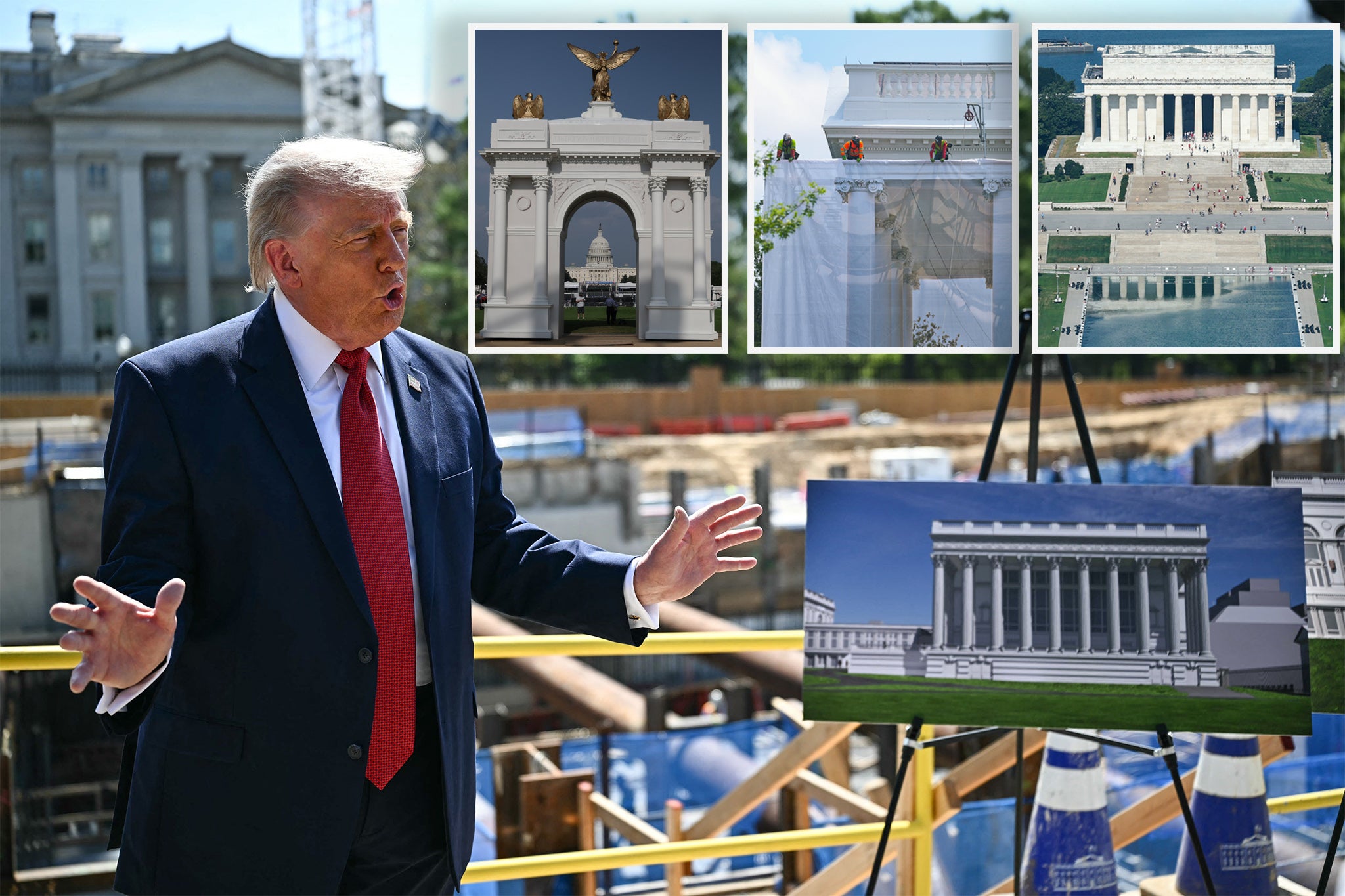
Most recently, the White House veiled the iconic North Portico entrance in a tarp bearing a photorealistic image of the very thing it was covering.
A White House official told The Independent that the tarp is meant to shield the portico while it undergoes “standard restoration work,” and during a media availability last week, Trump himself said work crews had already “taken about 150 years of paint off of the columns and re-did them” while claiming that they had been “in very bad shape” because they were “treated very badly by a lot of presidents,” though he offered no evidence to support the claims.
Separately, CNN reported that the project includes security upgrades to the White House’s front door that have long been advocated by the Secret Service.
The Oval Office remains awash in gold and gold-colored ornamentations, discarding its prior spartan but tasteful décor for one heavily reliant on the yellow precious metal that is also a hallmark of his Trump Tower and Mar-a-Lago homesteads.
What the president claims to be pure gold leaf paint now covers all manner of previously white surfaces — doorways, crown molding and the Great Seal of the United States that has long been installed in relief on the ceiling of the room. Plus at least two gilded decorations — angel statuettes now visible above a pair of doorways — were brought to the White House from Mar-a-Lago, which he shifted from his native New York during his first term.
Outside the Oval Office, there is now gold-colored lettering rendered in a typeface that largely resembles the signage at Trump’s Florida club — indicating that the entrance to the Oval Office is in fact “The Oval Office,” plus similar labels indicating locations of the Rose Garden and Trump’s “Presidential Walk of Fame.”
The total cost of these latest renovations is unknown, but last month the New York Times reported that the president’s various vanity projects and capital improvements around the nation’s capital appear to have drained at least $1 billion from the federal coffers.
These include his infamous ballroom project and the associated bunker beneath it — a project that was supposed to be free to taxpayers — plus a quarter-billion spent on “upgrades” to the John F. Kennedy Center for the Performing Arts (which was briefly named the Trump-Kennedy center until a federal judge said the Trump-appointed board for the center had no authority to change the name).
And inside the White House, the president has added new floors, tile and fixtures to the Lincoln Bedroom’s Truman-era bathroom, renovated the Palm Room and intends to turn the historic Treaty Room into a bedroom. He’s also paved over the Rose Garden, replaced the stone floor on the colonnade leading to the West Wing from the White House proper, and has coated most of the Oval Office in gilded things.
The cost of these interior updates is unknown, but here are a few items we do know the price of.
From ‘Donation’ to Deficit: The $600 Million White House Ballroom
The crown jewel of the administration’s architectural ambition is the wholesale demolition of the White House East Wing to make way for a massive new presidential ballroom.
Earlier this year during what was billed as “executive time” on his schedule, Trump summoned the White House press pool for a nearly hour-long bull session at the edge of the cavernous excavation site.
Standing beside computerized renderings of a neoclassical facade he explicitly compared to Cass Gilbert’s Supreme Court building — and shouting over the sound of heavy machinery — the president spun a rambling soliloquy about a “drone-proof” roof that would double as a military “drone-port,” declaring that there would never be another building like it.
.jpeg)
First announced in July 2025 with an estimated price tag of $200 million, the president initially promised the venue would be entirely financed by “generous American patriots.”
Promise made? Sure. Promise kept? Not so much.
According to a project summary from lead contractor Clark Construction, the estimated cost to complete construction has skyrocketed to $600 million. That’s more than double the $293 million the White House says it has raised from a who’s who of corporate and private donors, some of whom have been rewarded with intimate dinners hosted by Trump in the White House or in his revamped Rose Garden patio.
Those costs don’t include what’s happening below ground, where a World War II-era bunker is being replaced by what Trump has described as a “massive” military complex that includes a hospital and other emergency operations facilities.
Trump asked the Senate for a $400 million cash infusion for the underground portion of the project, but when it was stripped out, the White House reportedly took around $350 million from the Secret Service’s operating budget and redirected it to the bunker, justifying the move by declaring it all related to Trump’s security.
Meanwhile, around the north side of the White House, workers recently erected a large scaffold and draped a photorealistic tarp over the executive residence’s north portico in preparation for renovation work.
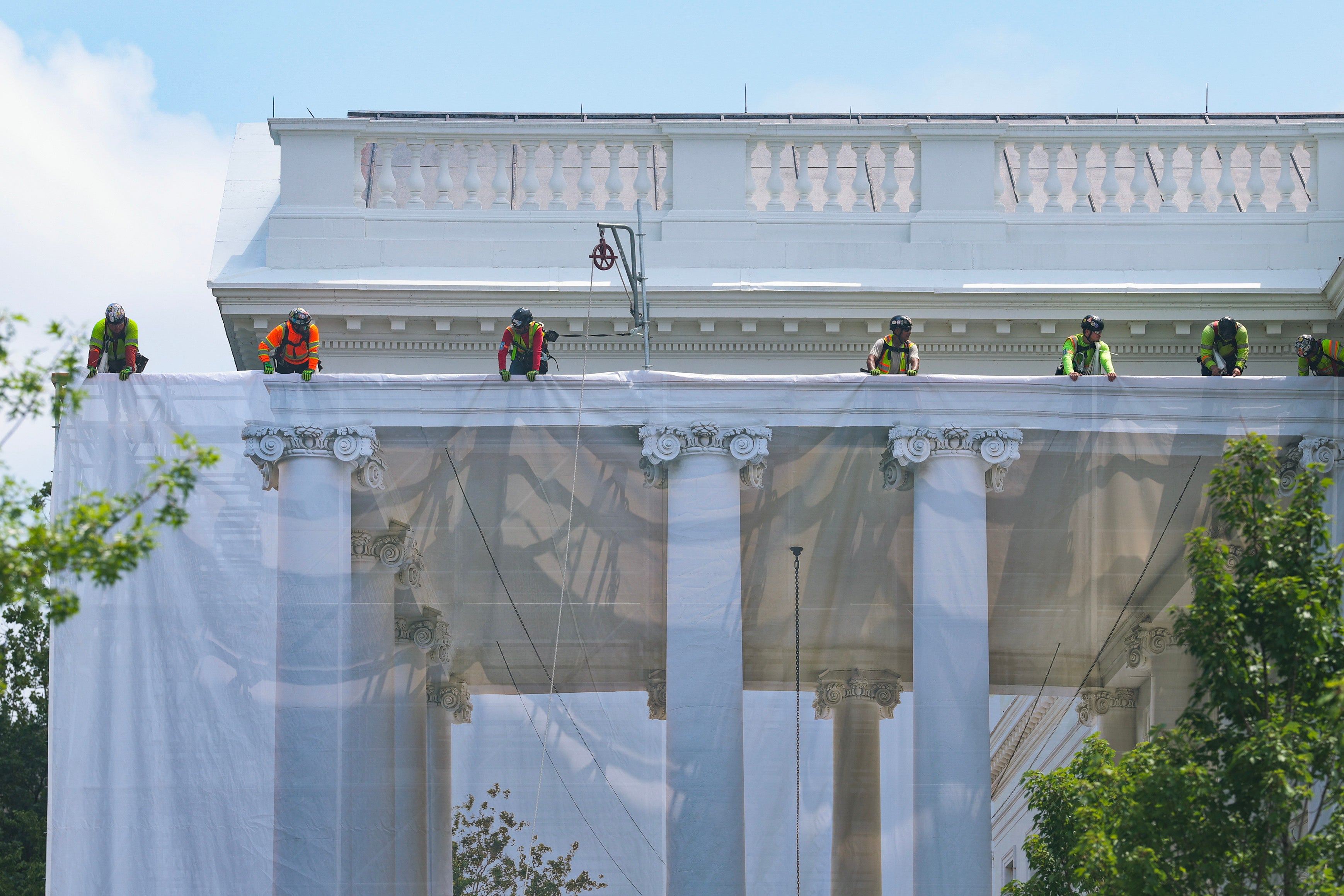
The massive covering was pre-printed with a shockingly accurate rendering of the very architectural feature it was intended to hide, making it appear to a casual observer as if there were no covering at all, sky peaking through and all.
“We’re restoring the plaster, and not just at the door level — all the way up to the crowns of those towers,” Interior Secretary Doug Burgum said of the work, adding that the project would be considered “historic renovation work.”
The cost for the portico perk-up has not yet been disclosed.
During a media availability, Trump said work crews had already “taken about 150 years of paint off of the columns and re-did them” while claiming that they had been “in very bad shape” because they were “treated very badly by a lot of presidents,” though he offered no evidence to support the claims.
Earlier this year, Rodney Cook, the Trump ally who heads the federal arts commission in charge of approving major construction projects in Washington teased the replacement of the simple Doric columns that have fronted the White House for two centuries with ornate Corinthian ones similar to those used at the U.S. Capitol and Supreme Court buildings.
The heavily decorated columns would match those that will be used in Trump’s planned ballroom.
Trump’s $14.8M Green Lagoon: A No-Bid Train Wreck
If the White House ballroom represents the pinnacle of Trumpian excess, the Lincoln Memorial Reflecting Pool renovation is a masterclass in micromanagement.
After Trump became disturbed by the pool’s historic tendency to develop seasonal algae, he promised a swift, cheap fix to turn the basin a permanent shade of “American flag blue” in time for the nation’s 250th anniversary.
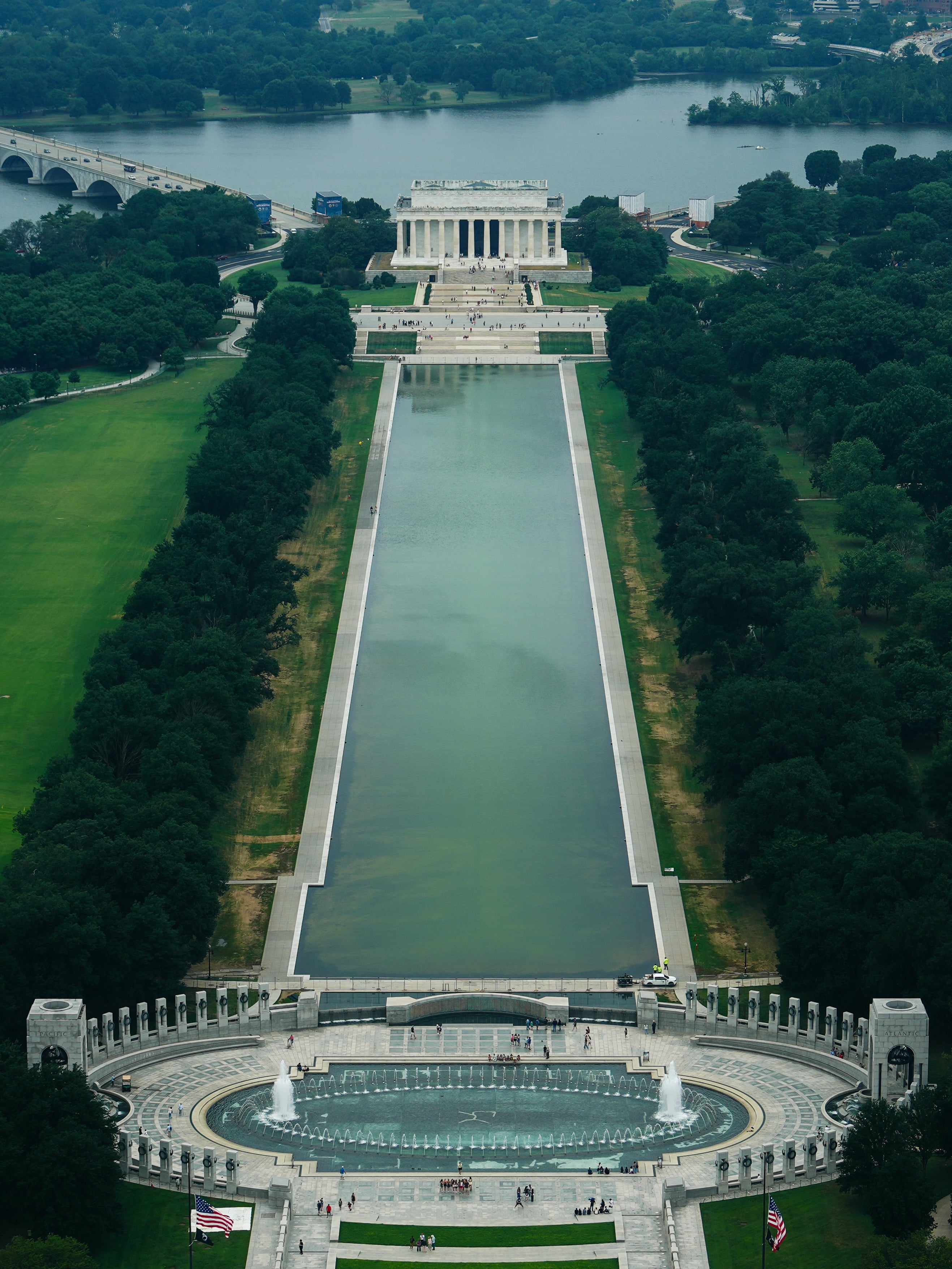
He took a personal interest in the matter, telling reporters he was engaging his “pool guy” to handle the job for as little as $ 2 million.
But Trump’s claim of massive savings was too good to be true.
Public records indicate the total value of federal contracts awarded for the reflecting pool overhaul actually topped $14.8 million, including a no-bid contract to a firm that had previously serviced a swimming pool, not a massive reflecting pool with drainage issues, at one of Trump’s private golf resorts.
The ultimate irony, of course, is that the $14.8 million rubberized coating failed almost immediately upon completion. The dark-blue lining upset the water’s thermal balance, triggering an unprecedented green algae bloom and causing the paint to peel off in massive sheets — forcing National Park Service staff to spend subsequent weeks frantically dumping commercial hydrogen peroxide into the monument.
Classical Warfare on Modern Art in Trump’s ‘Garden’
Yet more taxpayer funds are being pumped into the administration’s frantic push to build the National Garden of American Heroes, a project Trump first dreamt up during his first term as a response to conservative cultural grievances over civil rights protests in 2020.
Shelved by the Biden administration, the project was resurrected by executive action after Trump’s return to power. It is supposed to consist of at least 250 statues of notable Americans, including right-wing celebrities such as Justice Clarence Thomas and assassinated activist Charlie Kirk.
Congress allocated $40 million for the statue garden in the One Big Beautiful Bill partisan spending package signed into law last year, but the Trump administration has reportedly grabbed even more funds from the National Endowment for the Arts and the National Endowment for the Humanities to bankroll the project.
After both organizations killed scores of grants to recipients that fell afoul of Trump’s anti-DEI policies, the NEH and NEA jointly committed $34 million from their federal appropriations to establish a strict grant program offering up to $200,000 per statue.
The public grant guidelines contain an explicitly political aesthetic mandate, dictates that entirely ban any modernist or abstract designs, strictly requiring that all 250 planned sculptures be portrayed in a “realistic manner” and rendered exclusively in “marble, granite, bronze, copper, or brass.”
The Fencing and No-Bid Favors of Lafayette Park
Directly across from the White House, Lafayette Park has been systematically transformed from a public square into a fortified, high-dollar construction zone. National Park Service records reveal that the park was abruptly fenced off under a sweeping closure notice ostensibly designed to protect historic assets and allow the Secret Service to conduct sweeping security checks ahead of the nation’s 250th anniversary.
However, investigative reporting and public procurement databases expose a far more transactional reality. The administration quietly ballooned a contract with Clark Construction—the very same firm handling the president’s massive White House ballroom project—from an initial $11.9 million to a staggering $17.4 million.
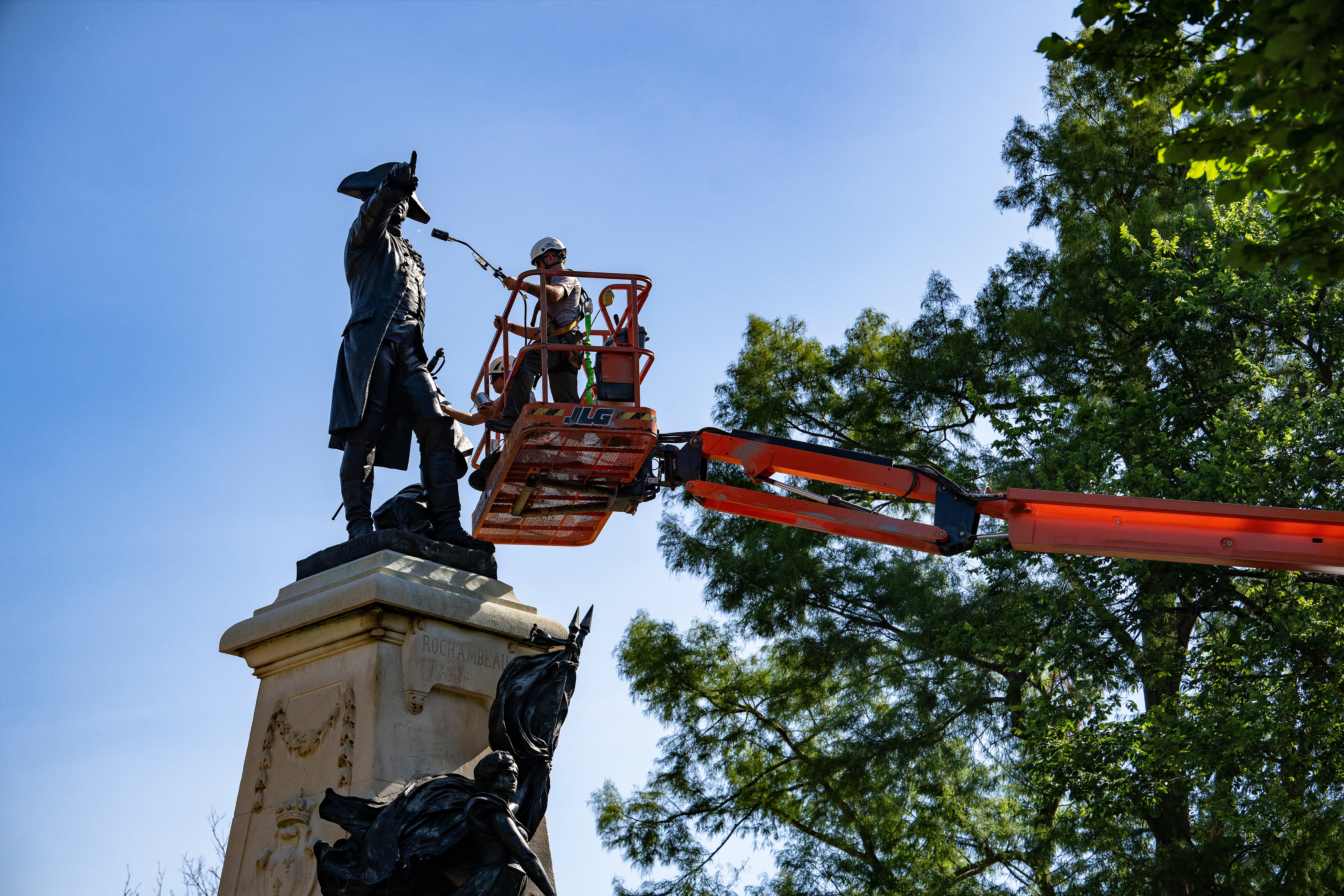
The core justification for this no-bid, fast-tracked payout was the repair of Lafayette Park’s two historic ornamental fountains.
Contracting specialists analyzing the public documents noted that the exact same fountain repairs were projected to cost a modest $3.3 million. To justify the massive price hike, the National Park Service invoked an emergency exemption to bypass the standard competitive bidding process, double-counting inflation and tacking on a flat, completely un-itemized “fast-track” fee.
Furthermore, internal administration plans obtained by reporters reveal that the ultimate goal of the closure isn’t just cosmetic; the president plans to erect permanent heavy steel fencing on the north and south sides of the square, effectively giving the White House a permanent kill-switch to lock the public out of Washington’s most iconic protest grounds at a moment’s notice.
The Murky Waters of the ‘Beautified’ Fountains
This frantic effort to get the capital’s water features flowing in time for the summer festivities is part of a broader, centralized branding effort christened the “Make D.C. Safe and Beautiful Again” campaign.
Yet, much like the bleeding blue paint on the National Mall, the administration’s rush to repair the city’s fountains has repeatedly collided with institutional incompetence and physical reality.
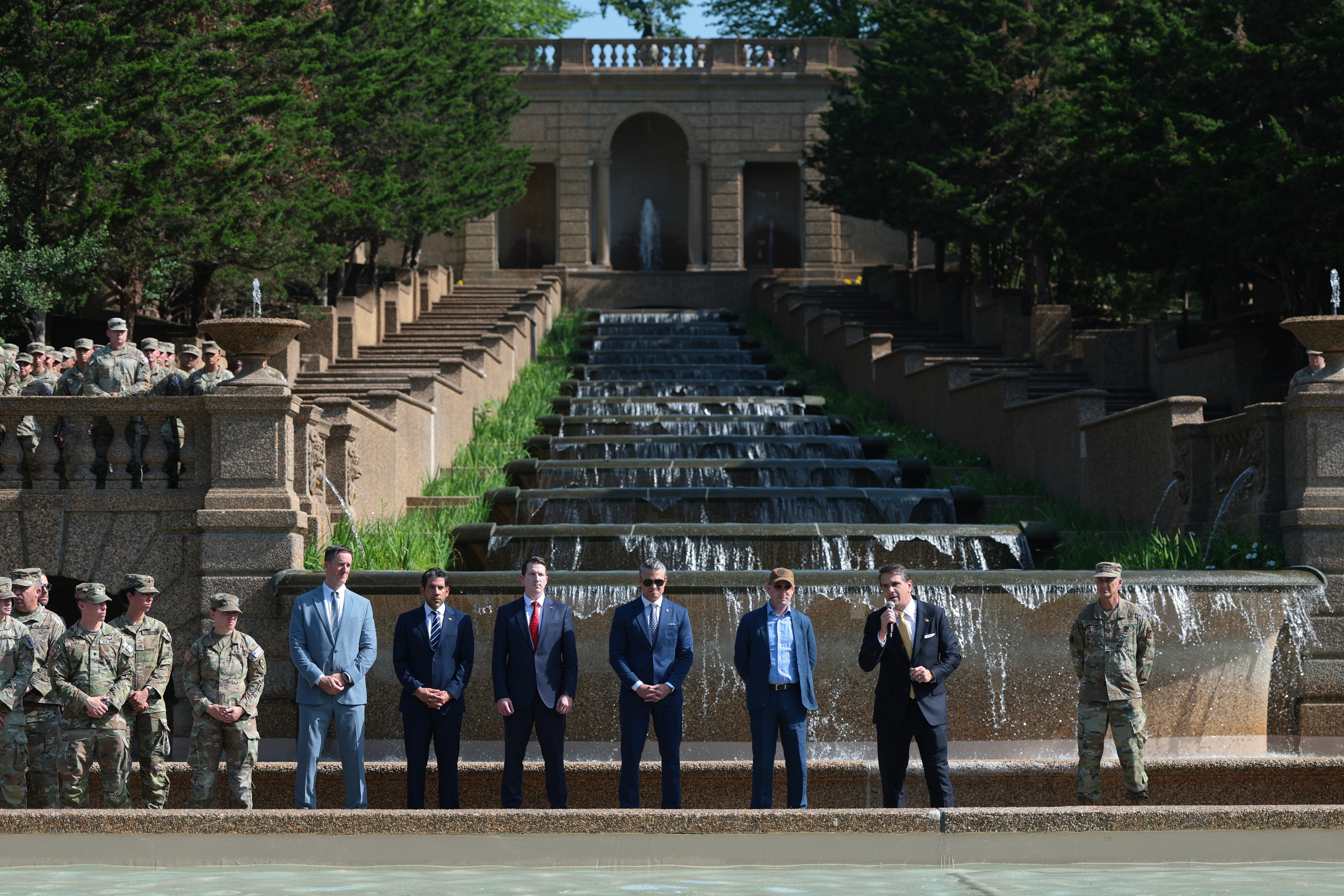
At Meridian Hill Park in Northwest Washington, a $16 million restoration of the historic 13-basin, 300-foot cascading fountain ended with water through its grand terraces for the first time after a years-long shutdown.
But that success, which has been largely welcomed by residents, has been tempered by unforeseen problems reminiscent of the Lincoln Memorial Reflecting Pool debacle.
Just months after the grand reopening, the pristine cascading waters abruptly turned a murky, sludge-like brown due to sediment dislodged from ancient, poorly remediated pipes.
The surprise hiccup turned into theater of the absurd last week when Pete Hegseth arrived at the park flanked by National Guard troops during a sweltering summer heatwave to inspect the murky mess, only to be met by crowds of furious local protesters.
That’s not to say that there haven’t been positive outcomes, such as at Union Station, where the administration is planning a sprawling $465 million federal grant to revitalize the train terminal. Outside, the station’s iconic Columbus Circle Fountain was brought back to life after nearly two decades of dormancy.
All told, Park Service records show approximately $58 million spent on fountains, most from national park user fees and some from the agency’s working capital fund.
Golden Horses and the 250-Foot ‘Arc de Trump’
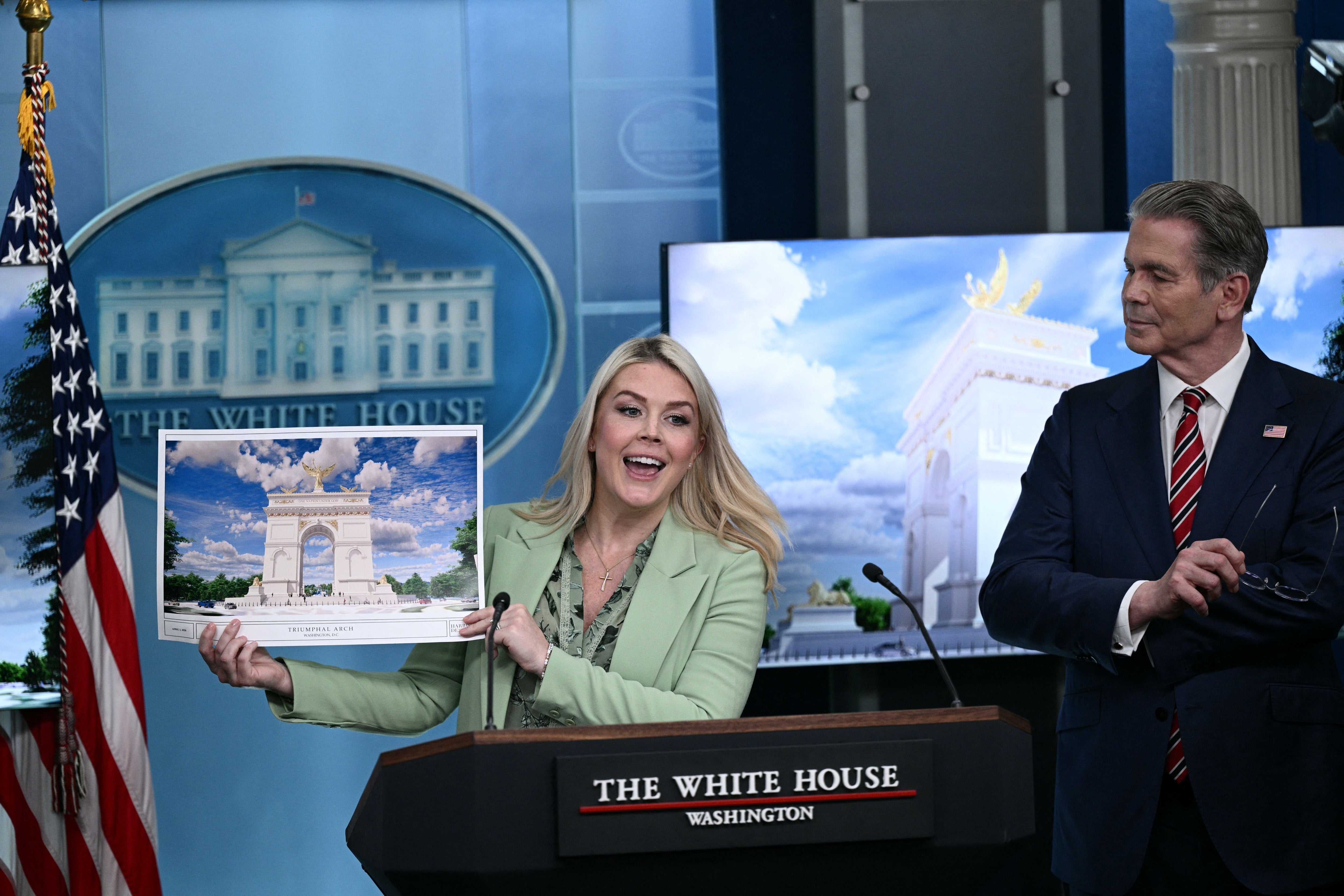
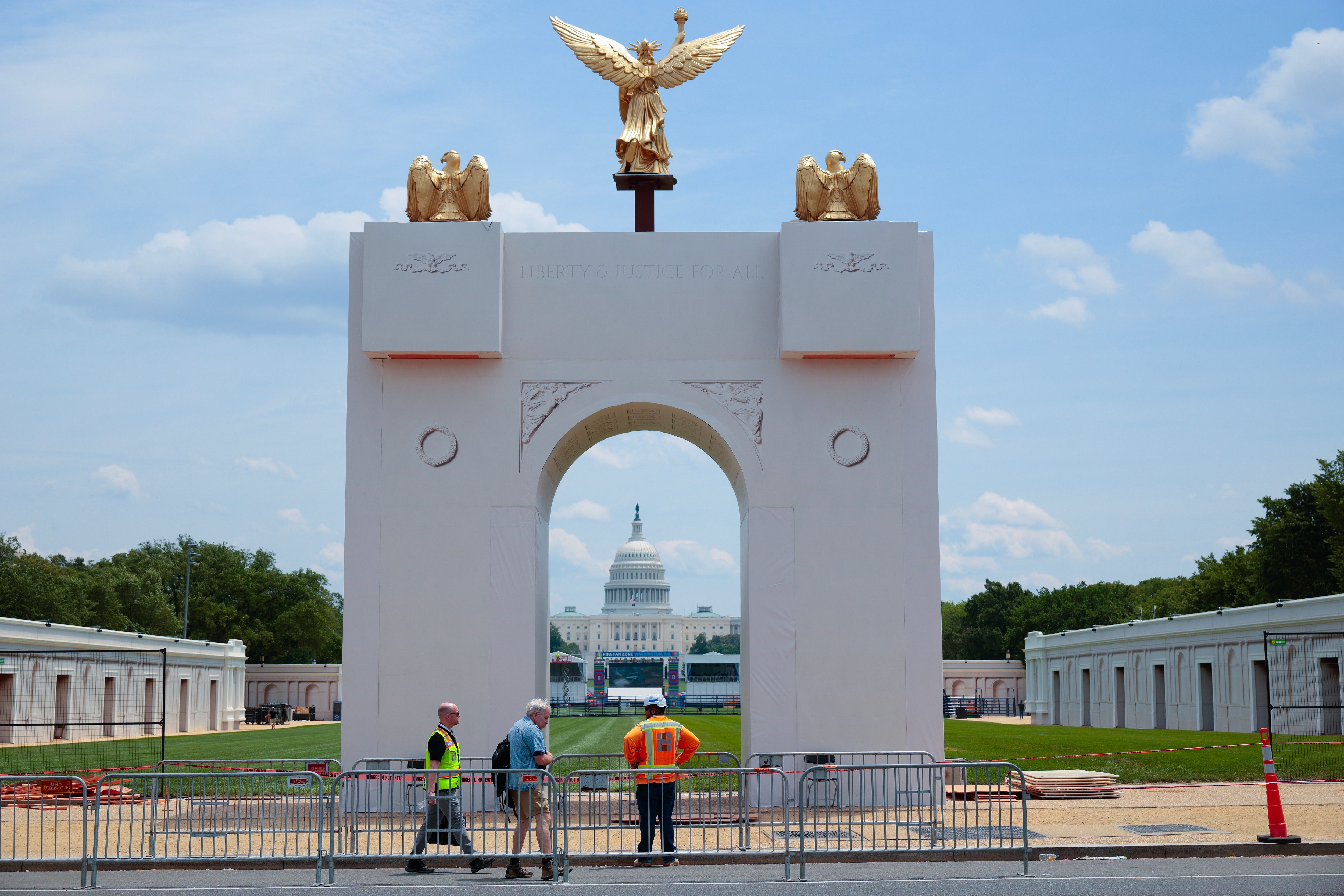
Trump’s desire to leave a mark on the nation’s capital has also manifested itself in an aggressive, legally contentious push to erect a towering “Triumphal Arch” at Memorial Circle, positioned directly between the Lincoln Memorial and Arlington National Cemetery — and on the iconic Arlington Memorial Bridge that spans that distance.
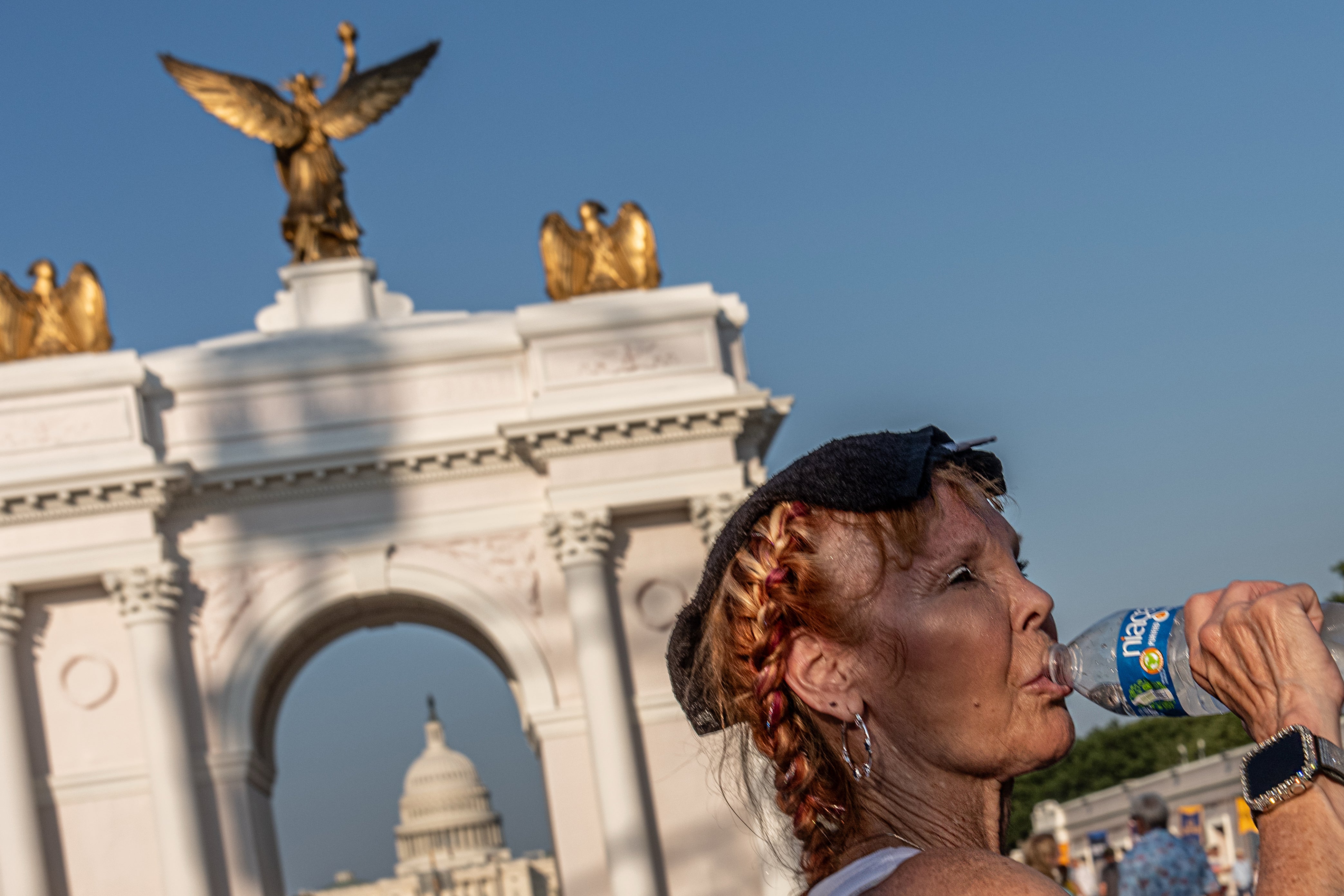
A pair of giant bronze equestrian statues — known as Arts of War and Arts of Peace — have been shrouded from view for months because the president decided they’d look better covered slathered in a thin layer of gold paint.
Earlier this year, the Trump administration awarded The Gilders’ Studio a $2.8 million no-bid contract to do their best King Midas impression on the statues, which have been on the Washington, D.C. end of the bridge since 1951.
Trump promised the gilding work would be finished by the July 4th semi-quincentennial celebrations, but the project is still unfinished and the cost has reportedly ballooned to $5 million and counting.
To bypass the pesky requirement of congressional authorization, Justice Department and administration lawyers have drafted a highly unusual legal defense: they claim that a century-old congressional act from 1925, which originally envisioned two 166-foot-tall columns to represent Civil War reconciliation, somehow grants them the unilateral authority to build a 250-foot-tall arch today.
Trump’s officials have argued that the century-old discretion to modify monument designs never expired, effectively attempting to leverage a forgotten Jazz Age blueprint into a blank check for a modern, personal monolith.
At 250 feet tall, the proposed arch would absolutely dwarf the nearby 99-foot-tall Lincoln Memorial, completely severing the historic, symbolic sightline connecting Abraham Lincoln’s monument with the cemetery where many of the troops who died during his presidency are buried.
Despite a public comment period that generated over 100,000 responses — including a public hearing where federal planners reported that 100 percent of the feedback submitted to the Commission of Fine Arts was opposed to the project — the administration’s handpicked panels have rushed to clear the runway. The U.S. Commission of Fine Arts, composed entirely of Trump appointees, swiftly approved the design concept, albeit after stripping out four proposed stone lions at the base.
More recently, the National Capital Planning Commission voted 8–1 to advance the preliminary plans, though there remains the possibility that the monument may need to be reduced in size to avoid interfering with flights to and from Washington National Airport.

