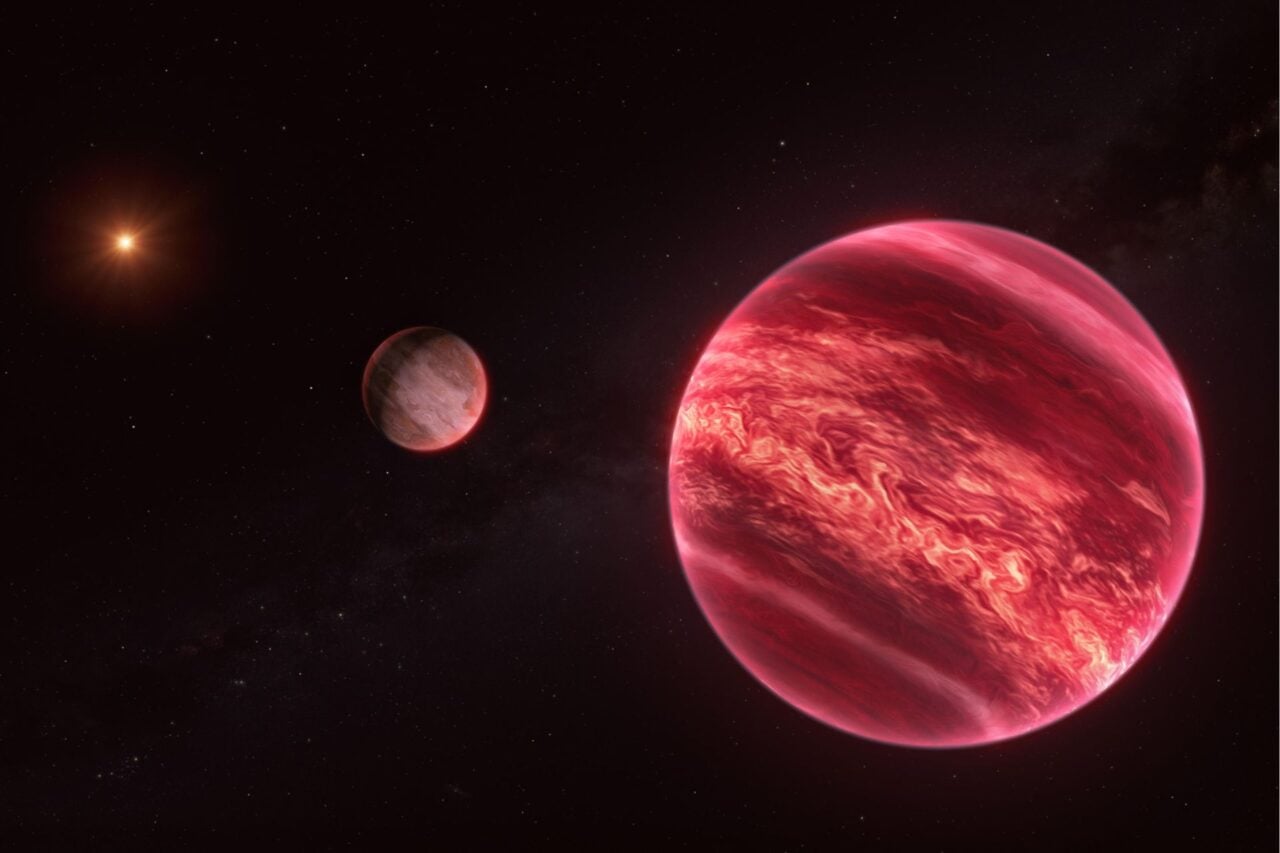
Эрдэмтэд оддын аймгаас гаднах орчинд сарны шинж чанарыг агуулсан, бор одой одны эргэн тойронд эргэдэг шинэ биетийг олж илрүүлжээ.
NASA өнөөг хүртэл 6,000 гаруй экзопланетийг нээсэн ч одоогоор экзосар буюу нарны аймгийн гаднах сарны оршин тогтнолыг албан ёсоор батлаагүй байна. “Nature” сэтгүүлд нийтлэгдсэн судалгаагаар Чилийн Диего Порталесийн их сургуулийн судлаач Кевин Хой тэргүүтэй баг бор одой одны эргэн тойронд эргэдэг, өөрөө бас нэгэн одны тойрог замд орших гурван шатлалт тогтолцоог илрүүлжээ. Уг биет нь сарны шинж чанаруудыг агуулж байгаа хэдий ч одоогоор “экзосар” гэх шинжлэх ухааны нэгдсэн тодорхойлолт байхгүй тул үүнийг анхны экзосар хэмээн албан ёсоор баталгаажуулахад хүндрэлтэй байна.
https://www.nature.com/articles/s41586-026-10751-w
Судлаач Кевин Хой болон түүний баг 2023 оны аравдугаар сараас 2026 оны хоёрдугаар сар хүртэлх хугацаанд радио хурдны шинжилгээний аргыг ашиглан уг биетийг ажиглажээ. Энэхүү арга нь Доплерийн эффект болон төвөөс зугтах хүчний нөлөөгөөр үүсэх одны хэлбэлзлийг хэмжихэд суурилдаг бөгөөд үүний тусламжтайгаар тухайн биет 170 хоногт нэг удаа бор одой одны тойрог замыг туулдаг болохыг тогтоосон байна. Уг биет нь эзэн биетээсээ 2.5 хувийн харьцаатай масстай бөгөөд Бархасбадь гаригтай ойролцоо хэмжээтэй юм.
Экзосарын тодорхойлолт тодорхойгүй байгаа нь энэхүү нээлтийг баталгаажуулахад гол саад болж байна. Манай нарны аймагт сарууд нь гаригуудыг тойрон эргэдэг бол энэхүү шинэ биет нь “бүтэлгүйтсэн од” гэгддэг бор одойг тойрч байгаа нь ангиллын хувьд маргаан үүсгэж буй юм. Хэдийгээр энэ биетийг экзосар гэж шууд нэрлэх эсэх нь эргэлзээтэй байгаа ч уг судалгаа нь цаашид экзосар хайх, тодорхойлох шинэ аргачлалыг баталгаажуулсан чухал алхам боллоо.
Дэлгэрэнгүйг эх сурвалжаас харах
Эх сурвалжийг нээх ↓
NASA has discovered more than 6,000 exoplanets peppered throughout the galaxy, but astronomers have yet to confirm the existence of a single exomoon. A newly discovered moon-like object could be a promising candidate.
In a study published today in the journal Nature, researchers describe a three-tiered hierarchical system: a satellite orbiting a brown dwarf, which in turn orbits another star. While the satellite fits a moon-like classification in several ways, astronomers lack a concrete definition for exomoons, so the authors can’t definitely say this is the first one. Still, their work demonstrates an effective technique for finding moon-like objects outside of our solar system, which could help lead to the conclusive detection of an exomoon in the future.
“The lack of any definition to even argue on the criteria is why we say we are unsure if this counts as the first exomoon or not,” lead author Kevin Hoy, an astrophysics PhD student at Diego Portales University in Chile, told Gizmodo.
What is an exomoon?
In our solar system, it’s fairly obvious what a moon is and isn’t. Astronomers may quibble about size constraints—whether a small satellite counts as a moon or an orbiting asteroid, for instance—but the distinction is relatively straightforward. When looking beyond the solar system, things get a lot more complicated.
Other solar systems don’t look like ours, so the few natural exosatellites astronomers have discovered don’t fit neatly within our moon classification system. While researchers have pinpointed a few candidates in recent years, they have yet to find one that can’t be disputed. The lack of confirmed discoveries means astronomers don’t have a set of examples to compare new candidates to, so the whole question of what constitutes an exomoon is fraught.
The exosatellite Hoy and his colleagues identified may not be a definitive exomoon, but it is certainly moon-like. It orbits a substellar object—any object whose mass is below the threshold required to sustain hydrogen fusion—and it’s significantly smaller than its host, with a mass ratio of 2.5%. What’s more, it’s the last component in a three-tiered hierarchical system, which means it’s a satellite orbiting an object that orbits a star. Our moon is exactly the same: it orbits the Earth which in turn orbits the Sun.
Well, they’re not exactly the same. One of the biggest issues with calling this exosatellite an exomoon is that it orbits a brown dwarf, which is essentially a failed star. These objects are too low in mass to be stars but too high in mass to be planets. All the moons in our solar system orbit bonafide planets, so there is no consensus on whether brown dwarfs should count as moon hosts.
Its size is another issue. Even though this exosatellite is much smaller than its host, it’s still way bigger than any moon in our solar system, with a mass just below that of Jupiter. There is no agreed-upon upper limit for exomoon size, but one could argue that there should be.
Finding new candidates is exactly how astronomers will solidify an exomoon definition, and with this discovery, Hoy and his colleagues demonstrate an effective way to hunt them down. To their knowledge, this is the first time this technique has produced evidence of a satellite orbiting a brown dwarf.
A promising search technique
The researchers found this exosatellite using radio velocity analysis, which exploits two key pieces of physics, according to Hoy. The first is the Doppler effect. Astronomical objects emit waves of electromagnetic radiation, and the frequency of those waves appears to change depending on whether the object is moving toward or away from the observer. This allows astronomers to measure velocity changes along their line of sight, or radial velocity.
The second concept is that when an object is orbiting a host, they both orbit a shared center of mass, causing the host to wobble. “You can take that wobble, and if that causes velocity changes towards or away from you, then you can detect that change over time to infer the existence of satellites orbiting the thing you’re looking at,” Hoy explained.
He and his colleagues used this technique to monitor the brown dwarf between October 2023 and February 2026. Their analysis revealed the signal of at least one orbiting satellite—this new exomoon candidate. After modeling the properties of the system, the researchers determined that the satellite completes one trip around the brown dwarf every 170 days.
While confirming this exomoon candidate will have to wait for a clear classification system, there’s a lot to be learned about it in the meantime. Hoy hopes to perform an astrometry analysis to measure the true mass of the satellite and calculate its orbital angles. His team could also apply this technique to other targets to see if they can find similar objects, he said. The search for the first exomoon may not be over yet, but studies like this one will help astronomers build the foundation of a definition.

