Дэлхийн хойд туйлын бүс нутаг, Гренланд, Исланд болон Испанийн нутгаар дайран өнгөрөх энэхүү ховор үзэгдлийг олон улсын одон орон судлаачид анхааралтай ажиглаж байна.
2026 оны наймдугаар сарын 12-нд болох бүтэн нарны хиртэлт нь Оросын алс дорнодын бүс нутгаас эхлэн Гренланд, Исланд, Португал, Испани улсуудын нутгаар үргэлжлэн, Газар дундын тэнгист жаргах нартай давхцан өндөрлөх юм. Хиртэлтийн хамгийн дээд хугацаа нь Исланд улсад 2 минут 18 секунд үргэлжлэх бол Испанид хоёр минутаас бага хугацаанд ажиглагдана. Нийт хиртэлтийн үйл явц дөрвөн цаг 23 минут үргэлжлэх бөгөөд Хойд Америк, Европ, баруун хойд Африкийн нутгаас хэсэгчилсэн байдлаар харагдах боломжтой.
Энэхүү хиртэлт нь Сарны сүүдэр дэлхийн хойд туйлаас 100 км хүрэхгүй зайд өнгөрөх онцлогтой. Ажиглагчид нарны титмийг зөвхөн хиртэлтийн бүтэн үе шатанд харах боломжтой бөгөөд энэ үеэр Сугар гариг нарны зүүн хэсэгт тод харагдах төлөвтэй байна. 1860 онд одон орон судлаач Уоррен де ла Рю нарны титэм нь нарны өөрийнх нь бүтээгдэхүүн болохыг Испанид хийсэн ажиглалтаараа анх тогтоож байсан түүхтэй.
https://www.universetoday.com/article_images/SE2026Aug12T_20260728_161803.gif
https://eclipse.aas.org/eye-safety/iso12312-2
https://aas.org/press/american-astronomical-society-warns-counterfeit-fake-eclipse-glasses
https://science.nasa.gov/eclipses/safety/
https://www.facebook.com/ChristopherBecke
https://en.wikipedia.org/wiki/Solar_Saros_126
https://eclipse2026.is/stories/meet-the-nasa-scientist-looking-for-aurora-during-icelands-eclipse
Ажиглалт хийхдээ ISO 12312-2 стандартын шаардлага хангасан хамгаалалтын шил ашиглах нь нүдний аюулгүй байдалд нэн чухал. Хэсэгчилсэн хиртэлтийн үеэр нарны гэрэл бүрэн хиртэлтийн үеийнхээс илүү хүчтэй байдаг тул ямар ч тохиолдолд нар руу шууд харж болохгүй. Мөн модны навч, шүүр зэрэг нүхтэй зүйлсийг ашиглан нарны тусгалыг гадаргуу дээр буулгах замаар аюулгүй ажиглалт хийх боломжтой.
Энэхүү үзэгдэл нь “Saros 126” цувралын нэг хэсэг бөгөөд 2044 онд тус цувралын дараагийн бүтэн хиртэлт болно. NASA-гийн эрдэмтэн Лиз Макдоналд Исландад хиртэлтийн үеэр туйлын туяа ажиглагдах эсэхийг судлахаар төлөвлөж байгаа бөгөөд энэ нь Персеидын солирын борооны оргил үетэй давхцаж байгаа нь ховор тохиолдол юм. ESA уг үзэгдлийг цахимаар шууд дамжуулахаар бэлтгэж байна.
Дэлгэрэнгүйг эх сурвалжаас харах
Эх сурвалжийг нээх ↓
Get ready for the only total solar eclipse of 2026
Where will you be on August 12th? Many an eclipse chaser and the ‘eclipse curious’ will make the journey to stand in the Moon’s shadow on that Wednesday date. This unique eclipse sees the pencil-thin shadow of our Moon curl around the Earth’s pole, before arcing across Greenland, Iceland and the Iberian peninsula towards a dramatic sunset over the western Mediterranean.
The eclipse sees a maximum duration for totality of 2 minutes and 18 seconds over far western Iceland, though most viewers across northeastern Spain will see less than two minutes in duration. The entire eclipse including partial phases lasts four hours and 23 minutes.
An animation of the August 12th eclipse. Credit: NASA/GSFC/A.T. Sinclair.
The path is a unique one as eclipses go. Totality touches down off of the Arctic coast of far eastern Russia near the far-flung Saint Peter Islands and the small village of Syndassko at 16:58 Universal Time (UT). The umbral shadow of the Moon then loops and just misses the Earth’s northern rotational pole by less than 100 kilometers, sweeping down across Greenland, nicking Iceland and crossing the North Atlantic before grazing Portugal and heading across northeastern Spain towards a photogenic sunset over the Spanish islands of Mallorca and the western Mediterranean Sea.
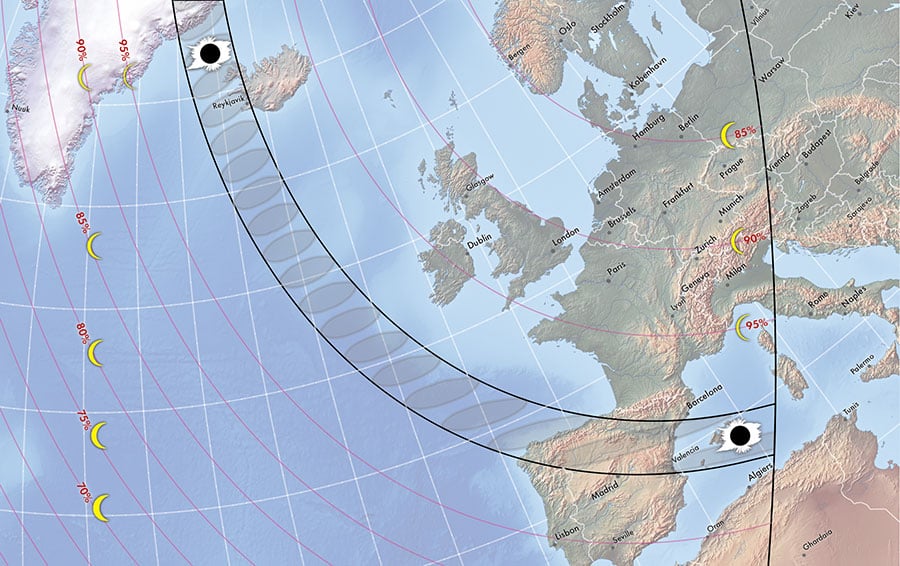 The path of the August 12th total solar eclipse. Credit: Michael Zeiler.
Totality’s trail presents a challenge, featuring an ocean track with very few landfalls. The Basque region of Spain presents the biggest swath of ground witnessing totality, though the region has also been plagued with record-setting heat and destructive fires this summer.
It’s also worth noting that partial phases outside of the track extend across Europe, northwestern Africa and a good portion of North America. Viewers across the northeastern U.S. and the Canadian Maritimes might want to dig out those eclipse glasses from 2024 if skies are clear on the 12th, to catch part of the show. Partial phases for the eclipse run from 15:34 to 19:57 UT, with the peak right around 17:45 UT.
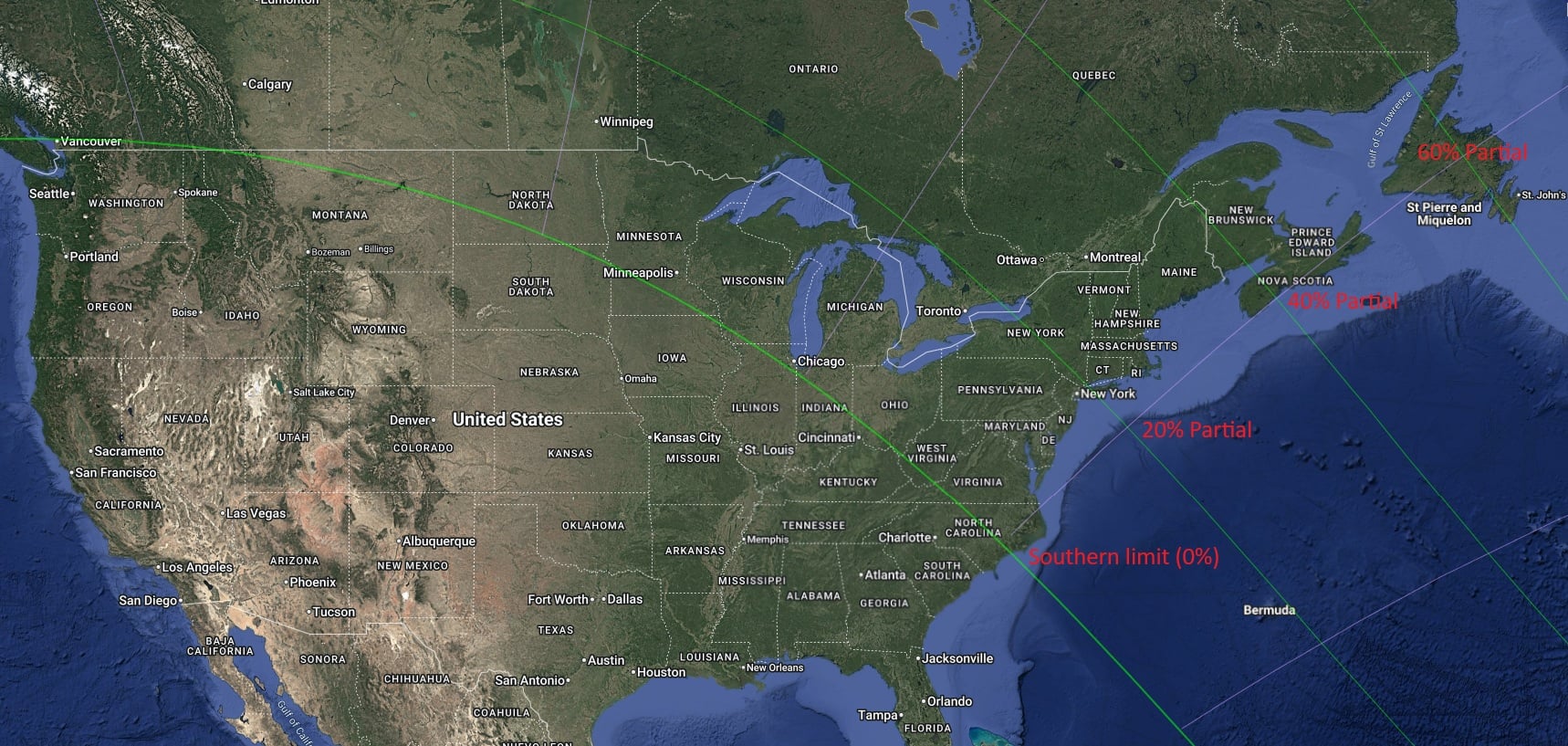 The southern edge of the partial phases for the August 12th total solar eclipse over North America. Credit: Xavier Jubier.
Observers along the U.S. East Coast will want to look for a maximum partial phase just before 18:00UT/2:00 PM EDT.
Viewing and Safety
The sunset eclipse across Spain will be low to the horizon, with an altitude of just under five degrees for Spain’s eastern shore. This could spell trouble for viewers if any clouds turn up on eclipse day, though it does offer opportunities to catch the eclipsed Sun along with foreground objects.
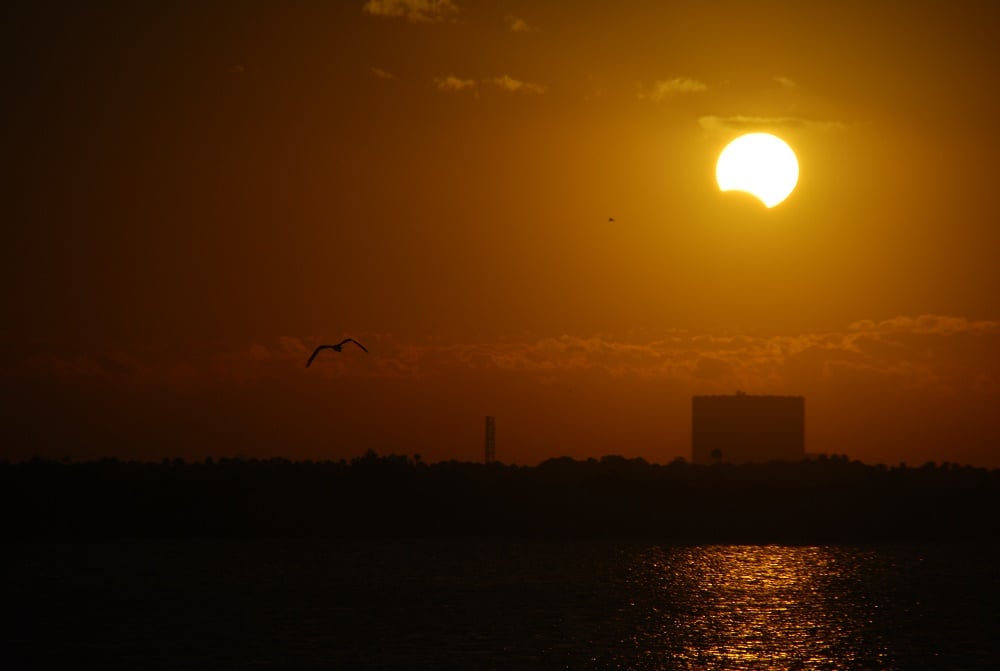 A partial solar eclipse over the Vehicle Assembly Building at the Kennedy Space Center in 2013. Credit: Dave Dickinson.
Remember, you need to take proper safety precautions during all partial phases of the eclipse. Even a 99% eclipsed Sun is still eye-damaging bright. Be sure to check those old glasses prior to use, and only use glasses with an approved ISO 12312-2 rating on them from a trusted vendor and beware of counterfeits NASA has a great resource page covering eclipse safety.
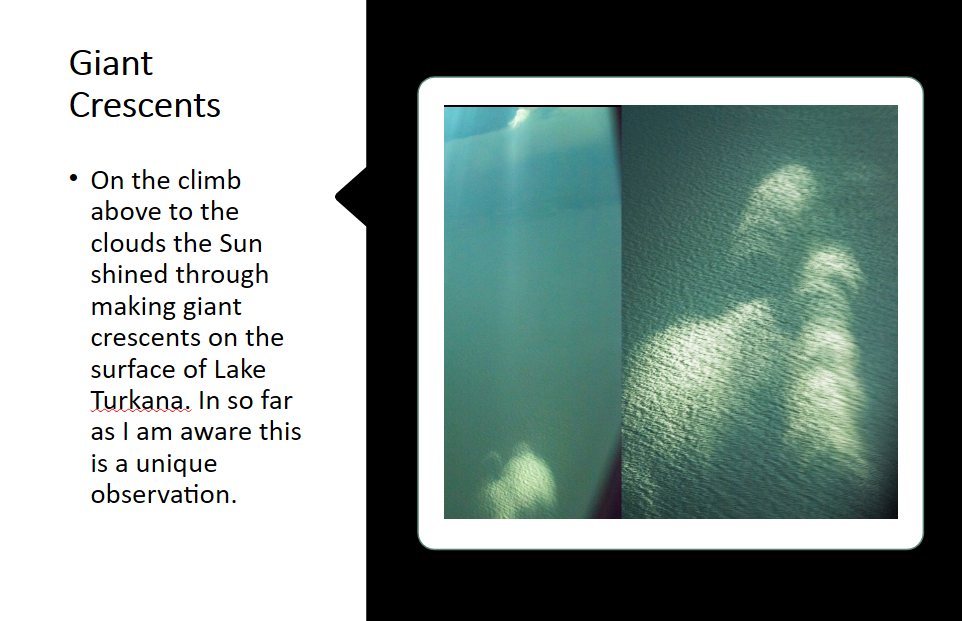 Crescent Suns seen across the surface of Lake Turkana, during the 2013 hybrid/annular solar eclipse. Credit: Eliot Herman.
Projection offers a good safe alternative. A spaghetti strainer, lattice work, and even gaps in tree leaves can act as natural projectors during the partial phases of a solar eclipse. This effect is especially noticeable against sidewalks, walls and high contrast surfaces.
Totality passes quickly. My impression during the 2024 eclipse was as if someone had abruptly thrown a dimmer switch on the sky. We were then immersed in a strange 360 degree twilight as the Moon’s shadow sped past. Watch for animals and insects to be fooled into nocturnal activity with the sudden onset of totality. Humans can act strangely, too. What struck me as surprising were the number of people still driving around during totality (!) Did they even know there was an eclipse that day?
Watch for crimson prominences on the solar limb, and the pearly white corona of the Sun bracketing the Moon. About twice the brightness of a Full Moon, the source of the corona was a mystery until astronomer Warren de la Rue pegged it correctly as a product of the Sun (versus the Moon or the Earth’s own atmosphere) in 1860. Coincidentally, de la Rue was also observing from northern Spain. You only see the elusive corona during totality. The sky itself during totality is brighter than you might think. Watch for brilliant -4.4 magnitude Venus 46 degrees east of the Sun as totality approaches.
They always say to photograph your second total solar eclipse, but simply watch and enjoy your first. One of several eclipse chasers headed to Spain to once again witness totality is astrophotographer Chris Becke:
“After successfully making it into the path of totality in 2017 and 2024 and being fortunate enough to have had clear skies for both, my wife and I will be trying for our third totality—this time in the Asturias region of Spain, where the Sun will be fully eclipsed for one minute and 47 seconds.” Becke told Universe Today. “I booked lodging nearly a year ago, and followed it up about a month later with airline tickets from Washington DC to Madrid, knowing high demand was inevitable. We’ve located a viewing spot on a nearby hilltop with panoramic views (and a convenient restaurant and toilet) to spend the day.”
“Because totality will occur with the Sun just 10 degrees above the western horizon, getting a clean, unobstructed landscape view is critical. I’m working on imaging plans that will be as ‘set it and forget it’ as possible so as not to distract from the experience. I’ll have a DWARF mini taking a continuous time-lapse from first to last contact; I’m leaving the included solar filter on the entire time just to capture the partial phases without needing to touch the rig. For totality, I will be running my Fujifilm X-T4 and X-M5. One is paired with an 18mm lens to capture a wide-field view of the low-altitude eclipse against the Spanish landscape, while the other is zoomed in to 600mm for a close-up of the corona. Both will be programmed for bracketed exposures and automatic interval timing. All I’ll have to do is pull the solar filters and press each shutter once. Of course, hoping for clear skies.”
Tales of the Saros
A total solar eclipse occurs when the Moon’s path intersects the ecliptic plane near New phase, passing between the Earth and the Sun. The Moon’s path is inclined 5.15 degrees versus the ecliptic. If it was flat with the ecliptic, we’d see eclipses every month. As it stands, eclipses happen in biannual seasons. This month’s total solar eclipse season starts with the August 12th total solar eclipse, and is bracketed by a deep partial lunar eclipse for the Americas on August 28th.
This eclipse is a member of saros series 126, which started on March 10th, 1179 and runs out until its final slim partial solar eclipse on May 3rd, 2459. In fact, this is the second to last total solar eclipse for saros series 126, with the series producing totality one last time on August 23rd, 2044.
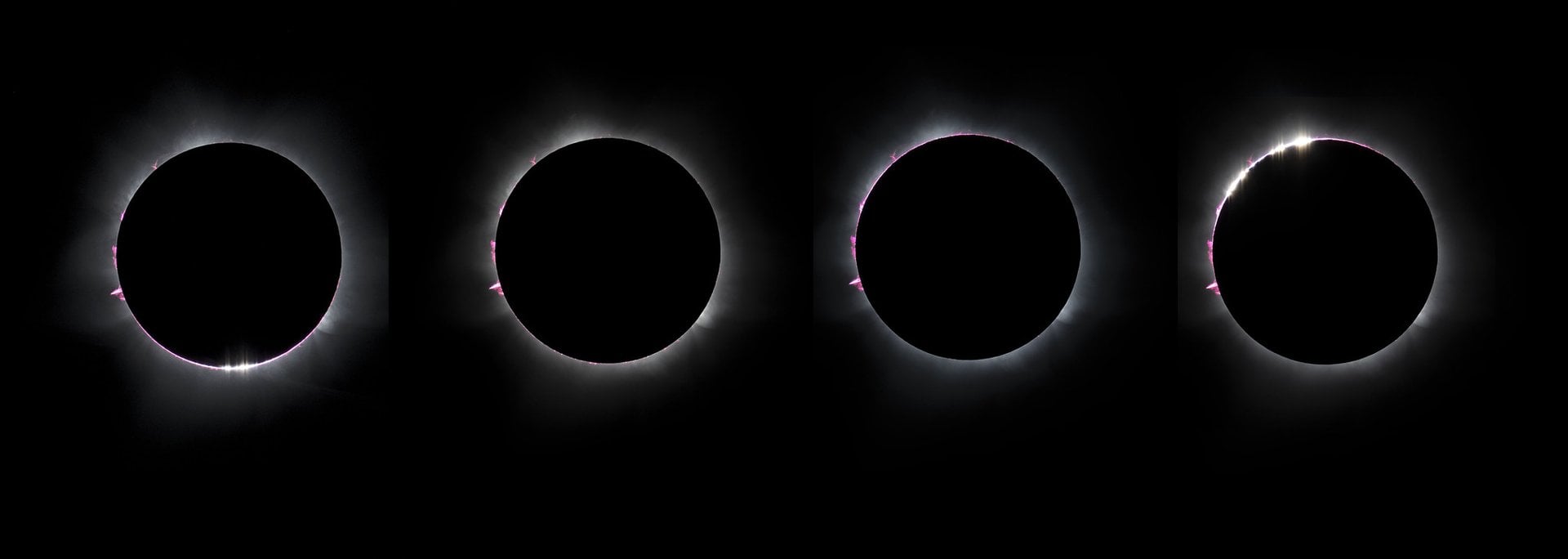 Totality! Captured in 2023 from western Australia. Credit: Eliot Herman.
From the Earthward side of the Moon looking back, you would see the shadow of our satellite crossing the disk of our fair world. Weather satellites, solar observing missions, and even iSpace’s ill-fated Hakuto-R mission have captured this scene from space. It’s often said that Earth’s solar eclipses are a rarity, but they’re actually a happy result of our place in time and space. Even in the current epoch, annular eclipses are more common than totals, as the Moon slowly recedes from the Earth. What’s more, the major moons of Jupiter see ‘em, too, as one moon passes in front of the other.
Can you seeing aurora during a total solar eclipse? Certainly prospects are slim, though a polar eclipse would offer the best circumstances. You’d need a powerful solar storm hitting the Earth, at just the right time. Observers during the 2015 eclipse over Svalbard came up with a null result. This year, NASA’s Liz MacDonald plans to take another shot at this rare observation from Iceland. Note that the August eclipse transpires during the peak of the 2026 Perseid meteors. Now, a shot featuring totality, aurora and a Perseid would be the capture of a lifetime.
The European Space Agency plans on streaming the eclipse live and we’ll feature a roundup of eclipse webcasts prior to eclipse day. We’ll also be looking at solar sunspot prospects, aurora activity, any possible sungrazing comets, the coronal shape, and cloud cover forecasts, leading up to eclipse day.
Good luck, stay cool and clear skies. We admit, a quick Iceland Air flight still sounds enticing right now. We’re officially jealous of anyone making the journey to totality on August 12th, to stand in the shadow of the Moon.