NASA-ийн санхүүжүүлж буй шинэ төсөл нь экзопланетийн гадаргуу дээрх тив, далайг олон гэрлийн жилийн зайнаас дүрслэн харуулах боломжийг судалж байна.
Өнөөг хүртэл илрүүлсэн бүх экзопланет нь одныхоо гэрэлд уусан, шууд харагдах боломжгүй байсаар ирсэн. Эрдэмтэд тэдгээрийг одны хэлбэлзэл эсвэл гэрлийн бууралтаар нь таньдаг боловч гадаргуугийн нарийн бүтцийг нь хэзээ ч харж байгаагүй. Физикч Пол Станкусын удирдаж буй энэхүү шинэ судалгаа нь одны хурц гэрлийг дарж, гаригийн гадаргууг ялган харах зорилготой юм.
Тус судалгааны эхний шатанд “динамик шатлалт нуллинг” интерферометр хэмээх шинэ багажийг ашиглана. Энэ нь олон цэгээс цуглуулсан гэрлийг маш нарийн нэгтгэснээр одны гэрлийг бараг бүрэн халхлахын зэрэгцээ гаригийн бүдэг гэрлийг нэвтрүүлэх зарчим юм. Ингэснээр од болон гаригийн гэрлийн ялгааг 10 тэрбумыг нэг гэсэн харьцаатайгаар бууруулж, гэрэлт цамхгийн хажууд буй гал голомтыг харахтай адил үр дүнд хүрэх юм.
Хоёр дахь шатанд 100 км орчим зайтай хоёр тусдаа сансрын хөлгийг ашиглан Майкельсоны интерферометрийн аргыг хэрэгжүүлнэ. Энэ нь хоёр жижиг дуранг нэгтгэн, асар том виртуал дуран авай болгон ашиглах технологи бөгөөд одны дарсан гэрлийг лавлагаа болгон ашиглаж, хоёр хөлгийн ажиллагааг синхрончлох юм.
Энэхүү төсөл нь NASA-ийн “Innovative Advanced Concepts” хөтөлбөрийн хүрээнд хийгдэж буй эхний шатны судалгаа юм. Одоогоор энэ нь зөвхөн онолын түвшинд байгаа бөгөөд хэрэгжих хугацаа эсвэл тодорхой төлөвлөгөө гараагүй байна. Гэсэн хэдий ч, хэрэв энэ технологи бодит ажил хэрэг болбол экзопланетийг зөвхөн оршин байгааг нь батлахаас гадна гадаргууг нь зураглах шинжлэх ухааны цоо шинэ эринийг эхлүүлэх юм.
Дэлгэрэнгүйг эх сурвалжаас харах
Эх сурвалжийг нээх ↓
Every exoplanet we’ve ever found has been, in some sense, invisible. We infer them from a star’s wobble, or a fractional dimming as a planet passes in front of it, or in the rare best cases, a single point of light too faint and too close to its star to show any detail at all. We know these worlds exist. We have never once seen what they actually look like. A new NASA funded concept study wants to change that, and the ambition is not just detecting an Earth like planet around another star, but resolving its actual surface, mapping its version of continents and oceans, from many light years away.
The star is roughly ten billion times brighter than an Earth sized planet reflecting its light, and the two sit so close together in the sky that separating them at all, let alone photographing surface features on the planet, has always seemed a technology generation or two away. The idea, led by physicist Paul Stankus, tackles this problem in two stages.
An artist’s concept of exoplanet Kepler 1649c, one of the closest Earth size, Earth temperate worlds found so far. The kind of planet a future surface mapping mission would target (Credit : NASA/JPL-Caltech)
The first is a new kind of instrument called a “dynamic hierarchical nulling” interferometer, essentially a way of combining light gathered from multiple apertures so precisely that it can cancel out starlight almost perfectly, while letting the much fainter planetary light through. The design aims for a contrast ratio of ten billion to one or better, in ordinary visible light, which is roughly the gulf in brightness between the star and the planet in the first place. It’s the difference between trying to spot a firefly next to a lighthouse, and actually managing to switch the lighthouse off.
The second stage is where things get properly bold. Once starlight is suppressed, you still need enough angular resolution to make out surface detail on the planet itself, and that requires an effective telescope far larger than anything physically buildable. Stankus’s solution is to fly two of these nulling instruments on separate spacecraft, stationed around 100 kilometres apart, and combine their beams using Michelson interferometry, a technique that lets two smaller instruments act together as one vastly larger virtual telescope. Cleverly, the nulling process doesn’t throw the starlight away entirely, it keeps it as a separate reference beam, which can then be used to keep the whole interferometric setup properly phased and aligned, like a conductor’s baton keeping two orchestras playing in time despite standing 100 kilometres apart.
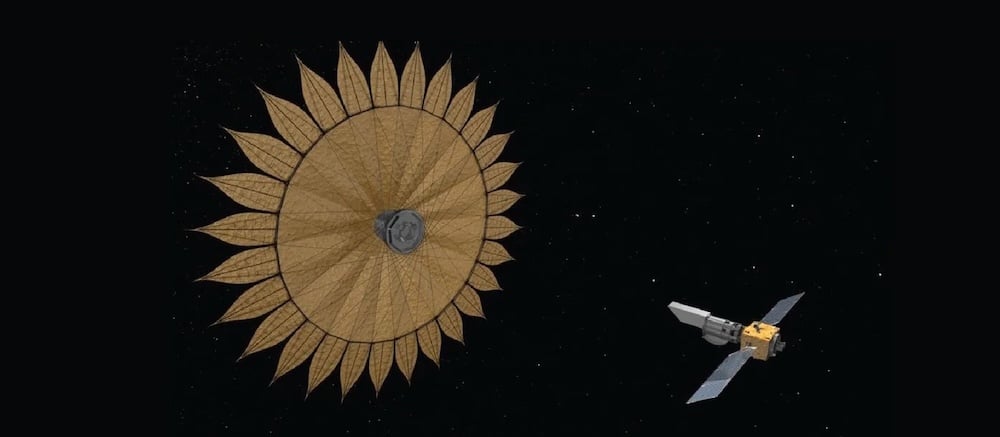
An artist’s depiction of a starshade blocking a star’s glare so a trailing space telescope can image the far fainter planet nearby, the same 10 billion to one contrast problem the new nulling interferometer concept is designed to solve (Credit : NASA/JPL-Caltech)
Currently this is a NASA Innovative Advanced Concepts study, the agency’s programme for funding early, speculative ideas that are years, possibly decades, from any hardware. There’s no mission, no launch date, no guarantee it will ever leave the drawing board. But that’s rather the point of NIAC, to give genuinely ambitious ideas room to be explored before anyone commits real money to building them. If something like this ever did fly, it would mark the moment exoplanet science stopped simply proving worlds exist, and started actually mapping them.
Source : Mapping Alien Continents: Achieving Optical VLBI for Exoplanet Imaging

