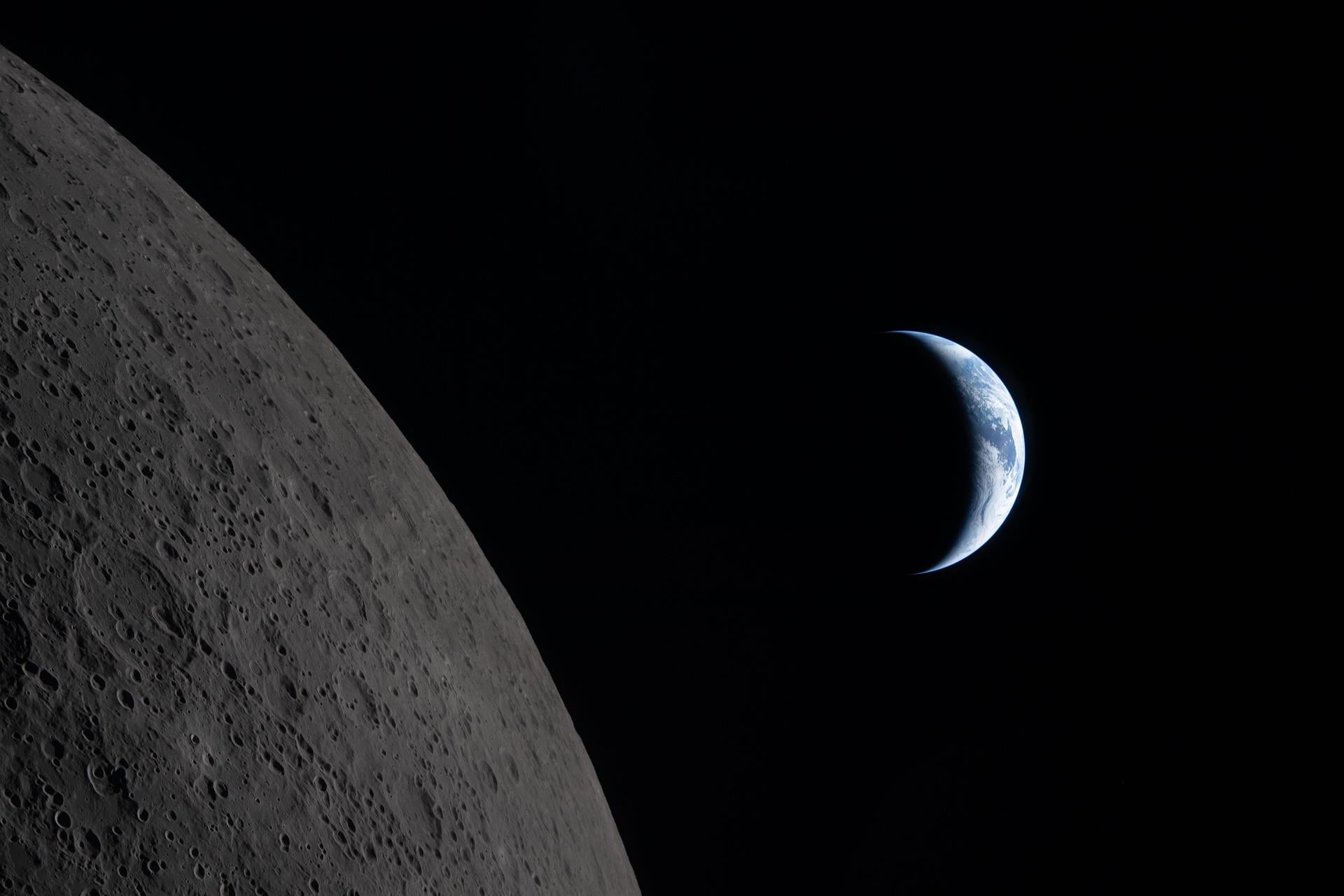
NASA-гийн Artemis II номлолын багийнхан сарны тойрог замд ажиллах хугацаандаа хийсэн ажиглалт, судалгааны үр дүнгээ танилцууллаа.
2026 оны дөрөвдүгээр сарын 1-нд сансрын нисгэгчид Рид Уайзман, Виктор Гловер, Кристина Кох, Жереми Хансен нар Artemis II номлолоор сарыг тойрон 9 хоног, 1 цаг, 32 минутын турш ажиллажээ. Энэхүү нислэг нь Аполло эринээс хойш анх удаа сарны гадаргуу болон орчныг илүү нарийвчлалтай ажиглах боломжийг олгосон юм. Нисгэгчид сарны алсын тал, нарны хиртэлт, болон сансрын уудам дахь оддын бүтэц зэргийг баримтжуулж, шинжлэх ухааны үнэ цэнтэй мэдээллийн санг бүрдүүлжээ.
Нислэгийн үеэр багийнхан сарны гадаргуу дээрх солирын цохилтын улмаас үүсэх гэрлийн гялсхийлтийг ажигласан нь онцгой ач холбогдолтой байв. Эдгээр нь урьд өмнө бүртгэгдсэн хамгийн бүдэг үзэгдэл бөгөөд солирууд нь ердөө 5 см-ээс бага диаметртэй байсан гэж судлаачид таамаглаж байна. Энэхүү мэдээлэл нь ирээдүйд сарны гадаргуу дээр байгуулах суурин болон техник хэрэгслийг сансрын биетүүдийн цохилтоос хамгаалах арга хэмжээг төлөвлөхөд чухал хувь нэмэр оруулна.
Түүнчлэн, нисгэгчид сарны гадаргуугийн геологийн бүтцийг өнгө, бүтэц, гэрэл сүүдрийн ялгаагаар нь судалж, өөр өөр эрдэс бодис агуулсан бүсүүдийг тодорхойлсон байна. Сарны өдөр, шөнийн зааг буюу “терминатор” бүсийн налуу гэрэлтүүлэг нь гадаргуугийн рельефийг тод харуулж байсан нь ирээдүйн Artemis III болон IV номлолуудад саран дээр буух цэгүүдийг сонгоход дэмжлэг үзүүлэх юм. Энэхүү урьдчилсан тайлан нь сар руу хүн төрөлхтөн эргэн очих бэлтгэл ажлын гол тулгуур болж байна.
Дэлгэрэнгүйг эх сурвалжаас харах
Эх сурвалжийг нээх ↓
On April 1st, 2026, the crew of the Artemis II mission launched to space atop NASA’s Space Launch System (SLS). Roughly three and a half hours after launch, the rocket’s first stage separated from the Orion spacecraft (Integrity), and astronauts Reid Wiseman, Victor Glover, Christina Koch, and Jeremy Hansen began their nearly ten-day journey around the Moon. As the second mission in the Artemis Program, the astronauts’ flight was another crucial step toward returning astronauts to the Moon for the first time since the Apollo Era.
In addition, the Artemis II flight provided an opportunity for observation, science, and data gathering that has not existed since the Apollo Era. During the flight, the astronauts studied the “dark side’s” geology, witnessed nighttime impacts on the surface, and watched the Earth and Sun rise from the far side of the Moon. And now, with the mission data processed, NASA has released “Artemis II: Sights & Sounds of Science, a field guide to the Artemis II Preliminary Lunar Science Report.
The report reveals much about what the crew of four witnessed and documented during their 9 days, 1 hour, and 32 minutes in space. As the report summarizes:
Through photographs, spoken observations, drawings, and annotations, the Artemis II crew created a unique scientific record—one that is now available to the science community and the public for further study. Explore highlights here, and find the full suite of reports and select data resources at the bottom of the page.
This nighttime picture of Earth was taken on April 2, 2026, by an Artemis II crew member. Credit: NASA
“Hello World”
Who can forget the lovely picture the Artemis II astronauts took of planet Earth on Day 2 of the mission? But for mission scientists, it was more than a pretty picture; it captured active weather systems, auroras at both poles, distinct atmospheric layers, a Saharan dust plume, zodiacal light, and city lights on the surface. While Earth-observation satellites are crucial to science, they observe the Earth in strips rather than getting a holistic view.
What was especially intriguing about the picture is that the Moon’s light, not sunlight, was illuminating Earth’s face. Said mission specialist Christina Koch:
I feel like right now the Moon is a light sponge and the Earth is a light mirror. The Earth has not quite looked like the pictures. You really can’t make out the deep royal blue. It’s just a bright, bright, light blue. And then the continents are like a dark, dark bluish green. But overall, the whole thing is just like, electric blue.”
Total Eclipse
As they passed behind the Moon, the crew witnessed a total solar eclipse as the Moon occulted the Sun. From their advantageous position, the Moon completely blocked the Sun for 54 minutes, far longer than a solar eclipse lasts on Earth. This gave the crew an unprecedented view of the Sun’s corona, usually visible only during brief eclipses on Earth and only with scientific instruments. This outer layer of the Sun’s atmosphere drives space weather, and the crew observed its evolving shape and structure for nearly an hour.
This eclipse also allowed the crew to see zodiacal light around the Moon, the soft light reflected by interplanetary dust, and study features that would ordinarily be obscured by light. In addition to seeing meteorites hitting the surface that would otherwise be too faint to observe (see below), the crew had a pristine view of the stars. They also had a clear view of Mars, Saturn, galaxies, and the Milky Way unobstructed by light pollution. As Canadian astronaut Jeremy Hansen related:
And then the stars, when you’re in space. You know, I only learned this in the last few days, but there’s a depth to them that you don’t see from Earth. And so they look closer [or] further based on their brightness. Their brightness probably has nothing to do with their distance, but with the brightness of the stars. And they really look to you, like you can see where they are in the galaxy.
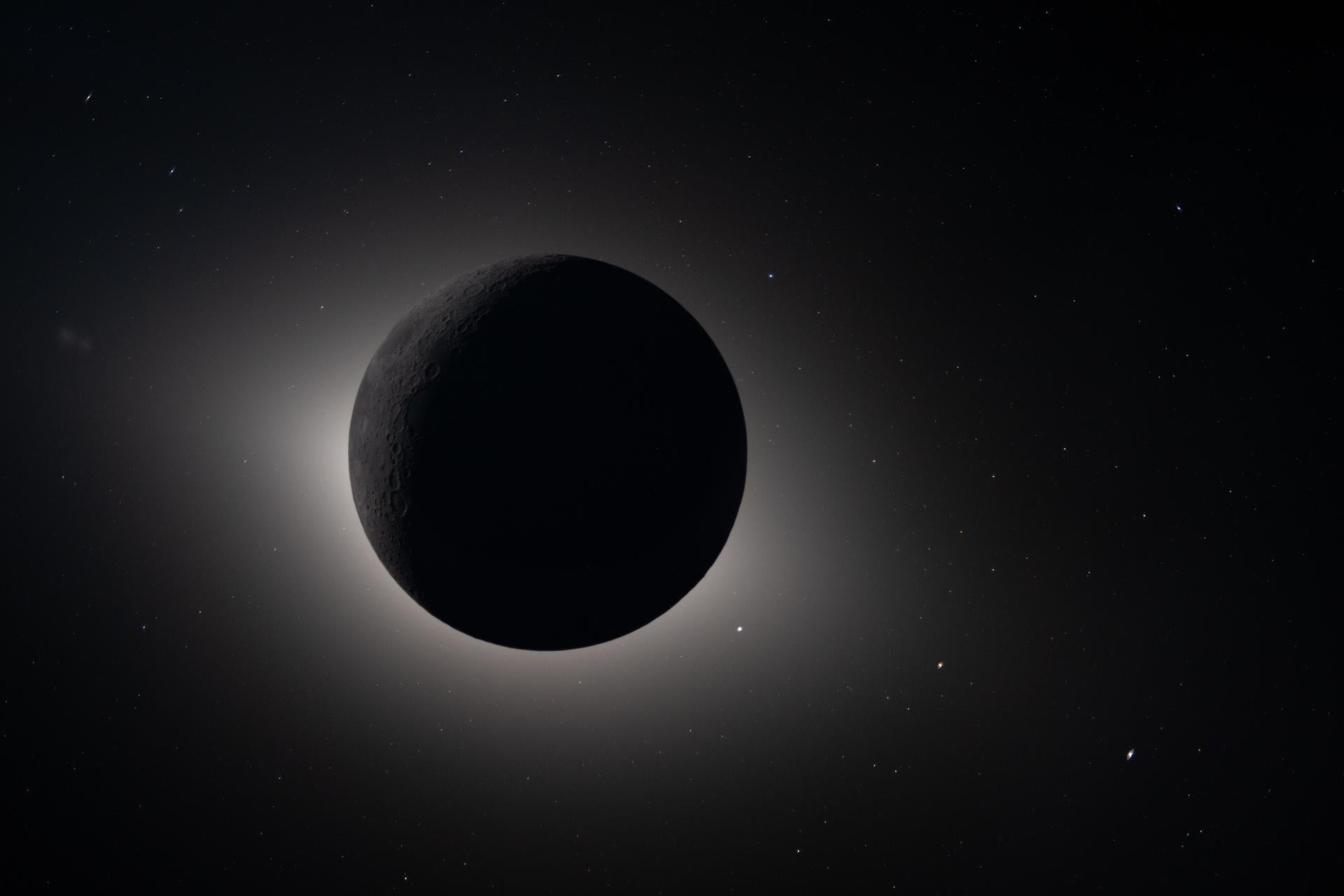 Captured by the Artemis II crew during their lunar flyby on April 6, 2026, this image shows the Moon fully eclipsing the Sun. Credit: NASA
Flashes
Because the Moon is an airless body, meteors don’t burn up in its atmosphere and regularly strike the surface. These impacts release tremendous amounts of energy, leaving melted patches where they strike and throwing up plumes of regolith. On Earth, astronomers are sometimes able to witness these impacts by the tiny flashes of light they produce. During the Apollo missions, astronauts saw these flashes from orbit, and Artemis II gave the crew the chance to be the first to see them since.
Per the mission plan, lunar scientists asked the Artemis II crew to use the nearly hour-long total solar eclipse as they passed the Moon’s far side. The observed flashes coincided with a planned communications loss as Integrity passed into the Moon’s shadow. The crew then sent the video they acquired to the Lunar Science Team at NASA’s Johnson Space Center Mission Control Center in Houston (shown in the video above).
Whereas similar flashes had been observed by the Apollo astronauts, the ones witnessed by the Artemis II crew were likely the faintest ever seen with the unaided eye. Based on their brightness, scientists estimate that the meteors were no more than 5 cm (2 inches) in diameter. But given the speed at which they hit the surface, the energy produced was enough to be visible from space. Direct observations provided a rare dataset that will help scientists constrain how often these impacts occur.
That data is essential to the Artemis program and its long-term objective of creating lunar habitats that will enable long-term operations on the lunar surface. In addition to radiation shielding and protection against the vacuum of space, measures will need to be taken to protect crews, vehicles, landers, and ascent vehicles from meteors and the resulting dust plumes.
Lunar Geology
Samples returned from the Moon’s far side by China’s Chang’e-6 mission have revealed that the Moon’s two hemispheres have distinct geological histories. The circumlunar flight allowed the Artemis II crew to visually examine the far side, paying close attention to how different colors indicated different types of rocks and minerals. The crew used handheld cameras to make observations that scientists can compare with data from NASA’s Lunar Reconnaissance Orbiter (LRO) to better understand how color, tone, brightness, contrast, and texture shift on the Moon based on perspective.
The crew reported seeing subtle hues of gray, black, brown, tan, white, green, and blue across the Moon’s surface, reflecting the composition of different lunar regions. Blue corresponds to titanium-rich volcanic rocks, brown to iron-rich rocks, and green to volcanic glass or impact-melted regolith. Scientists can use this information to understand the Moon’s geological evolution better. For future astronaut missions, it could also help them to identify potential resource sites for mining.
Lunar Terminator
The Artemis II science team also asked the astronauts to study features along the boundary between day and night, known as the “terminator.” This is partly because the terminator region is in constant twilight, and low-angle light casts long shadows that highlight the surface features. This is similar to conditions around the Moon’s South Pole-Aitken Basin, where NASA, China, and other space agencies plan to build their proposed lunar habitats.
With no natural or artificial obstructions to obscure the view, the Artemis II crew could see surface features in crisp detail. This included craters and peaks measuring miles in depth and height, which came into sharp relief along the Moon’s glowing edge (“limb”). This was especially true during the total solar eclipse when the Moon was backlit by the Sun. As Artemis II pilot Victor Glover reported during the flyby:
I wish I had more time to describe what I’m seeing, but the terminator right now is just fantastic. It’s the most rugged that I’ve seen it. From a lighting perspective, there are little islands – there are islands of terrain out there that are completely surrounded by darkness, which indicates some real variation in the terrain. It’s very, very interesting to see.
These results are already helping NASA prepare for the next steps in the long-awaited return to the Moon. Artemis III, scheduled for sometime in 2027, will launch a crewed Orion spacecraft to orbit, where it will rendezvous with a Human Landing System (HLS) and practice crew transfers. This will set the stage for Artemis IV, scheduled for 2028, where a crew of four will fly to the Moon and use the HLS to reach the surface, putting boots on the ground for the first time in over 50 years.
The full Preliminary Lunar Science Report can be viewed and downloaded here.
Further Reading: NASA

