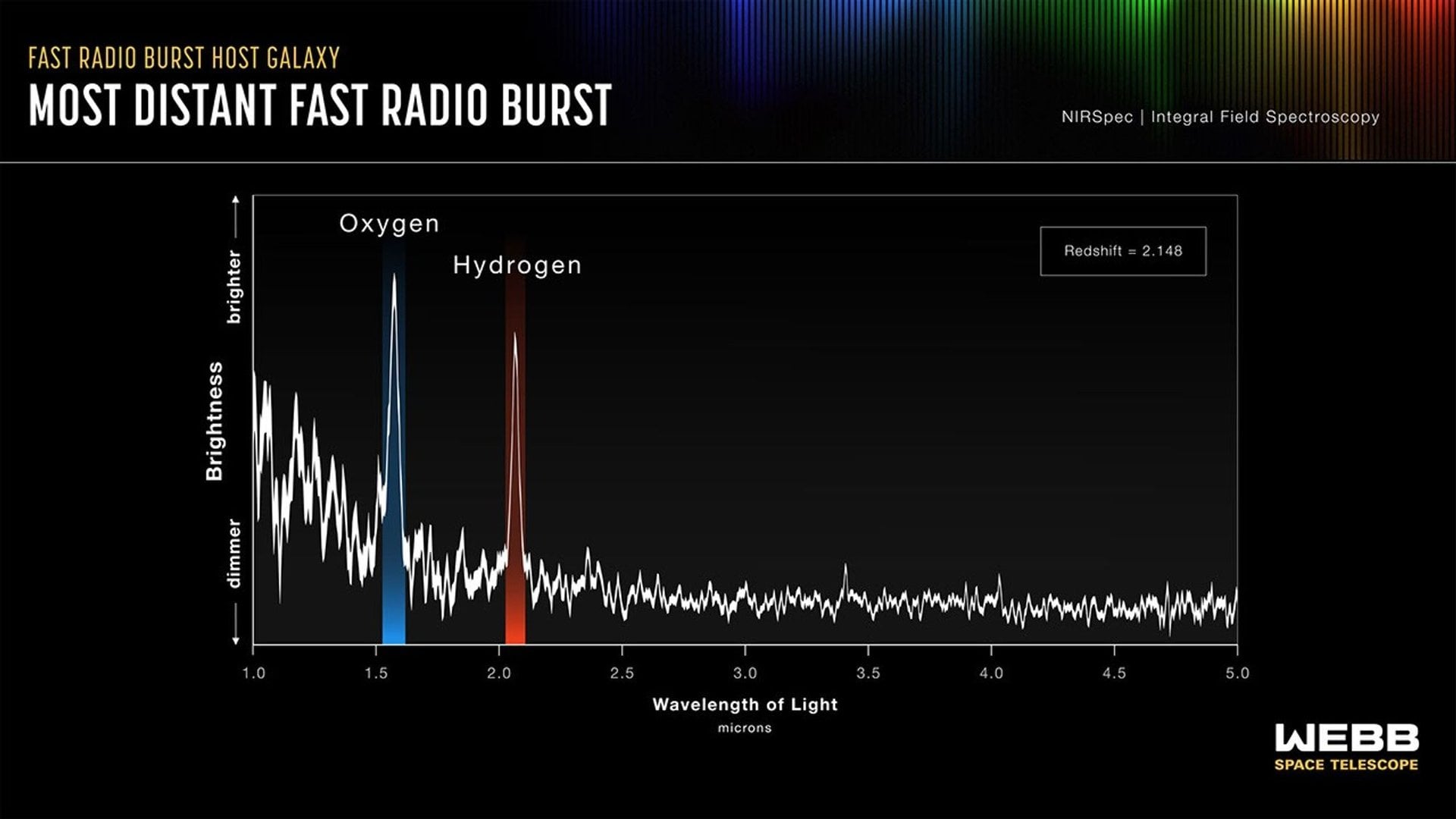
Огторгуйн түүхэн дэх хамгийн алс зайд бүртгэгдсэн хурдан радио тэсрэлтийн эх үүсвэр нь залуу оддоор дүүрэн жижиг галактик болохыг эрдэмтэд илрүүлжээ.
Хурдан радио тэсрэлт (FRB) нь ердөө миллисекунд үргэлжилдэг, өндөр эрчимтэй радио дохио бөгөөд тэдгээрийн үүсэл нь одон орон судлалын томоохон оньсого байсаар ирсэн. Судлаачид эдгээр үзэгдлийг нейтрон оддын нэгдэл эсвэл магнетарын гадаргуу дээрх хүчтэй дэлбэрэлттэй холбоотой гэж таамагладаг ч тодорхой нотолгоо дутмаг байв.
2024 онд MeerKAT радио телескопын сүлжээгээр илрүүлсэн FRB 20240304B тэсрэлтийг судлаачид James Webb Space Telescope-ийн тусламжтайгаар дахин ажиглажээ. Энэхүү телескоп нь алс холын бүдэг галактикуудыг судлахад онцгой ач холбогдолтой бөгөөд уг тэсрэлт нь орчлон ертөнцийг дөнгөж 3 тэрбум настай байх үед тохиолдсон болохыг спектрийн шинжилгээгээр тогтоов.
Галактикийн спектрийн судалгаагаар тухайн бүс нутагт ихэнх од нь 30 сая жилийн өмнө үүссэн, харьцангуй залуу оддын бүлгэмдэл болох нь харагдаж байна. Нейтрон оддын нэгдэл нь олон тэрбум жил үргэлжилдэг процесс тул ийм залуу галактикт тохиолдох магадлал бага юм. Иймд энэхүү олдвор нь тухайн радио тэсрэлт нь магнетараас үүдэлтэй гэх таамаглалыг илүү баттай болгож байна.
Хэрэв радио тэсрэлтүүд үнэхээр магнетараас үүсдэг бол ирээдүйд илүү хүчирхэг ажиглалтын төхөөрөмжүүдийн тусламжтайгаар орчлон ертөнцийн анхны тэрбум жилийн хугацаанд тохиолдсон үйл явдлуудыг ч илрүүлэх боломжтой юм. Энэхүү судалгаа нь огторгуйн хамгийн алс холын радио тэсрэлтүүдийн гарал үүслийг тайлах чухал алхам болж байна.
Дэлгэрэнгүйг эх сурвалжаас харах
Эх сурвалжийг нээх ↓
Fast Radio Bursts (FRBs) are notoriously difficult to study. They are bright radio chirps that only last just milliseconds. When FRBs were first observed, it was difficult to distinguish them from terrestrial noise sources. As we learned out to distinguish real FRBs from noise, it became clear that most of them originate from other galaxies. This means they must be caused by a powerful and fast-acting astrophysical process.
Given their intensity and duration, the likely causes of FRBs are either the merging of neutron stars as they become a black hole or some kind of flare-like event on the surface of a magnetar. More exotic answers such as the collapse of hypothetical dark-matter stars have been proposed as well. But with only the radio bursts to go by, a specific origin is hard to prove.
Back in 2024 the MeerKAT radio array observed a burst designated FRB 20240304B. The MeerKAT data was able to pin down the FRB’s location very precisely, but optical observations of the area didn’t reveal an object in that location. So recently a team tried again using the James Webb Space Telescope. The Webb is particularly good at observing faint and distant galaxies, and sure enough the team found a small galaxy.
By taking spectrum observations of the galaxy, the authors determined we see it at a time when the Universe was only about 3 billion years old. This would make FRB 20240304B the most distant burst observed. The galactic spectrum also suggests that most of its stars formed with about 30 million years. In other words, we see the galaxy at a time when it is filled with relatively young stars.
This provides us an important clue as to the origin of this particular FRB. The merger of neutron stars takes time. A binary neutron star can spiral inward for more than a billion years before finally merging. In this case we would expect to see FRBs in large mature galaxies with older stars. The fact that this is a small and young galaxy points to the magnetar origin.
If FRBs are indeed caused by magnetars, then we will expect to find even more distant events as we gather more data. Observatories such as MeerKAT might even be able to detect events from the first billion years of the cosmos.
Reference: Caleb, Manisha, et al. “A fast radio burst from the first 3 billion years of the Universe.” arXiv preprint arXiv:2508.01648 (2025).

