
Цэргийн зориулалтаар анх үүссэн түлш идэвхгүйжүүлэх технологи нь орчин үеийн агаарын тээврийн аюулгүй байдлын салшгүй хэсэг болжээ.
Орчин үеийн агаарын хөлгүүд түлшний савны дээд хэсэгт үүсэх шатамхай уурыг саармагжуулах зорилгоор азотын хийг өргөн ашиглаж байна. Нислэгийн явцад түлш болон агаар холигдож, шаталтын камерт очих нь хөдөлгүүрийн ажиллагаанд зайлшгүй шаардлагатай ч сав доторх уур гал авалцах эрсдэлийг дагуулдаг. Азотын хийг нэмснээр түлшний шатамхай чанар өөрчлөгдөхгүй боловч савны дотоод орчны хүчилтөрөгчийн хэмжээг бууруулж, гал гарах эрсдэлийг эрс багасгадаг байна.
Энэхүү технологийг анх 1960-аад онд цэргийн нисэх хүчинд XB-70 Valkyrie дуунаас хурдан бөмбөгдөгч онгоц болон C-5 тээврийн онгоцнуудад ашиглаж эхэлжээ. Тухайн үед шингэн азотыг ашиглан түлшний савыг идэвхгүйжүүлэх системүүдийг нэвтрүүлж байв. Өнөөгийн агаарын хөлгүүдэд азотыг нөөцийн савнаас авах эсвэл молекул шүүлтүүрийн тусламжтайгаар агаараас шууд ялган авч түлшний сав руу шахах дэвшилтэт аргуудыг хэрэглэж байна.
Иргэний агаарын тээврийн салбарт уг технологийг нэвтрүүлэх шийдвэр 1996 онд TWA Flight 800 нислэг сүйрсний дараа гарчээ. Нисэх хүчний аюулгүй байдлын үндэсний зөвлөлөөс (NTSB) хийсэн мөрдлөгийн дүнгээр түлшний сав дахь уур гал авалцсаны улмаас дэлбэрэлт үүссэн болохыг тогтоосон байна. Үүний үр дүнд Холбооны нисэхийн захиргаа (FAA) 2008 онд агаарын хөлгийн түлшний савны аюулгүй байдлын шинэ стандартыг баталж, азот ашиглан идэвхгүйжүүлэх системийг заавал суулгахыг шаардах болжээ.
Дэлгэрэнгүйг эх сурвалжаас харах
Эх сурвалжийг нээх ↓
Modern airplanes have nitrogen in their tires, but you may not know that this gas is used in many fuel tanks as well. The reason for that has to do with overall safety. Airplanes need a conventional fuel source to generate the power required for flight. This is made possible when fuel is combined with air and burned in the engine’s combustion chamber.
Jet fuel can produce flammable vapors inside a tank, which is necessary forthe plane’s propulsion system to generate thrust. However, it alsocreates a potential fire hazard if those vapors come into contact with an ignition source.The flammability of this space can be affected by factors such as fuel temperature and pressure, which is why controlling the tank’s atmosphere is so important.
Adding nitrogen doesn’t make the fuel itself less flammable, but it does change the atmosphere surrounding the fuel, making a fire less likely to start or continue. In other words, nitrogen makes it harder for fuel vapors to ignite and sustain combustion. This gas is widely used in fuel-inerting systems, whichare recommended by the Federal Aviation Administration (FAA) and designed to reduce the amount of oxygen in the space above the fuel.
The evolution of aircraft fuel-inerting systems
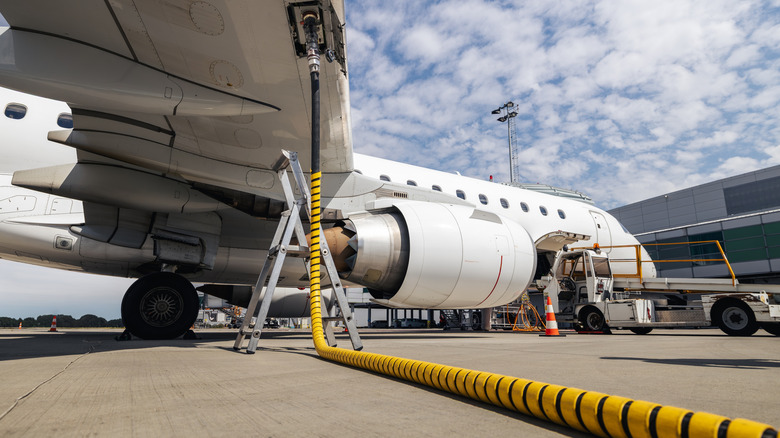
Jaromir Chalabala/Shutterstock
The nitrogen used in modern airplanes can come from a stored supply or be produced onboard the aircraft itself. The system regulating those with a stored supply is fairly self-explanatory, but those that produce nitrogen onboard are slightly more complex. In systems that produce it during flight, molecular sieves separate the nitrogen from the surrounding air. The resulting gas is then sent to the fuel tanks. Once the nitrogen is in the tank, it begins reducing the amount of oxygen in the space above the fuel, thus giving the tank the protection it needs.
The practice of adding nitrogen to a fuel tank actually began in military aviation and not in passenger aircraft. An early example of this came in the 1960s with the supersonic XB-70 Valkyrie, which was equipped with a fuel-tank inerting system that used liquid nitrogen. The same basic technology was also used on the C-5 aircraft in the early 1970s.
This technology remained a military application until the 1996 loss of TWA Flight 800, in which 230 lives were lost.In its investigation after the crash, the National Transportation Safety Board (NTSB) concluded that the center wing tank had exploded after the fuel vapor and air inside it caught fire. This led the NTSB to recommend aircraft include nitrogen-inerting systems to prevent similar incidents from happening in the future. Ultimately, this led tonew FAA fuel-tank safety rules in 2008.

