Испанийн Сеута хот руу хэд хоногийн өмнө олон мянган хүн нэвтэрсэн явдал нь нутаг дэвсгэрийн бүрэн бүтэн байдлыг зөрчсөн үйлдэл хэмээн Мадрид үзэж байна.
Өнгөрсөн долоо хоногт Мароккоос Испанийн хойд Африкт орших Сеута анклав руу 50,000 орчим хүн гатлан очсон нь дипломатийн болон хүмүүнлэгийн хурцадмал байдал үүсгэлээ. Испанийн Ерөнхий сайд Педро Санчес уг үйл явдлыг тус улсын нутаг дэвсгэрийн бүрэн бүтэн байдлыг зөрчсөн хэрэг гэж мэдэгдсэн бол Мадридын зүгээс үүнийг хүний наймааны бүлэглэлүүдтэй холбон тайлбарлаж байна. Гэвч энэхүү олноор нэвтэрсэн явдал нь Мароккогийн эрх баригчид Баруун Сахарын асуудлаарх Испанийн байр суурьт дургүйцсэнээ илэрхийлж хилийн хяналтаа сулруулсантай холбоотой байж болзошгүй гэсэн таамаглалууд гарчээ.
Энэхүү хил давах үйл явцын үеэр Испанийн нутаг дэвсгэрт хүрэхээр завдсан хүмүүсээс ус руу живж эсвэл дарагдаж амиа алдсан тохиолдол гарсан бөгөөд хүмүүнлэгийн байгууллагууд болон орон нутгийн иргэд ирж буй хүмүүст тусламж үзүүлж байна. Албаныхны мэдээлснээр олон арван мянган хүн хоёр хоногийн дотор Марокко руу буцаж гарсан хэдий ч зарим хүмүүс гудамж талбайд хоног төөрүүлж, хууль ёсны бичиг баримт болон цаашдын хувь заяаныхаа талаар тодорхойгүй байдалд байна. Хэт барууны үзэлтэй бүлэглэлүүд болон улстөрчид энэхүү нөхцөл байдлыг өөрсдийн ашиг сонирхолд ашиглах вий гэсэн болгоомжлол оршин суугчдын дунд үүсээд байгаа ажээ.
Дэлгэрэнгүйг эх сурвалжаас харах
↓Эх сурвалжийг нээх ↓
Four days ago, Youssef El Abbas saw an opportunity to reclaim the life he had lost years seven earlier.
News was circulating that about 400 people had swum from Morocco to the neighbouring Spanish enclave of Ceuta on the north African coast, approximately 12 miles (19km) across the strait of Gibraltar from mainland Spain.
Here was a chance for the 44-year-old Moroccan father of four to return to Spain, from which he had been deported when his residency expired after the loss of his job in Bilbao in 2019.
El Abbas took a taxi and headed to the city of Tétouan, south of the enclave. While en route, he saw Facebook posts and news reports claiming that the Moroccan authorities were allowing people to pass through their side of the border. That meant that, unlike those who had crossed the previous night, he could simply travel overland before swimming across the border from Moroccan to Spanish territory for just five minutes to avoid the Spanish border controls.
He reached Tétouan to find the city completely overwhelmed.
“Young men were running through the streets, flooding every corner,” he said. By the time a second taxi took El Abbas to Fnideq, the town bordering Ceuta, he realised that the usual blockades and checkpoints preventing people without European documents from even approaching the frontier had been removed.
“The Moroccan police were shouting at us: ‘Go, go, go! Run now, run into Spain,’” he said. “The night before, they were beating people. But that morning they were letting us through. Nothing made sense.”
Despite the crowds, El Abbas noticed the police were only letting Moroccans cross over: “All the sub-Saharan migrants were being pushed back by force.”
He reached the border at 2.45pm on Wednesday. By 3pm, after a short swim, he was standing on Spanish soil. Not everyone was so lucky.
“In just 10 minutes in the water, I saw four people floating dead in Moroccan waters,” he said. “People were pulling their bodies out.” They were among at least 72 people who drowned or were crushed trying to reach the Spanish territory.
El Abbas is just one of the 50,000 or so people to have crossed into Ceuta this week in what Spain’s prime minister, Pedro Sánchez, described as “a violation of Spain’s territorial integrity”.
Madrid has attributed the latest influx to “human-trafficking mafias” that have taken advantage of a decision by Spain’s supreme court, which recently ruled that those intercepted at sea while trying to enter Ceuta or Melilla – the other Spanish enclave on the north African coast – could not be summarily returned under special rules.
But there has also been speculation that the Moroccan authorities may have opened the border to signal their displeasure at Sánchez’s recent visit to Algeria, which supports efforts to free the disputed territory of Western Sahara from Moroccan occupation.
Morocco’s ambassador to Spain, Karima Benyaich Millán, said Rabat was not happy about the mass crossing, adding that it hoped those in Ceuta would return.
Moroccan government sources told the Europa Press news agency that the surge of people entering Ceuta was down to “criminal organisations” and insisted that Rabat’s cooperation with Spain remained “exemplary”.
In May 2021, Rabat loosened border controls – allowing 10,000 people to cross into Ceuta over the course of two days – during a diplomatic standoff triggered after Madrid allowed a Western Sahara independence leader to be treated for Covid-19 in Spain.
El Abbas said he had never stopped dreaming of returning to Spain, where he had worked, mainly in the hospitality sector, for 14 years. Since being deported to Morocco in 2019, he has lived apart from his wife and four daughters – who remain in the northern Spanish city of Bilbao – scraping by with occasional work repairing mobile phones alongside his father.
“I never stopped thinking about coming back,” he said. “In Morocco, I was alive, but I wasn’t really living.”
after newsletter promotion
The return has been bittersweet. When he swam ashore in Ceuta, a Spanish Guardia Civil officer extended a hand to pull him from the sea. But that gesture of aid eventually gave way to one of violence. Three days after arriving, the group of people he was with were surrounded by a military patrol and beaten.
“The same hand that helped me out of the water was the one that later hit me,” he said.
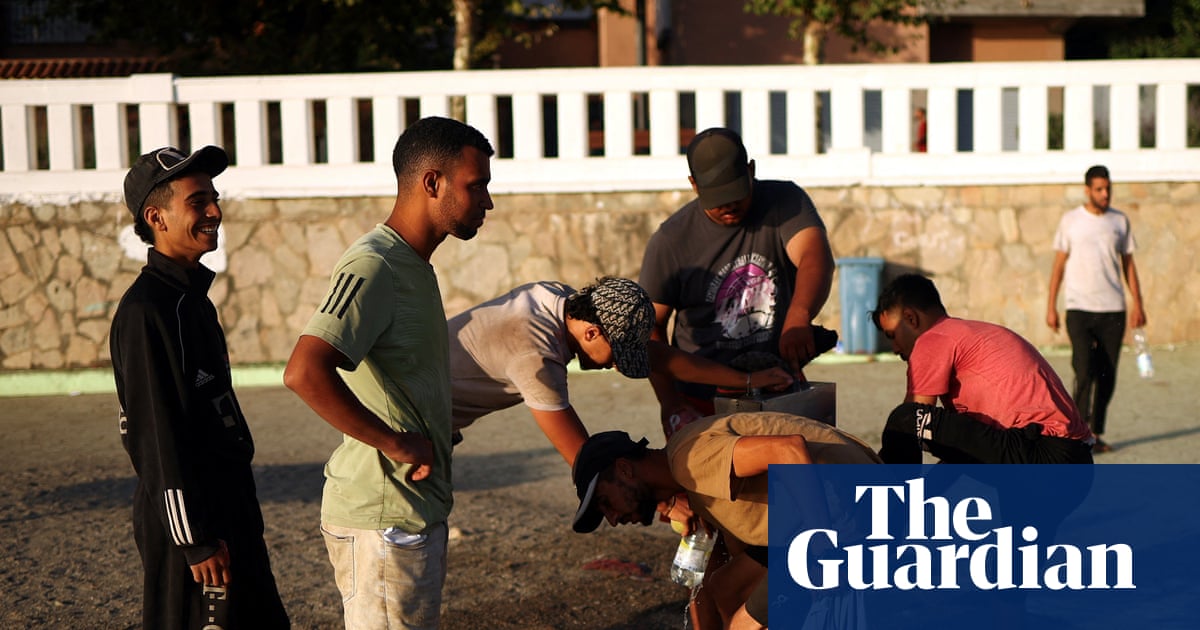
El Abbas’s story is hardly unique. Although more than 48,000 people had crossed back into Morocco by Friday night, hundreds are still sleeping in parks, public squares and on pavements, waiting for a chance to move on or simply find somewhere to rest. It appears to be virtually impossible for migrants to leave Ceuta for mainland Spain.
Said, a 17-year-old from Casablanca, was sitting on a kerb a few hundred metres away. He, too, had joined the Ceuta-bound crowds when he heard that the border was open. But the jubilation had given way to reality and all he had was a bottle of water and the carton of yoghurt a local resident had given him.
The teenager said he was taken to a centre for unaccompanied minors after he crossed, but that there were no places available, so he ended up back on the streets. According to a soldier, who asked to remain anonymous, the current protocol for the authorities – including the military, the police and the Guardia Civil – is to treat unaccompanied minors as regular migrants and return them to Morocco.
Said and the other teenagers with him said no one would sell them food or allow them into shops and restaurants because they did not speak Spanish.
Three days after the mass influx, Ceuta is slowly trying to recover a sense of normality. By early evening on Saturday, cafe terraces were beginning to fill again and some businesses had reopened their doors. Many of the remaining arrivals are being tended to by Ceuta locals, who walk the streets handing out bottles of water, sandwiches, blankets and clothes. Others stop to ask if they need help or to offer to call a relative.
Such shows of solidarity have been threatened by the arrival of far-right politicians and a neo-Nazi group, all keen to use the humanitarian crisis for their own ends.
“They’re going to exploit our feelings to claim the credit and say they defended Ceuta,” said a local woman called Malika. “We don’t want them here. If they want to defend something, they should go somewhere else.”
Malika, who was born in Ceuta to a soldier who served in the Spanish army, rejects the notion that the city should be defined solely by the political confrontation that followed this week’s mass arrival. But she also acknowledges the pressure on a city of just over 80,000 people.
“It would have been an impossible situation for any city,” she said.
Fatima Hamed Hossain, a member of Ceuta’s assembly, fears that the strain created by the crisis has deepened existing divisions within the city.
“Everything we’ve lived through has created tensions between neighbours,” she said. “That’s exactly what feeds the far right.”
As a caravan of people returned back over the border, Said’s mind was on the future. His goal is simple: get a place in a protection centre, spend the next year learning Spanish and, once he turns 18, find work as a barber. What he fears most is ending up without legal documentation and seeing that plan collapse before it has even begun.
Leaving, however, is not on his agenda. “All I need,” he said, “is a chance.”


