
Шинэ судалгаагаар мисофони буюу өдөр тутмын дуу чимээнд хэт мэдрэг байх эмгэг нь тархины тодорхой бүс нутаг болон мэдээлэл боловсруулах сүлжээтэй нягт холбоотой болохыг тогтоожээ.
Канадын Монреалийн мэдрэлийн хүрээлэн болон АНУ-ын Оклахомагийн их сургуулийн судлаачид Human Brain Mapping сэтгүүлд шинэ судалгаа хэвлүүлжээ. Энэхүү судалгаагаар тархины зүүн болон баруун талын бусад хэсгүүдийн холбоос болон анхаарал сарниулах сүлжээ мисофони эмгэгтэй шууд холбоотой болохыг илрүүлсэн байна. Эрдэмтэд 162 насанд хүрэгчдийн тархины соронзон резонансын дүрслэлийн өгөгдлийг судалснаас гадна, тусдаа 777 хүнийг хамруулсан өгөгдлийг ашиглан уг эмгэгийн хүндрэлийн түвшинг тооцоолжээ. Судалгааны үр дүнгээр мисофони нь тодорхой нэг хязгаарлагдмал бүлэг бус, харин хүн амын дунд тархсан үргэлжилсэн спектр хэлбэртэй болох нь батлагдсан байна.
Энэхүү тархины үйл ажиллагааны ялгаа нь түгшүүр, сэтгэл гутрал, аутизмын шинж тэмдгүүдтэй давхцахгүй болохыг судлаачид онцолжээ. Гэсэн хэдий ч судалгаанд оролцогчдоос тусгайлан мисофони өвчний талаар шууд асуугаагүй бөгөөд тэдний хариу урвалыг статистикийн тооцоололд үндэслэн гаргасан нь зарим хязгаарлалтыг бий болгож байна. Цаашид эрдэмтэд уг эмгэгийг илүү нарийвчлан судлахын тулд мисофонитой болон эрүүл хүмүүсийн тархины үйл ажиллагааг шууд харьцуулан шалгах шаардлагатай гэж үзжээ.
Дэлгэрэнгүйг эх сурвалжаас харах
↓Эх сурвалжийг нээх ↓
As many as one in five of us have misophonia, a severe reaction to everyday sounds such as chewing or sniffing.
Despite it being relatively common, misophonia’s origins in the brain are still something of a mystery.
Past studies haven’t been conclusive, but have pointed to the anterior insular cortex region of the brain, which plays roles in handling disgust and pain and in directing attention.
This brain region is part of what’s known as the salience network, which processes numerous internal and external cues.
In a study published in Human Brain Mapping, researchers from the Montreal Neurological Institute in Canada and the University of Oklahoma in the US have now provided more evidence that the anterior insular cortex and the salience network are closely tied to misophonia.
What’s more, they suggest there’s not a clear delineation between people with misophonia and people without.
“Our results provide neural evidence that misophonia exists on a spectrum, with observable differences in a large sample from the general population in which misophonia experiences vary,” write the researchers in their published paper.
The team looked at functional magnetic resonance imaging (fMRI) scans of resting brains for 162 adults, available in an existing database.
However, as this database didn’t include specific information on misophonia, a separate analysis of 777 individuals who were asked about the disorder was used to estimate misophonia severity.
Severity was based on general sensory responses (for example, how someone might react to a strong smell in a store).
The researchers found that misophonia symptom severity was associated with how closely anterior insula activity was synced with areas of the salience network responsible for auditory processing, and motor and movement planning.
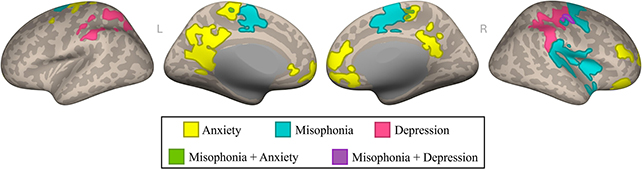
What’s more, this clustering didn’t meaningfully overlap with brain activity linked to anxiety, depression, or traits of autism.
These conditions often accompany misophonia, and can make it difficult to tease out biological processes related specifically to misophonia.
“These results underline the importance of the salience-network anterior insula in understanding misophonic aversion and provide tentative evidence of neurological differences between misophonia and anxiety, depression, and autism,” write the researchers.
When the team attempted to group the study participants into two distinct groups – those with misophonia and healthy controls – the statistical brain patterns they’d identified disappeared.
In other words, misophonia seems to be more of a sliding scale.
That’s an essential piece of information that can inform future studies as researchers look to get more of a handle on the condition and how it’s triggered.
“This work aids in our understanding of neural mechanisms of misophonia and emphasizes the benefit of treating misophonia as a continuous spectrum disorder to better reflect the variability of symptoms in the real world,” write the researchers.

As insightful as these findings are, it’s important to remember that none of the brain scan participants were asked about misophonia – their tendency or otherwise to have the condition was inferred based on statistical estimates. No triggering tests based on uncomfortable sounds were carried out.
However, that does come with some benefits.
When studies specifically select for conditions like misophonia, there is the risk of bias towards more extreme cases, whereas these results are likely more indicative of the disorder in the general population.
The clever use of the separate dataset of 777 people is helpful for future research too, showing that it’s not always necessary to start completely from scratch with enrolment and analysis, and that existing information can often be repurposed.
Potential next steps in this research are to fill in some of the gaps of this study – looking at brain activity for people who definitely do (or don’t) have misophonia to some degree, and checking that these findings hold.
Related: Humans Can Learn to Echolocate in Just 10 Weeks, And It Rewires The Brain
“Future work can utilize other neuroimaging methods to get a clearer picture of how misophonia presents in the brain,” write the researchers.
The research has been published in Human Brain Mapping.
This article was fact-checked by Rebecca Dyer and edited by Rebecca Dyer. While we pride ourselves on our process, we are only human. If you spot a mistake, please let us know.


