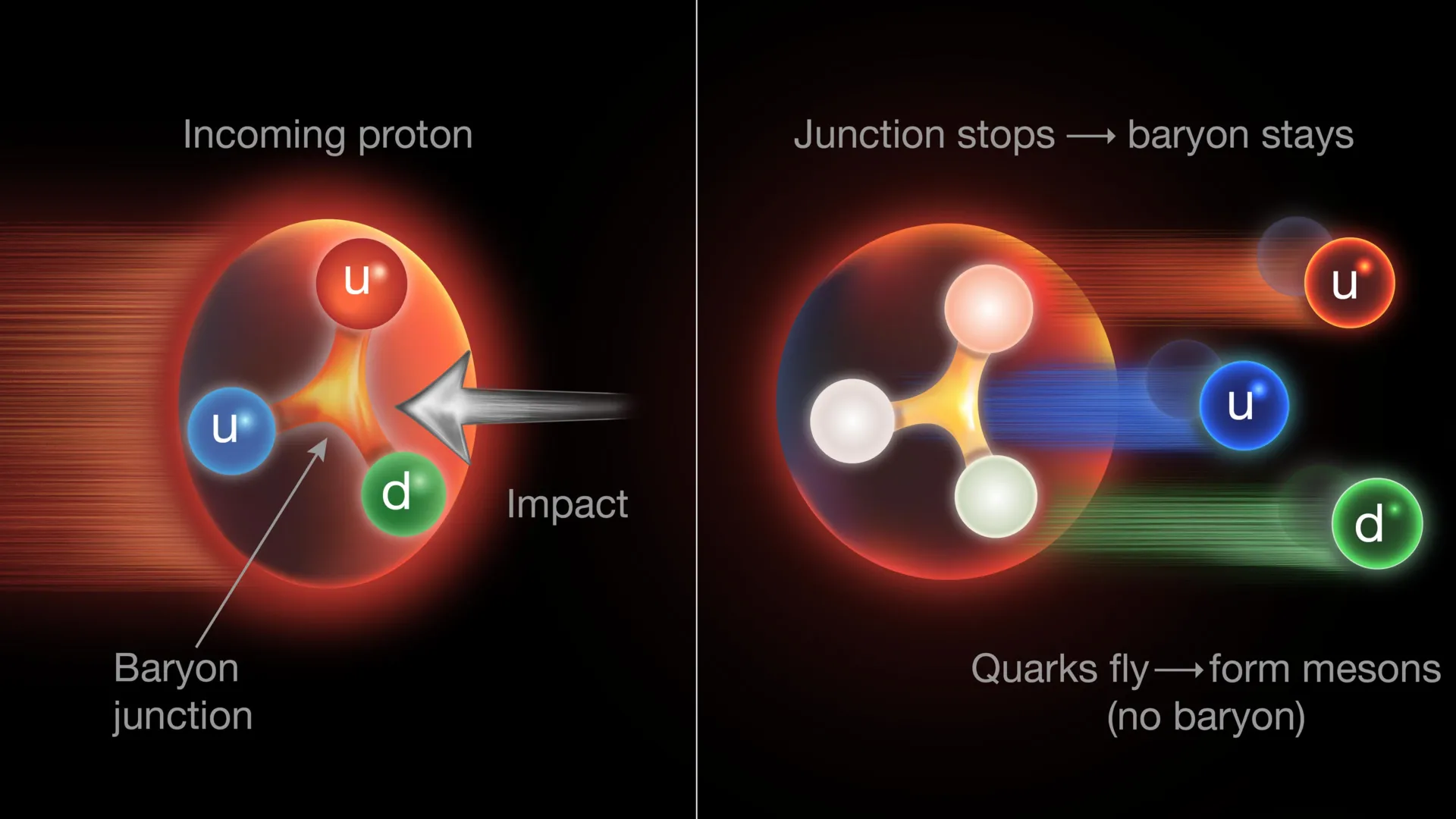
Эрдэмтэд протоны доторх кваркуудыг холбодог глюоны бүтэц нь барион тоог хадгалахад гол үүрэг гүйцэтгэдэг болохыг илрүүлжээ.
АНУ-ын Брукхэвэний үндэсний лабораторийн Relativistic Heavy Ion Collider (RHIC) төхөөрөмж дээр хийсэн өндөр энергитэй бөөмсийн мөргөлдөөний туршилт протоны бүтцийн талаарх уламжлалт ойлголтыг сорьж байна. Шинжлэх ухааны сэтгүүлд нийтлэгдсэн энэхүү судалгаагаар, барион тоо нь зөвхөн гурван үндсэн кваркаас хамаардаг бус, харин тэдгээрийг холбогч Y хэлбэрийн “глюон холбоос”-оос хамааралтай байж болзошгүйг харуулжээ. Энэхүү таамаглал батлагдвал протоны дотоод бүтэц болон материйн тогтвортой байдлын талаарх сурах бичгийн ойлголтуудыг өөрчлөх шаардлагатай болно.
Судлаачид RHIC-ийн мөргөлдөөний үеэр илэрсэн барионы илүүдэл нь зөвхөн кваркуудтай холбоотой байх боломжгүйг тогтоосон байна. Тэд цахилгаан цэнэгийн хуваарилалтыг хэмжих замаар кваркуудын шилжилтийг тооцоолж, хэмжигдсэн барион тоо нь онолын таамаглалаас хоёр дахин их байгааг илрүүлжээ. Энэхүү зөрүү нь барион тоог тээвэрлэхэд глюоны холбоос идэвхтэй оролцдог гэсэн таамаглалыг дэвшүүлэх үндэслэл болж байна.
Протоны доторх глюонууд өндөр энергитэй үед салж, олширдог тул энэхүү глюон холбоос нь хурдан хөдөлгөөнтэй кваркуудтай харьцуулахад мөргөлдөөний үеэр тогтоогдоход илүү хялбар байдаг аж. Энэхүү бүтэц нь энергиэ шинэ бөөмс болгон хувиргаж, барион тоог хадгалахад чухал үүрэг гүйцэтгэдэг гэж физикчид тайлбарлаж байна. Энэхүү нээлт нь матери ба эсрэг материйн харьцаа, протоны гайхалтай тогтвортой байдал зэрэг орчлон ертөнцийн суурь нууцуудыг тайлахад хувь нэмэр оруулах юм.
Дэлгэрэнгүйг эх сурвалжаас харах
↓Эх сурвалжийг нээх ↓
New findings from the STAR detector at the Relativistic Heavy Ion Collider (RHIC) are challenging a familiar picture of what gives protons one of their defining quantum properties. The results suggest that gluons, the particles that act as the glue holding quarks together, may play a key role in carrying and conserving baryon number.
The evidence comes from high-energy particle collisions at RHIC, a U.S. Department of Energy (DOE) Office of Science user facility for nuclear physics research that operated at DOE’s Brookhaven National Laboratory from 2000 to early 2026. According to the new study, published in Science, baryon number may be associated with a Y-shaped “junction” of gluons connecting the proton’s three main quarks. If confirmed, that would challenge the long-standing assumption that baryon number belongs exclusively to those quarks.
“Traditionally, scientists have assumed that each of the three main ‘valence’ quarks inside a proton or neutron carries one-third of the baryon number,” said Zhangbu Xu, a professor at Kent State University with a joint appointment at Brookhaven Lab.
A Decades-Old Idea About Gluons
Physicists first proposed the baryon junction, also called a gluon junction, in the 1970s as a way to describe how gluons connect the valence quarks inside a proton. In 1996, four years before RHIC began operating, Dmitri Kharzeev, a theoretical physicist at Stony Brook University and Brookhaven Lab, proposed that this junction might do something even more fundamental. Rather than the valence quarks carrying baryon number, the junction itself could be responsible.
The STAR collaboration has now developed a way to test that possibility using several types of collisions produced at RHIC.
“Using data collected from different types of particle collisions at RHIC, our results suggest that the baryon number is not simply carried by individual quarks,” Xu added. “Our findings strongly support the idea that baryon number is more favorably carried and transported by gluons, the particles that hold quarks together, when arranged in this special configuration.”
Why Baryon Number Matters
Determining what actually carries baryon number matters far beyond the internal structure of a proton. In RHIC collisions, conservation of baryon number means that the total number of baryons, three-quark particles such as protons and neutrons, must remain unchanged before and after the collision. The same conservation principle also applies on the scale of the universe.
“Since the Big Bang, the number of protons and neutrons all together never changes as a function of time,” said Nicole Lewis, a STAR physicist at Rice University who started this project as a postdoc at Brookhaven Lab in 2020. “The reasons for this conservation are not well understood. It’s one of the mysteries of the universe, related to why we have more matter than antimatter,” she said.
Baryon number conservation also has a much more tangible consequence. It helps explain the extraordinary stability of protons, which form a central part of atomic nuclei and do not appear to decay under ordinary circumstances.
“It’s believed that the lifetime of a proton is longer than the lifespan of the universe,” Lewis said. “This allows atomic nuclei to form and be stable — which means matter, as we interact with it in the universe, can exist.”
A More Complicated Proton
The possibility that gluons carry baryon number would overturn the standard simplified description found in many textbooks. In that picture, a proton has a baryon number of plus one, divided equally among its three main valence quarks. Each quark therefore carries plus one third of the baryon number, much as the proton’s electric charge is distributed among its three valence quarks.
But real protons are much more complicated than that simplified model suggests.
“In the naïve quark model, there are three quarks inside a proton, but nothing else,” said Tommy Tsang, formerly a postdoc at Kent State University, now at DOE’s Argonne National Laboratory. “But if we look at details inside, there are not only three quarks but also a lot of gluons interacting, connecting between those quarks, and there are also quarks and antiquarks that pop up from the vacuum, so it’s actually a really complex object.”
Quantum chromodynamics (QCD), the theory used to describe these interactions, has been highly successful in explaining the strong force that acts among quarks and gluons. Even so, models inspired by QCD often need additional assumptions to reproduce some of the particle patterns observed when RHIC smashes nuclei together at nearly the speed of light.
An Unexpected Excess of Baryons
One observation in particular caught the STAR team’s attention. The detector repeatedly records more baryons than antibaryons emerging sideways from the collisions, perpendicular to the direction of the incoming beams.
“In the STAR detector, we consistently see an excess of baryons coming out of the collisions perpendicular to the direction of the colliding beams,” Tsang said. “The fact that we end up with more baryons than antibaryons — or more matter than antimatter — is not surprising since our collisions start with matter,” he said.
These extremely energetic collisions convert tremendous amounts of energy into thousands of newly created particles. What puzzled the researchers was not simply that more baryons than antibaryons were produced. It was where the excess baryons appeared.
If valence quarks alone carried the baryon number, explaining the excess away from the beamline would require all three valence quarks from one colliding proton to stop near the center of the detector. They would then have to undergo a conversion from matter into energy and back into matter, producing new baryons that move outward perpendicular to the beam.
The STAR researchers suspected there might be another explanation.
Electric Charge Provides a Test
The team found a way to investigate the mystery by taking advantage of another property of valence quarks: electric charge. Scientists compared the net baryon number measured in different RHIC nuclear collisions with the way electric charge was redistributed in those same events.
“Measuring the electric charge coming out perpendicular to the collision gives you a definitive way of measuring how many quarks are stopped and transformed into new particles,” said Zebo Tang, a professor at the University of Science and Technology of China who led a group of students performing data analyses and model simulations.
The comparison revealed a striking mismatch. Researchers observed roughly twice as many baryons as should have been produced based on the electric charge associated with stopped quarks.
According to models based on QCD, that means too few quarks were being stopped to account for all the baryons appearing in the detector.
That left an important question: What was carrying the extra baryon number?
The STAR physicists argue that gluons offer a possible answer, specifically the three-pronged gluon junction that connects the proton’s valence quarks.
How the Gluon Junction Could Carry Baryon Number
The proposed mechanism depends on what happens when protons inside colliding nuclei reach enormous energies. According to the STAR team, the “gluon junction” or “baryon junction” that links the quarks may be much easier to stop in a collision than the three quarks themselves.
If the junction is stopped, its energy can be converted into newly produced baryons that travel outward in directions perpendicular to the beams. Meanwhile, the valence quarks that were previously connected by the junction can continue moving forward along the beampipe.
Understanding why requires looking at the changing internal structure of a proton as its energy increases.
“The baryon junction is always there even as protons are accelerated to higher and higher energy,” Prithwish Tribedy, a STAR physicist at Brookhaven Lab. “But at high energy, gluons within the proton split and multiply.”
As the number of gluons increases, the proton’s momentum becomes spread among more of them. Each individual gluon, including those forming the junction, therefore carries a smaller portion of the proton’s total momentum. The valence quarks, however, continue to carry much of the proton’s forward motion.
As a result, when the collision occurs, the comparatively slower three-pronged gluon junction should be easier to stop and convert into new particles than the rapidly moving quarks.
Stopping one connected structure is also simpler than stopping three separate quarks, making such an interaction more likely, according to Tribedy.
“In the collision, the baryon junction gets held behind, and the quarks continue on,” he noted.
Building New Particles After the Collision
Quarks and gluons cannot remain isolated, so after the collision they quickly combine with other particles.
In a simplified example, a quark continuing down the beampipe could join with an antiquark and form a two-quark particle called a meson. At the same time, the three-pronged gluon junction could behave somewhat like a Y-shaped magnet, drawing in three newly created quarks from the vacuum and producing a new baryon.
Actual RHIC collisions are considerably more violent and complex.
“Even though we start with nuclei that contain roughly 100 protons and 100 neutrons, these collisions create thousands of new particles; 99% of the energy is transformed into new particles,” said Rongrong Ma, a Brookhaven Lab physicist.
The STAR team found that collisions producing larger numbers of particles also showed a greater excess of “midrapidity” baryons compared with predictions based on the simpler picture in which quarks alone carry baryon number.
The fact that so many of these baryons emerge perpendicular to the beamline provides strong evidence, according to the researchers, that the baryon junction exists and plays an important role in transporting baryon number.
Rethinking a Fundamental Property of Matter
The results suggest that one of the proton’s defining quantum properties may not reside solely in its three valence quarks. Instead, the gluon structure connecting those quarks could be central to how baryon number is carried through energetic collisions.
“Our research challenges the long-held idea that baryon number is simply divided among and carried by the three quarks,” said Ma. “This new understanding reshapes how we think about the structure of matter and deepens our knowledge of the most fundamental element that is responsible for the universe in its current form.”
The research was supported by the DOE Office of Science, the U.S. National Science Foundation (NSF), and numerous international agencies and organizations listed in the scientific paper. Researchers also used the Open Science Grid, which is supported directly by NSF, along with computing resources at Brookhaven Lab’s Scientific Data and Computing Facilities and the National Energy Research Scientific Computing Center (NERSC), another DOE Office of Science user facility located at DOE’s Lawrence Berkeley National Laboratory.


