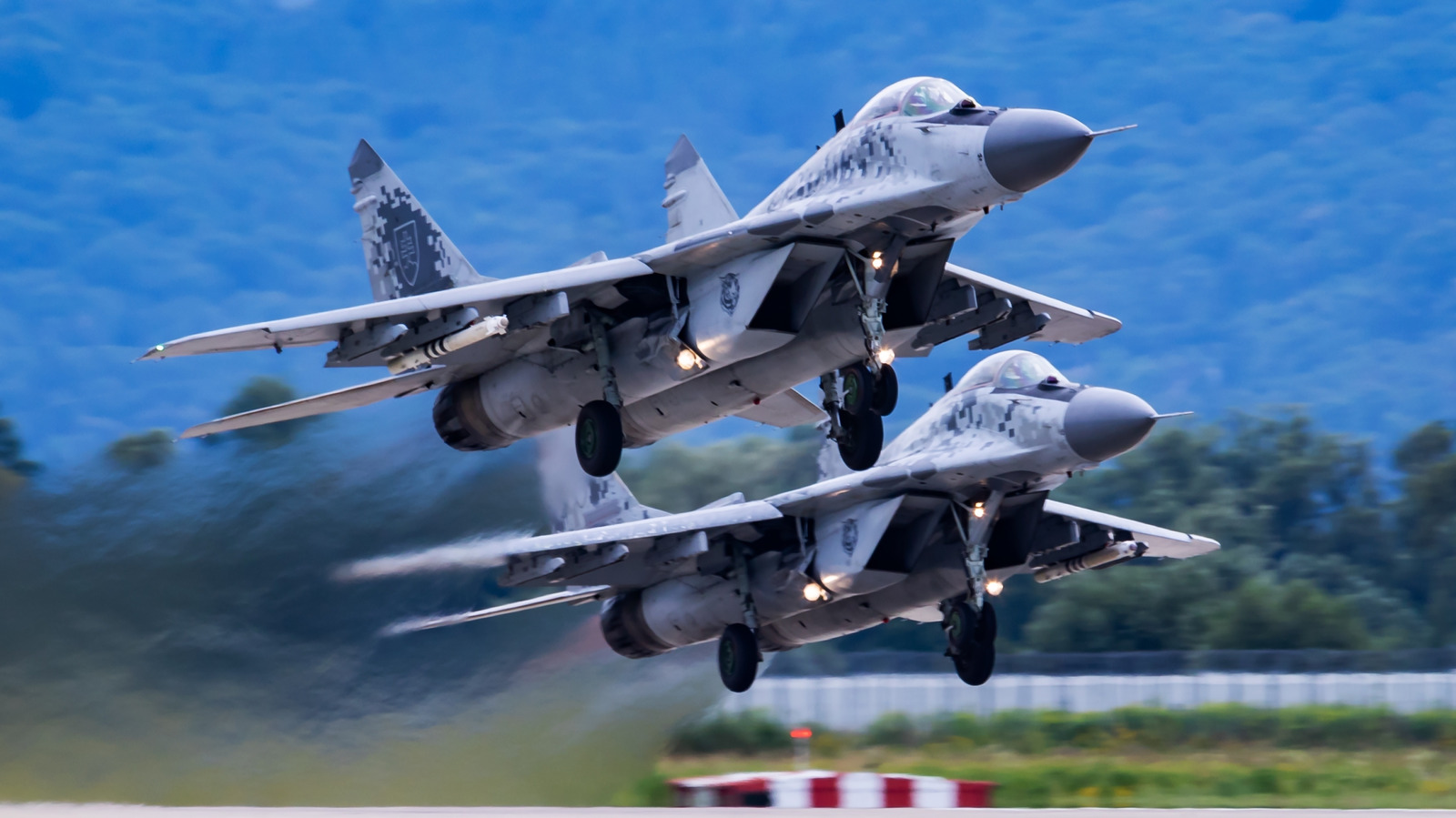
Орчин үеийн тав дахь үеийн сөнөөгч онгоцнуудад байдаггүй техникийн шийдэл нь хээрийн болон гэмтсэн нисэх зурваст ажиллах чадварыг нэмэгдүүлж байна.
Тийрэлтэт хөдөлгүүр нь ажиллахын тулд асар их хэмжээний агаарыг сорж, шатаах шаардлагатай байдаг бөгөөд энэ үйл явцад нисэх зурвас дээрх шороо, чулуу, бетон болон металлын хэлтэрхий зэрэг гадны биетүүд (FOD) орох нь хөдөлгүүрийн сэнс болон бусад эд ангиудад ноцтой гэмтэл учруулдаг. F-22 Raptor, Su-57, J-20 зэрэг орчин үеийн сөнөөгч онгоцнууд агаарын урсгалыг оновчтой болгох нарийн төвөгтэй системтэй боловч хөдөлгүүрийг гадны биетээс хамгаалах тусгай механик шийдэл дутагдалтай байдаг.
Хүйтэн дайны үед бүтээгдсэн МиГ-29 сөнөөгч онгоц нь дайны нөхцөлд бөмбөгдөлтөд өртөж, эвдэрч сүйдсэн нисэх зурвас дээрээс хөөрөх шаардлагад нийцүүлэн бүтээгдсэн юм. Энэхүү онгоц нь хөөрөх болон газардах үед хөдөлгүүрийн үндсэн агаар сорох хоолойг автоматаар хааж, далавчны дээд хэсэгт байрлах туслах хоолойгоор агаар сорох өвөрмөц системийг ашигладаг. Энэ нь хөдөлгүүрийг нисэх зурвасаас дэгдэх хог хаягдлаас хамгаалахаас гадна, нислэгийн үеэр агаарын урсгал тогтворгүй үед нэмэлт агаар оруулах боломжийг олгодог байна.
Сүүлийн үеийн зэвсэгт мөргөлдөөний нөхцөл байдал нь нисэх зурвасуудыг пуужин болон нисгэгчгүй онгоцны бай болгож байгаа нь энэ асуудлыг дахин чухалчилж байна. Орчин үеийн тав дахь үеийн сөнөөгч онгоцууд нь өндөр хамгаалалттай, цэвэрхэн нисэх зурваст ажиллахаар төлөвлөгдсөн тул эвдэрхий зурвас дээрх хог хаягдлын эрсдэл тэдний хувьд томоохон сорилт болж байна. МиГ-29-ийн энэхүү хуучны шийдэл нь ирээдүйн байлдааны ажиллагаанд нисэх хүчний тогтвортой байдлыг хангах стратегийн чухал ач холбогдолтой байж болох юм.
Дэлгэрэнгүйг эх сурвалжаас харах
Эх сурвалжийг нээх ↓
While they do represent a marvel of modern engineering, jet engines ultimately rely on one relatively simple requirement: air. In order to turn fuel to fire, and fire to thrust, a fighter’s engines must ingest, compress, and combust enormous quantities of air. At full power, this could equate to up to 500 pounds of oxygen being ingested per second.
The importance of airflow can be seen across the design principles of every modern fifth-generation fighter. The F-22 Raptor, Su-57 Felon, and J-20 Mighty Dragon all feature large, lateral, twin intakes capable of scooping and driving huge amounts of air directly into the engine. Simultaneously, these intakes are designed to ensure the airflow remains clean. “Clean” air, in the context of air combat, generally refers to smooth, undisturbed, high-velocity airflow entering the compressor. To achieve this, modern jets employ highly sophisticated inlet designs intended to provide a continuous, smooth, and highly compressed airflow.
But beyond that complex realm of air-breathing jet propulsion and the Brayton Cycle, “clean” air also demands consideration in its most literal sense. Dust, stones, fragments of concrete, pieces of metal, and other debris all represent potential foreign object debris, or FOD. This simple detritus exists on all airfields, but if sucked into an engine, can strike compressor blades at extraordinary speeds, causing critical damage or catalyzing cascading failures.
Today’s fighters solve airflow problems brilliantly. But the Mikoyan MiG-29 Fulcrum was also designed to solve the FOD problem. How do you keep a core-airflow turbojet breathing when the runway itself may be trying to feed it gravel? The answer is one of the Fulcrum’s strangest and most ingenious features: intake-covering anti-FOD doors, combined with top-mounted auxiliary air intakes.
The MiG-29: a fighter built for a broken runway
Ali _Cobanoglu/Shutterstock
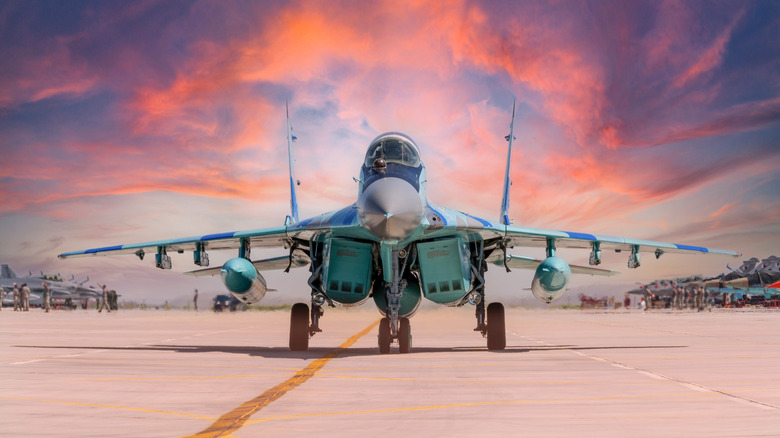
The MiG-29 was conceived during the Cold War, being designed to fight on a very different battlefield than the ones modern fighters have evolved on throughout the counterinsurgency era of the past few decades. Soviet planners had every reason to believe that airfields would be among the first targets of a major European war. Runways would be cratered, parking aprons and taxiways would be struck, and instead of carefully swept surfaces, aircraft would be scrambled on runways littered with shattered concrete and metal scrap.
For a fighter expected to operate close to the front, that created a serious vulnerability. FOD is not merely an inconvenience,as a piece of debris entering a jet engine can strike guide vanes or compressor blades, deforming or breaking them. Even apparently minor damage can create an aerodynamic imbalance, reduce efficiency and, in severe cases, catalyze compressor stalls or cascading mechanical failure down the core of the engine.
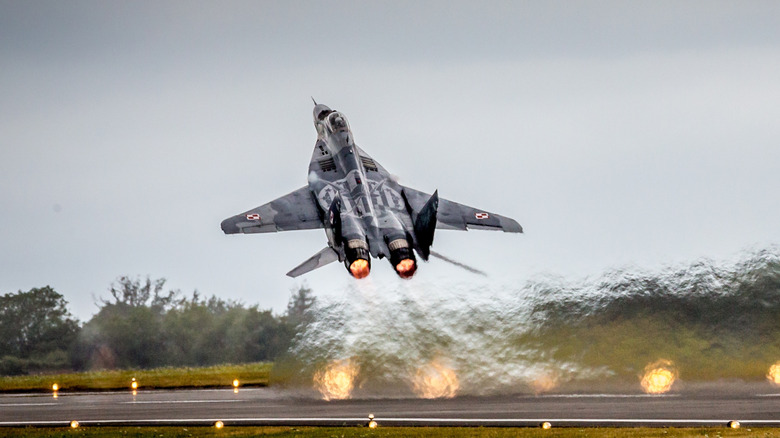
The MiG-29’s answer was remarkably simple. During takeoff and landing, while the weight-on-wheels sensor was engaged, FOD “doors” would automatically seal off the aircraft’s main ventral engine intakes. Instead, the engines would draw air through auxiliary intakes on the upper surfaces of the wing-root extensions. This kept the primary air source for takeoff and landing away from the debris being kicked up beneath the aircraft.
Once airborne, the main intakes would open and take over. As an added bonus, under some disturbed airflow conditions, such as during a high-angle-of-attack maneuver, the auxiliary intake louvers would flutter as pressure worked against the springs holding them closed, opening a second route for air into the engine as the main intakes struggled against airflow separation or a poor inlet flow angle.
The forgotten danger of symmetric contest
Jasper Dalgliesh/Shutterstock
Within the world of technical intelligence, a shift in the threat environment is becoming apparent. Today’s fighter aircraft represent evolution through a strategic era in which air supremacy was often assumed, and asymmetric adversaries did not possess the capability to target rear airbases. Decades of expeditionary counterinsurgency warfare reinforced the belief that fighters would only operate from heavily defended and well-maintained facilities, far beyond the reach of an enemy. Cratered runways littered with combat debris weren’t considered a concern, so mechanical solutions dedicated specifically to FOD protection could therefore be traded away to save weight and allow for more aerodynamically efficient designs.
However, that assumption is beginning to look increasingly fragile in an impending era of symmetric conflict between peer adversaries. Airfields are once again valuable, and reachable, targets. Drones, missiles, and other long-range weapons can turn a previously secure runway into a debris field in minutes. Shrapnel, wreckage, or fragments of concrete, all FOD, are becoming an increasingly likely issue for near-future air operations, and one that no fifth-generation fighter has a genuine solution for.
Even a minor dent, crack, or defect in a compressor blade, guide vane, or other internal component can create stresses and compound issues that propagate downstream. In high-performance air combat, where aircraft components operate close to their limits, that small defect can have immense consequences. In many aspects, a wayward bolt or chunk of tarmac can be almost as dangerous as an adversary missile.
Although the MiG-29’s auxiliary FOD doors may look like an artifact of the Cold War, they were designed around a problem that may be making a comeback. So while the Raptor may be the deadliest thing in the sky, that means nothing if a gauntlet of FOD seals its fate before takeoff.

