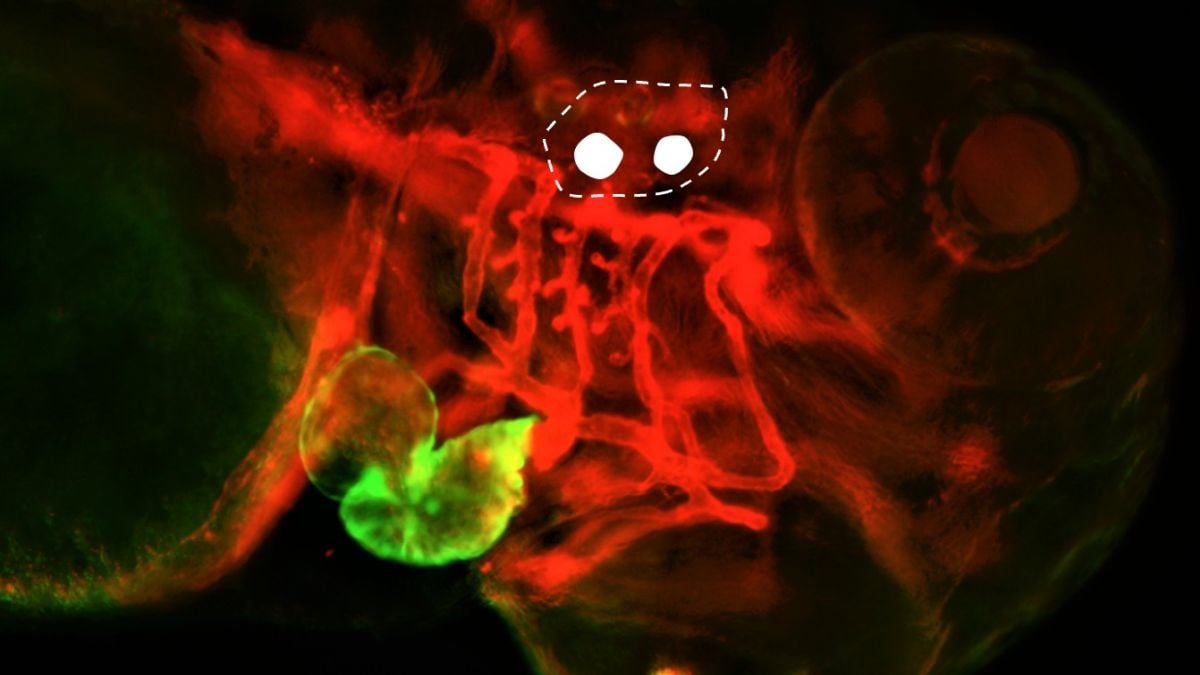
Эрдэмтэд лазерын туяа ашиглан загасны чихний дотоод бүтцийг чичиргээнд оруулах замаар зүрхний цохилтыг хянаж, зүрхний хэм алдагдлыг эмчлэх шинэ аргыг туршиж үзлээ.
Гуанжоугийн их сургуулийн физикч Сяошуай Лю болон түүний багийнхан тахө загасны (zebrafish) авгалдай дээр судалгаа хийж, гэрлийн туяаг ашиглан сонсголын эрхтэнээр дамжуулан зүрхний үйл ажиллагаанд нөлөөлөх боломжтойг тогтоов. Судлаачид оптик хясаа (optical tweezers) хэмээх технологийг ашиглан загасны чихний доторх жижиг талст буюу отолитуудыг алсаас чичиргээнд оруулжээ. Энэхүү механик хөдөлгөөн нь загасны тархины сонсголтой холбоотой хэсгүүдийг идэвхжүүлж, зүрхний цохилтын хурдыг 50 хүртэлх хувиар өөрчлөх үр дүн үзүүлсэн байна.
Тус багийнхан гэрлийн давтамж, хэмнэлийг өөрчлөх замаар хөгжим мэт “гэрлийн дохиог” зохион бүтээж, түүгээрээ дамжуулан зүрхний эмгэгтэй загаснуудыг эмчлэх туршилт хийжээ. Эмийн гаралтай зүрхний хэм алдагдалтай загаснуудад энэхүү гэрлийн өдөөлтийг үзүүлэхэд зүрхний цохилт нь тогтворжиж, хэвийн үйл ажиллагаа нь сэргэсэн байна. Зарим тохиолдолд уг нөлөөлөл нь гэрлийн дохио зогссоны дараа ч үргэлжилж байжээ.
Энэхүү судалгаа нь сонсголын эрхтэн болон зүрх судасны тогтолцооны уялдаа холбоог гэрлийн физиктэй холбосон шинэлэг нээлт юм. Сяошуай Люгийн хэлснээр, энэ нь одоогоор онолын үндэслэлээ баталгаажуулсан анхан шатны туршилт бөгөөд ирээдүйд илүү том биетэй амьтад болон хүн дээр эмчилгээний зориулалтаар ашиглах боломжийг судлах шаардлагатай гэв. Судалгааны үр дүнг Nature Communications сэтгүүлд нийтэлжээ.
Дэлгэрэнгүйг эх сурвалжаас харах
↓Эх сурвалжийг нээх ↓
If you want to make someone’s heart beat faster, there are probably better ways to approach it than shining a flashlight in their ear.
But swap the flashlight for a laser, and the someone for a zebrafish, and things get surprisingly interesting.
But how a signal from light gets from the ear to altering the rate of a heartbeat is a slightly more convoluted tale, according to physicist Xiaoshuai Liu of Guangzhou University in China.
He and his colleagues have done precisely that – and it’s every bit as incredible as it sounds.
“When people think of light and sound, they instinctively associate light with vision and sound with hearing, a seemingly natural pairing. However, if we trace back to the physical principle of sound, it is fundamentally vibration,” Liu told ScienceAlert.
“The idea of controlling heart rate was inspired by traditional music therapy. Given that rhythmic sound can modulate cardiac rhythm, we wondered: Could we use precisely programmed light beams to compose ‘light music’ and achieve heart rate regulation?”
An ear is a delicate, complex organ with sensitive structures capable of picking up tiny vibrations. For most vertebrates, these structures include otoliths – tiny, stone-like crystals of calcium carbonate. Sound or motion causes them to move, which stimulates sensory cells in the ear.
Sound is not the only thing that can physically wiggle a tiny object. For years, scientists have used something called optical tweezers to manipulate tiny objects. Basically, they use radiation pressure to exert a physical force that can push or move something very, very small.
The otoliths found in the ears of zebrafish larvae are very small indeed.
More importantly, their movement is part of how the fish detects sound and motion.
That made them an intriguing target for a tool designed to manipulate microscopic objects. If an optical trap could make an otolith move without any sound reaching the ear, the researchers could effectively bypass the first step in hearing.
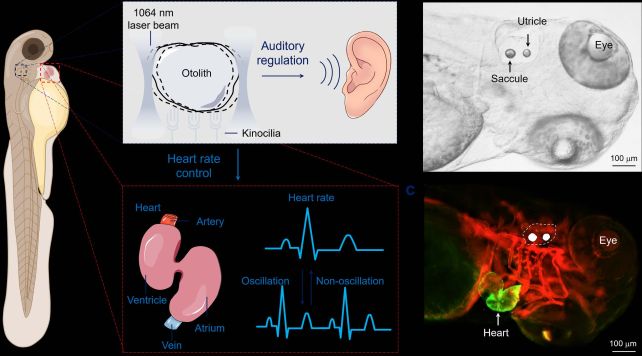
“Our initial motivation was to break away from the conventional association of light with vision and sound with hearing, and instead explore the possibility of making organisms ‘hear’ light,” Liu explained.
“Once we break free from conventional thinking, any strategy capable of oscillating can generate the equivalent of sound.”
So, they tried it. As one would.
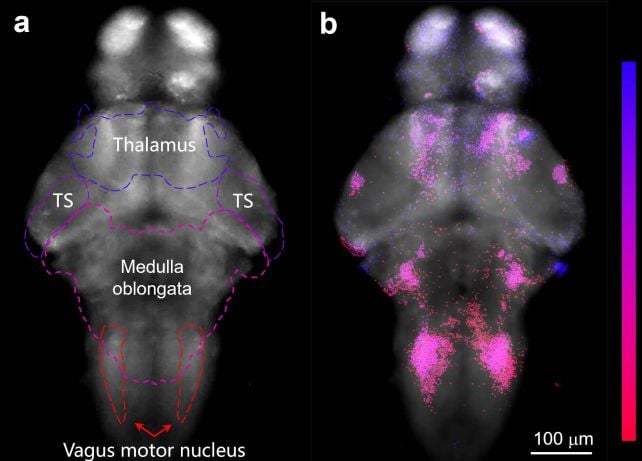
They used optical tweezers to oscillate individual otoliths in living zebrafish larvae while imaging brain activity. The stimulation activated auditory-related regions, suggesting that the mechanical movement was being processed by the fish’s hearing circuitry.
So does that mean that the fish is ‘hearing’ light? Well, that’s a bit harder to answer.
“The ancient Chinese philosopher Zhuangzi once said, ‘You are not the fish, how do you know the fish’s joy?'” Liu said. “Similarly, we cannot directly communicate with zebrafish to confirm whether they are consciously ‘hearing’ the light.”
“The ancient Chinese philosopher Zhuangzi once said, ‘You are not the fish, how do you know the fish’s joy?'” Liu said. “Similarly, we cannot directly communicate with zebrafish to confirm whether they are consciously ‘hearing’ the light.”
What the researchers could determine was that auditory-related neural centers became significantly more active during the optical stimulation.
But that’s not all.
The researchers noticed that when they moved a fish’s otolith, its heart sped up.
In one experiment, a resting heart rate of about 2 beats per second rose to about 2.7 beats per second during stimulation, then gradually returned toward baseline after the stimulation stopped.
Targeted otolith oscillation, the researchers found, could increase heart rate by around 50 percent.
And because the optical tweezers allowed the researchers to precisely control how the otolith moved, they could do something even stranger – reproduce patterns corresponding to music. By changing the amplitude, frequency, and timing of the oscillations, they could mimic properties corresponding to loudness, pitch, and rhythm.
These observations led the research in a new direction.
“Given that we could use light to reproduce musical stimuli and influence heart rate, it seemed like a natural progression to ask whether we could also apply this approach to correct abnormal cardiac rhythms,” Liu told ScienceAlert.
“This reasoning led us to conduct experiments on rescuing drug-induced arrhythmias.”
The researchers used drugs to induce three different kinds of abnormal heart rhythm in zebrafish larvae, then applied their optically generated musical stimulation.
In fish with abnormally slow heartbeats, the stimulation brought their heart rates close to normal.
In fish whose upper and lower heart chambers had fallen out of sync, normal coordination was restored in six of seven animals.

And in fish whose heartbeats were interrupted by abnormal pauses, normal rhythms returned in five of seven.
Even more incredibly, some of the improvements persisted even after the stimulation had ended.
Related: Hit Songs Do Something to Your Brain, And It Could Be The Future of Music
“The result that surprised us most was that this approach … could not only modulate heart rate but also rescue drug-induced pathological arrhythmias,” Liu explained.
“The fact that a purely optical stimulus, delivered through the auditory pathway, could restore normal cardiac rhythm in a disease model exceeded our initial expectations and might open up exciting possibilities for future therapeutic applications.”
Those possibilities, of course, are a long way from realization. Liu describes the study as a “very preliminary proof-of-concept demonstration”; exactly how the neural signals produce the changes in heart rhythm remains unclear, and whether the approach could work in larger animals is yet to be investigated.
“We view this work not as a definitive answer, but as an invitation to explore a new frontier at the intersection of optics, auditory neuroscience, and cardiac physiology,” he told ScienceAlert.
The findings have been published in Nature Communications.
This article was fact-checked by Fiona MacDonald and edited by Fiona MacDonald. While we pride ourselves on our process, we are only human. If you spot a mistake, please let us know.


