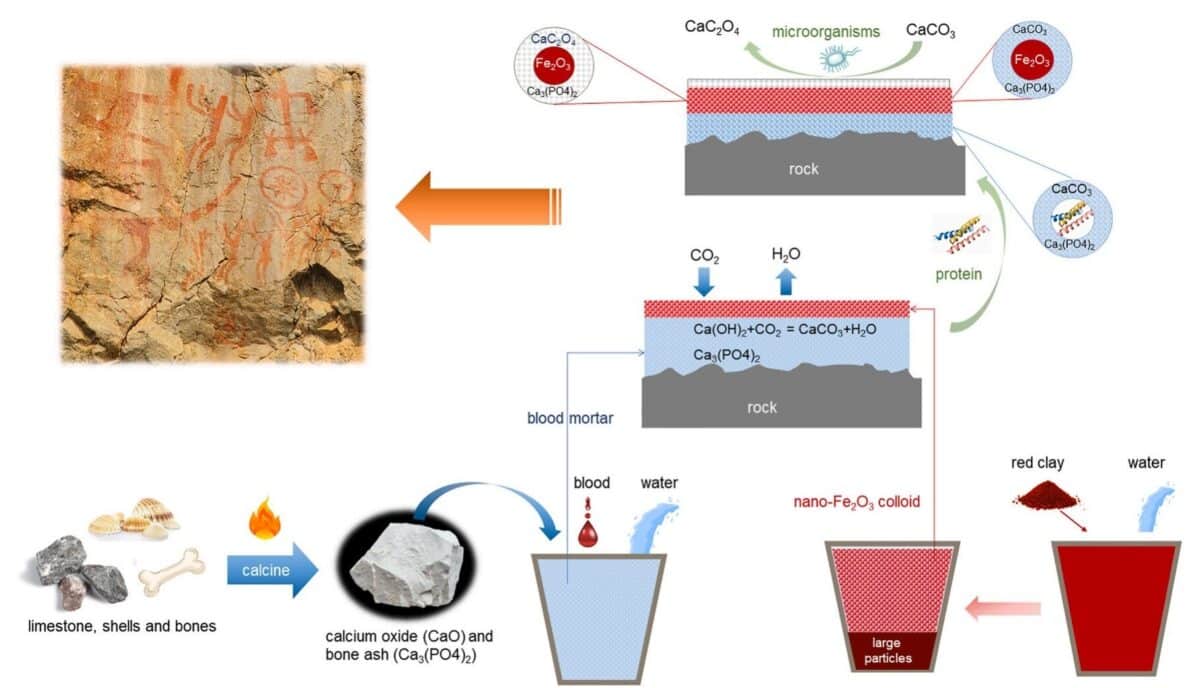
Эртний зураачид шохойн чулуун дээрх дүрслэлээ удаан хугацаанд хадгалахын тулд цус болон тусгай найрлагатай зуурмаг ашигласан нь тогтоогдлоо.
Шаньдуны их сургууль болон Гуансигийн антропологийн музейн судлаачид Хятадын өмнөд хэсэгт орших Хуашань хадны зургийн тэсвэрлэх чадварыг судалжээ. МЭӨ 5-р зуунаас МЭ 2-р зууны хооронд бүтээгдсэн эдгээр зураг нь халуун чийглэг уур амьсгал болон хүчтэй аадар бороог 2000 гаруй жилийн турш даван туулсан байна. Эрдэмтэд олдворуудаас дээж авч шинжилснээр тэдгээрийн бэхэлгээнд кальцийн карбонат, силикат, сульфат болон уураг агуулсан хиймэл зуурмаг ашигласныг илрүүлжээ.
Лабораторийн шинжилгээгээр зуурмагийн найрлагад хүний цусны ийлдэс агуулагдаж байгааг тогтоосон бөгөөд уургийн шинжилгээгээр энэ нь төрөх үеийн цус байх магадлалтай гэж судлаачид үзэж байна. Тухайлбал, жирэмсэн болон хөхүүл эмэгтэйн цусанд ихээр агуулагддаг пролактин даавар болон лактотрансферрин уургууд илэрсэн нь үүнийг баталж байна. Харин сүүний үндсэн уураг болох казеин илрээгүй тул сүү ашиглаагүй гэж дүгнэжээ.
Хадны зургийг хадгалан үлдээхэд гол үүрэг гүйцэтгэсэн зүйл нь кальцийн карбонат юм. Шохойн чулуу нь агаартай урвалд орж кальцийн карбонатын талст үүсгэснээр будагч бодисыг чулуутай нягт холбосон байна. Энэхүү нарийн технологийн процесс нь тухайн үеийн хүмүүс орон нутгийн түүхий эд болох шохой, шавар, яс болон цусыг ашиглан байгалийн хүнд нөхцөлд тэсвэртэй бүтээл туурвих мэдлэгтэй байсныг гэрчилж байна.
Дэлгэрэнгүйг эх сурвалжаас харах
↓Эх сурвалжийг нээх ↓
For more than 2,000 years, the Huashan rock paintings have clung to exposed cliffs in southern China despite intense heat, humidity, typhoons and heavy rain. Researchers now say they have identified part of the recipe behind that staying power: lime, red clay and blood, including human blood that may have come from women giving birth.
The paintings run across more than 80 sites along some 260 kilometers of the Zuojiang River valley, in the Guangxi Zhuang Autonomous Region. Created between the 5th century BC and the 2nd century AD, they depict people, animals and bronze objects.
What has puzzled researchers is how the red pigment stayed on the rock for so long. Summers in the area can top 40°C, and the cliffs are regularly exposed to torrential rain, high humidity and typhoons. An international team led by Shandong University and the Guangxi Museum of Anthropology examined fallen fragments from Gaoshan, Daningshan and Tupingshan to find out.
The Paintings Were Made With More Than Red Pigment
The ancient artists did not simply brush color onto the limestone. Beneath the pigment, researchers found a very thin artificial mortar made from calcium carbonate, calcium phosphate, silicates, sulfates and proteins. According to the study published in the Journal of Archaeological Science, this layer ranged from only 1 micrometer thick at Tupingshan to 150 micrometers at Gaoshan. Its particles were also remarkably uniform and measured less than 3 micrometers, unlike the irregular material found in nearby sediments.
The difference was not subtle. Some well-preserved samples from Gaoshan were so firmly attached that researchers needed an electric drill to remove them. Natural sediments collected nearby, by comparison, broke apart easily.
Earlier work suggested that plant sap rich in oxalic acid may have helped the pigment stick to the rock. But the new analysis tells a different story, pointing instead to a specially prepared, biomineralized mortar that helped keep the paintings in place.
Human Blood Shows Up In The Ancient Mixture
The team detected blood serum proteins, including albumin, fibrinogen and immunoglobulins, in all the samples analyzed. Researchers washed the fragments with ultrasound and excluded human keratins that might have come from modern handling. They also studied protein deamidation, a chemical process that happens over time, to check that the biological traces were ancient.
At Gaoshan, more than 97% of the proteins detected in three samples corresponded to Homo sapiens. At Daningshan, the split was 61% human and 39% bovine. But two proteins made the results even more unusual: prolactin-inducible protein and lactotransferrin. The source reports that these proteins are abundant in breast milk and in the serum of pregnant or breastfeeding women, but occur at much lower levels in men and non-pregnant women.

The team found no casein, the main protein in milk, so it ruled out milk itself. As explained by the researchers, the blood likely came from women during childbirth, possibly from birth or postpartum bleeding. They connect this possibility with the Luoyue, the people associated with the paintings, and with images at Huashan showing pregnancy, intercourse and prominent male genitalia. And surprisingly little blood may have been needed. The researchers estimate that around 8 milliliters could cover one square meter of painting.
Blood Was Only Part of the Formula
The blood makes for the most eye-catching part of the discovery, but it was calcium carbonate that appears to have kept the pigment attached for centuries. As lime reacted with air, calcium carbonate crystals formed around the pigment, effectively bonding it to the limestone.
“This stable organic-inorganic composite bonding system reveals the complex technological processes used by the creators and explains why the Huashan rock art has survived so well in such challenging conditions for over two millennia,” said the study authors.
This mineral layer could handle the region’s warm and wet conditions far better than a purely organic binder. One sample from Tupingshan offered a telling comparison: the original calcium carbonate had completely disappeared, leaving oxalate and phosphate behind, and the pigment flaked off easily.
“Clearly, it is the calcium carbonate, not the calcium oxalate, that bonds the pigment to the base rock,” they added.

The ingredients were all available locally, including limestone, shells, clay, bones and blood. Lime could be made by heating limestone, while bones or guano supplied phosphate. According to the authors, the real challenge was not gathering a large workforce, but knowing how to prepare and combine these materials.
“These findings provide new insights into the creation of prehistoric rock art, showing that it was a technically intensive project rather than a labor-intensive one.”
Enjoyed this article? Subscribe to our free newsletter for engaging stories, exclusive content, and the latest news.