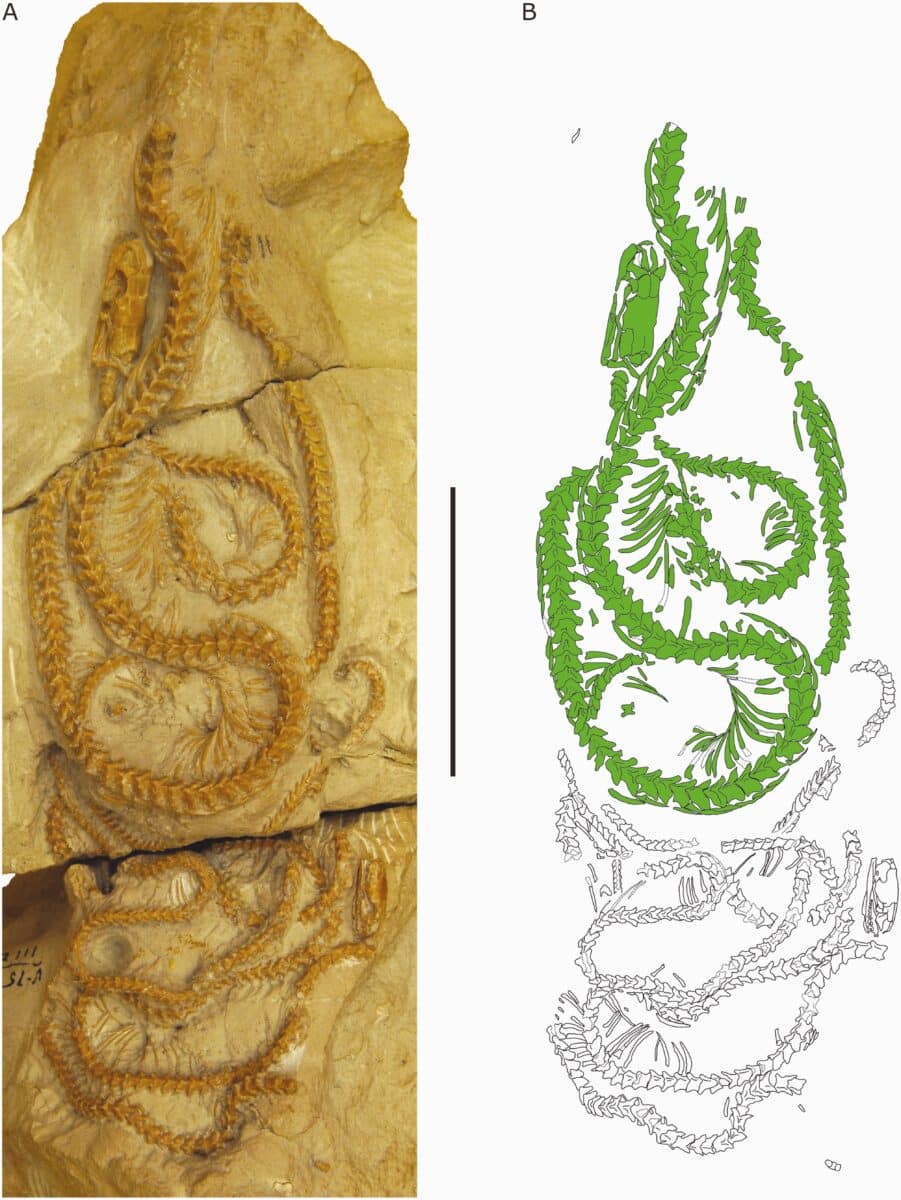
Эртний олигоцений үед хамаарах эдгээр могойнууд нь бүлгээрээ ичээндээ байхдаа галт уулын үнсэнд дарагдан хадгалагдаж үлдсэн байж болзошгүй байна.
Альбертагийн их сургуулийн профессор Майкл Колдуэллээр удирдуулсан судлаачдын баг Вайоминг мужаас Hibernophis breithaupti хэмээх шинэ зүйлийн дөрвөн могойн бүрэн бүтэн чулуужсан олдворыг илрүүлжээ. Ойролцоогоор 38 сая жилийн настай эдгээр олдворууд нь орчин үеийн резинэн могойнуудын хувьслын түүхийг судлахад чухал ач холбогдолтой юм. Могойнууд амьд ахуй үеийнхээ байрлалаар, нүхэндээ хамтдаа ороогдон хадгалагдаж үлдсэн нь палеонтологийн хувьд маш ховор тохиолдолд тооцогдож байна.

Эдгээр могойнууд нь тухайн үед идэвхтэй байсан Өмнөд сав газар болон Рэйндж галт уулын системийн үнс, шороо, үерийн усны нөлөөгөөр агааргүй орчинд битүүмжлэгдэн ийнхүү сайн хадгалагджээ. Zoological Journal of the Linnean Society сэтгүүлд нийтлэгдсэн судалгаагаар, энэхүү олдвор нь могойнууд эрт цагаас эхлэн өнөөгийн хоржигногч могойнуудын адил бүлгээрээ ичдэг байсан байж болзошгүй гэсэн таамаглалыг дэвшүүлж байна.

Судлаачдын үзэж буйгаар Hibernophis breithaupti нь өнөөгийн ихэнх могой болон питоныг багтаадаг Booidea овогт хамаарах эртний төрөл зүйл юм. Энэхүү олдвор нь Хойд Америкийн төв болон хойд бүс нутгийг могойнуудын хувьслын гол төв байсан байх магадлалыг нэмэгдүүлж байна. Хэдийгээр олдворын бүрэн бүтэн байдал нь анатомийн болон зан үйлийн судалгаанд үнэтэй хувь нэмэр оруулж байгаа ч бүлгээрээ ичдэг байсан гэх дүгнэлт нь одоогоор шинжлэх ухааны таамаглал хэвээр байна.
Дэлгэрэнгүйг эх сурвалжаас харах
↓Эх сурвалжийг нээх ↓
Four snakes, curled together in a burrow for 38 million years, have just given paleontologists their clearest window yet into the early history of boas. The species, newly named Hibernophis breithaupti, was unearthed in Wyoming in a state so remarkably intact that researchers can now trace the roots of modern rubber boas back to a region far from where anyone expected to find them.
Fossil snakes are notoriously difficult to study. Their skeletons are thin, delicate, and prone to falling apart long before they ever reach a museum drawer, which means most specimens turn up as scattered, disconnected fragments. That makes articulated remains, skeletons still arranged the way they were in life, a genuine rarity, and finding four of them together, seemingly frozen mid-hibernation, is rarer still.
That rarity is exactly what makes this find so significant. H. breithaupti lived during the Early Oligocene, roughly 38 million years ago, in what is now western Wyoming, and its unusually complete preservation is opening a door onto both the anatomy and, potentially, the social behavior of early snakes, details that are almost never available from the fossil record.
An Ancient Relative of Modern Rubber Boas
According to the research team, led by University of Alberta professor Michael Caldwell, Hibernophis breithaupti is likely an early member of Booidea, the broader group that today includes boas and pythons. More specifically, the fossils appear to be linked to the evolutionary line of rubber boas, small, secretive, burrowing snakes still found in parts of North America today.
“Modern boas are widespread in the Americas, but their early evolution is not well understood,” Caldwell and his colleagues said, noting that: “These new and very complete fossils add important new information, in particular, on the evolution of small, burrowing boas known as rubber boas.”
H. breithaupti, they contend, positions the northern and central regions of North America as a central hub for that evolutionary development, rather than the warmer climates typically linked to boas.
Volcanic Ash Helped Preserve the Snakes
The specimens survived in such fine condition thanks to a rather violent backdrop. Some 38 million years ago, the Southern Basin and Range Volcanic System was highly active, spewing enormous amounts of volcanic ash into the surrounding landscape. That ash settled over the area and helped preserve the snakes’ bodies within a matrix of fine, sandy mudstone typical of the White River Formation. Caldwell suggested the animals likely died in a small flood event, an unusual set of circumstances that, geologically speaking, worked in the fossils’ favor.
“Fossilization is a rough process. You need exactly the right conditions to preserve something,” he said. “Modern garter snakes are famous for gathering by the thousands to hibernate together in dens and burrows.”

This time, ash, mud, and a burst of floodwater worked together in a way that almost never happens, sealing an entire group of snakes in place and keeping them intact for tens of millions of years.
Possible Evidence of Ancient Group Hibernation
Perhaps the most intriguing detail is behavioral rather than anatomical. As explained by the study published Zoological Journal of the Linnean Society, the four Hibernophis breithaupti individuals were found curled together, a posture that hints at communal hibernation, a trait still very much alive in snakes today. Modern garter snakes, for instance, are known for gathering by the thousands in shared dens and burrows, huddling together to conserve heat as a group.

Caldwell described the parallel as striking, calling it fascinating to see possible evidence of this kind of social or hibernating behavior dating back tens of millions of years. If the interpretation holds, it would represent one of the oldest potential examples of group hibernation ever recorded in the fossil record. A small, ash-preserved burrow could therefore offer a surprisingly intimate glimpse into how ancient snakes weathered the cold.
Enjoyed this article? Subscribe to our free newsletter for engaging stories, exclusive content, and the latest news.


