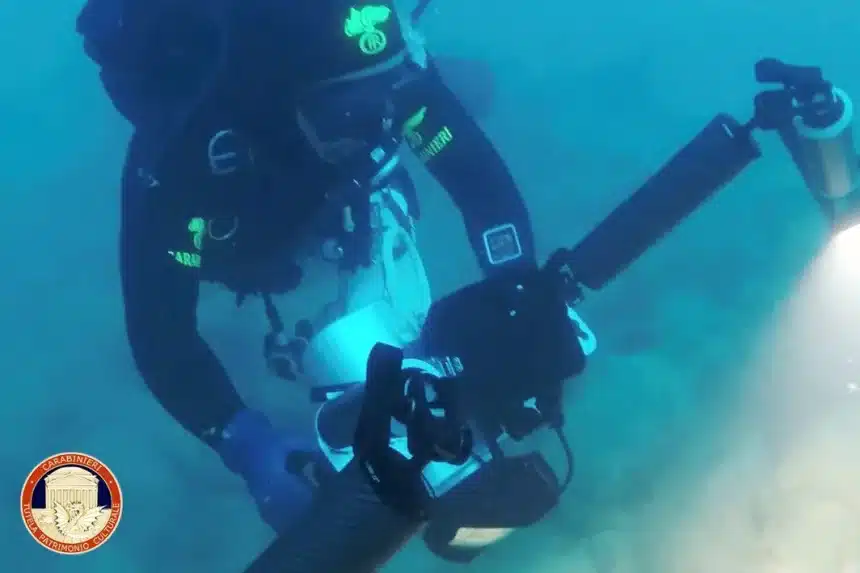
Далайн гүнд 2000 орчим жил дарагдсан худалдааны хөлөг онгоц болон түүний доторх ачаа бараа гайхалтай нөхцөл байдалд олджээ.
Италийн Мазара-дель-Валло хотын ойролцоох далайн гүнд шумбагч Жакомо Де Мола санамсаргүй байдлаар эртний Ромын үеийн худалдааны хөлөг онгоцыг илрүүлжээ. Далайн түвшнээс доош 46 метрийн гүнд орших 21 метр урт, 6 метр өргөн уг хөлөг онгоц нь МЭӨ I эсвэл II зуунд хамаарах бөгөөд Ромын Бүгд Найрамдах улсын үеийн түүхэн дурсгал юм.
Судлаачдын мэдээлснээр хөлөг онгоцны дотор дарс, оливын тос зэрэг бараа бүтээгдэхүүн тээвэрлэдэг байсан олон зуун шавар ваар буюу амфорууд өнөөг хүртэл бараг хоёр метр өндөр овоолготойгоор бүтэн хадгалагдсан байна. Эдгээр ваар нь Ромын “Dressel 1A” болон “Lamboglia 2” загвараас гадна Хойд Африкийн болон эртний Нео-Пуник гаралтай эд зүйлсээс бүрдэж байгаа нь тус хөлөг онгоц Газар дундын тэнгисийн олон бүс нутгийг дамжин худалдаа хийдэг байсныг илтгэж байна.
Италийн Соёлын яамны төлөөлөгчид энэхүү олдвор нь сүүлийн жилүүдэд тохиолдсон хамгийн чухал археологийн нээлтүүдийн нэг гэдгийг онцолжээ. Хөлөг онгоц болон түүний ачаа нь эртний түүх, худалдааны зам, соёл иргэншлийн харилцааг судлахад үнэтэй мэдээлэл өгөх юм.
Одоогоор хөлөг онгоцыг далайн ёроолоос гаргах шийдвэр гараагүй бөгөөд уг газрыг хамгаалалтад авч, цаашид хэрхэн судлах талаар нарийвчилсан төлөвлөгөө боловсруулж байна. Судлаачид тухайн газрын эмзэг байдал болон өмнө нь дээрэмдүүлсэн эсэхийг тогтоох, түүнчлэн зарим олдворыг шинжлэх ухааны зорилгоор гаргаж авах асуудлыг хэлэлцэж байна.
Дэлгэрэнгүйг эх сурвалжаас харах
↓Эх сурвалжийг нээх ↓
A spearfisherman diving off the coast of Sicily thought he had spotted an unremarkable rock formation 150 feet below the surface. What he actually found was a Roman-era merchant vessel, resting on the seabed with hundreds of ancient clay jars still stacked inside it, undisturbed for roughly 2,000 years.
The discovery, made by diver Giacomo De Mola near Mazara del Vallo, has drawn the attention of Italy’s cultural heritage authorities and is already being described as one of the more significant underwater finds of the past several years. Shipwrecks from antiquity are not unheard of in the Mediterranean, a sea that has served as a trade corridor for millennia, but few surface with their cargo so remarkably intact.
The find shows that countless pieces of ancient history remain concealed underwater, waiting to be discovered unexpectedly rather than uncovered through targeted exploration.
An Accidental Discovery Off Mazara del Vallo
Giacomo De Mola was diving about three miles off the coast of Mazara del Vallo, Sicily, when he came across what he initially assumed was a large rock. Moving closer, he realized he was looking at something else entirely. “I moved closer. And my heart stopped. It wasn’t a rock,” he wrote in a translated post on Instagram.
He surfaced and told his fishing partner what he had seen, and the pair alerted the Sicilian Regional Superintendency of the Sea. That report brought in the Carabinieri Command for the Protection of Cultural Heritage, which has since worked to document the site and confirm details of the wreck.
“This is, without a doubt, the most incredible discovery of my life,” De Mola continued. “It’s hard to describe what it feels like to be among the first humans in nearly 20 centuries to see that place again.”
The vessel measures 69 feet long and 20 feet wide, and dates to either the first or second century B.C.E. placing it firmly within the era of the late Roman Republic. The wreck sits at a depth of roughly 46 meters, per the Carabinieri’s own statement on the find, a depth that has likely helped keep it relatively shielded from disturbance over the centuries.
Hundreds of Amphorae, Several Distinct Origins
What makes the wreck particularly notable is the sheer volume and variety of cargo still aboard. The ship was carrying hundreds of amphorae, tall clay jars with two handles that the Romans relied on to transport goods such as wine and olive oil across the Mediterranean.
Most of the jars are of the Dressel 1A type, a common Roman design of the period, as explained by the Italian Ministry of Culture. But the cargo also included Lamboglia 2 amphorae, typically associated with wine shipments, along with several jugs believed to have originated in North Africa and even older Neo-Punic examples. That mix suggests a ship that may have taken on cargo from multiple regions along its route.

The Ministry’s statement notes that the amphorae are stacked nearly seven feet high across an area more than 60 feet long and 20 feet wide. Such density shows just how much of the ship’s original cargo appears to have survived intact.
Officials Weigh What Comes Next
Italian officials have been quick to underline the importance of the find. Alessandro Giuli, the Italian Minister of Culture, described it in a translated statement as one of the standout discoveries of recent years.
“This is one of the most significant underwater archaeological discoveries of recent years,” he said. “The sea continues to give back previous fragments of our history, and the wreck of Mazara del Vallo tells us about these people, the routes, and the trade that made the Mediterranean a crossroads of civilization. Research will continue to uncover its story.”

No decision has been made yet about whether to raise the wreck or leave it where it lies. The Ministry spokesperson told CNN that:
“There is no plan now to raise the entire shipwreck but some of the artifacts may be brought up for study — it may turn into a dive site, it may eventually be raised, there is more to study in terms of the fragility of the wreck site, etc. and they need to determine if there had been previous pillages. So it will stay put for now, protected, studied and valued.”
Enjoyed this article? Subscribe to our free newsletter for engaging stories, exclusive content, and the latest news.


