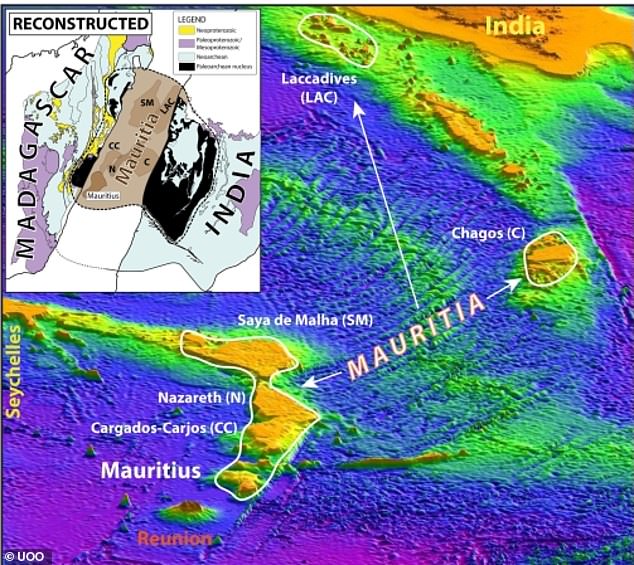
Эрдэмтэд Маврикийн орчимд хийсэн судалгаагаар Энэтхэг болон Мадагаскар салж байх үед үлдсэн эртний тивийн царцдасын хэлтэрхийг олж тогтоов.
Маврикийн эрэг орчмын элснээс 660 саяас 2 тэрбум хүртэлх жилийн настай циркон талстууд олдсон нь судлаачдын анхаарлыг татсан юм. Эдгээр талстууд нь тус арлын галт уулын гаралтай чулуулгийн наснаас хамаагүй хөгшин байгаа нь уг арлын доор эртний тивийн царцдас хадгалагдан үлдсэнийг илтгэж байна. Судлаачид таталцлын хүчний хэмжилт болон тектоник хавтангийн нөхөн бүрдүүлэлтийн аргаар Маврикийн доорх царцдас ердийн далайн царцдасаас илүү зузаан байгааг тогтоосон нь уг таамаглалыг баталгаажуулсан байна.
2013 онд Nature Geoscience сэтгүүлд нийтлэгдсэн судалгаагаар галт уулын магма дээш гарахдаа доорх эртний тивийн материалуудаас циркон талстуудыг хамт авчирсан гэж тайлбарлажээ. Харин 2017 онд Nature Communications сэтгүүлд гарсан дараагийн судалгаагаар далайн эрэг дээрх элснээс бус, харин 5.7 сая жилийн настай галт уулын чулуулгийн дотроос эдгээр эртний талстуудыг олборлосон нь хүний үйл ажиллагаатай холбоотой байж болзошгүй гэсэн өмнөх эргэлзээг үгүйсгэсэн юм. Эдгээр олдвор нь Маврикийн доорх бүтэц нь Мадагаскар болон Энэтхэгийн өмнөд хэсгийн эртний цөмтэй холбоотой болохыг харуулж байна.
Зарим хүмүүс энэхүү нээлтийг домогт гардаг “Лемуриа” тивтэй холбон тайлбарлахыг оролддог ч эрдэмтэд үүнийг шинжлэх ухааны баримт нотолгоогүй гэж үзэж байна. Одоогийн байдлаар Мавритиа хэмээх эртний тивийн үлдэгдлийн хэмжээ болон хэлбэр тодорхойгүй хэвээр байгаа бөгөөд царцдасын хил хязгаарыг тогтоох судалгаа үргэлжилж байна. Энэхүү нээлт нь эртний эх газрын хэлтэрхий хэрхэн салж, далайн ёроолд дарагдан үлдсэнийг ойлгоход чухал ач холбогдолтой юм.
Дэлгэрэнгүйг эх сурвалжаас харах
↓Эх сурвалжийг нээх ↓
Mauritius rose out of the Indian Ocean in black volcanic rock, green mountainous landscapes and white sandy beaches. It is geologically young (in terms of formation) and most likely rose from the sea approximately 9 million years ago due to volcanic activity.
However there are many ancient grains of sand on the beaches of Mauritius. These grains of sand contain zircon crystals which range from 660 million to over 2 billion years in age.
Some of these zircon crystals date back almost 2 billion years.
Scientists used this information along with gravity measurements, plate reconstructions and the mineral dating techniques to show that older, buried fragments of an ancient continents exist beneath the ocean floor.
These are called the remnants of Mauritia.
Many of these ancient pieces of the continent were left behind when Madagascar and India began separating tens of millions of years ago. Then they were buried under layers of newer volcanic rock created as the Indian Ocean expanded.
While some people like to compare this find to the “Lost Continent” of Lemuria, where it is said that a large area of land once existed beneath the Indian Ocean and disappeared from view.
This comparison goes beyond the scientific evidence. While scientists have shown that parts of ancient continents exist beneath the ocean floor and have attempted to reconstruct their break-up, they have not discovered a lost city or provided evidence that Mauritia was the Lemuria of legend.
Ancient Crystals on a Young Island
Zircon is particularly helpful to geologists.
Its unique ability to last for incredibly long periods of time allows geologists to measure its age based on the radioactivity rate of Uranium-lead.
Therefore, when researchers found zircon crystals aged anywhere from 660 million to just less than 2 billion years old in beach sand off Mauritius, they encountered a significant challenge to explain them.
Why would crystals found in 2-billion year-old rocks be located in volcanic rocks only millions of years old?
What the Zircon Grains Revealed
Researchers explored this question in a 2013 study published in Nature Geoscience. They suggested that as magma rose to form new volcanic rocks, it traveled through buried continental materials significantly older than the island of Mauritius.
Along the way, it picked up zircon from those rocks and brought them upwards.

Using uranium-lead (U-Pb) dating methods to determine the age of the zircon, researchers were able to identify zircons greater than 1.97 billion years old and other zircons dated at about 840 to 660 million years old.
Researchers believed that these zircon grains originated from buried older continental lithosphere beneath Mauritius.
These zircons were not the only evidence.
Evidence Beneath the Ocean Floor
Another method for observing what lay beneath the ocean floor came from analyzing gravity data.
From these data sets, researchers were able to estimate the thicknesses of Earth’s crust beneath Mauritius and portions of the surrounding Mascarene Plateau. Their findings indicated that unusually thick crust extended towards the Seychelles.
This finding contradicted expectations for regions consisting entirely of normal oceanic crust. Continental break-up processes provided a plausible solution for this problem.
How Mauritia Was Broken Apart
Based upon plate reconstructions, scientists hypothesized that Mauritius lies atop part of a Precambrian microcontinent, which broke away from Madagascar prior to being deformed into a ribbon-like shape during seafloor spreading events occurring between 83.5 and 61 million years ago.
Much of this older material never remained exposed. Volcanic activity that followed masked it.

Researchers attributed this history to the Réunion mantle plume, a source of volcanic activity beneath the Indian Ocean. They proposed that plume-generated lava both blanketed areas of buried continental crust and provided a conduit through it.
Thus, explaining how extremely old zircon could reach the surface of a much younger volcano-based island.
The Weakness in the First Discovery
However, although the original evidence was convincing, it suffered from one major weakness. The zircon grains had been retrieved from beach sand.
Jérôme Dyment, a geologist at the Paris Institute of Earth Physics who was not involved in the research, posed a possible alternative explanation: that the ancient zircon grains were delivered to Mauritius via human activity (perhaps in ship ballast or building materials), as reported in National Geographic’s coverage of the research.
Older zircon trapped inside rocks from Mauritius would make this a more difficult explanation. Four years later, researchers provided an example that addressed this issue.
A Study Finds Zircon Inside Volcanic Rock
A 2017 study published in Nature Communications presented examples of zircon grains recovered directly from a roughly 5.7-million-year-old volcanic rock referred to as trachyte. The ages of some of these zircon grains ranged from approximately 2.5 billion to 3 billion years.
This time, unlike the previous study, the researchers were extracting zircon grains from solidified volcanic rock rather than individual loose grains they had been gathering from the beaches.
The researchers stated that this result confirmed that ancient continental crust exists beneath Mauritius.

Additionally, they noted that the ages of the zircon grains corresponded with rocks in association with central-eastern Madagascar, approximately 700 km (or roughly 435 miles) west of Mauritius today.
By making this additional correlation, researchers added an additional component to support their plate reconstructions. Authors concluded that fragments represented under Mauritia are likely remnants of ancient geological cores for Madagascar and south India.
Geological Comparison Between Lemuria and Reality
Because a modern remnant of an ancient continent remains beneath the Indian Ocean, comparisons will certainly arise with Lemuria. However, this comparison is largely geographic in nature.
Modern plate tectonic theory accounts for continental crust being broken apart, stretching, submerging and eventually burying beneath volcanically generated deposits.
This is exactly how Mauritia fits into this model.
Unfortunately, researchers cannot confirm or deny any aspect related to Lemuria, including whether or not there was ever a lost civilization located beneath the Indian Ocean.
Moreover, even though researchers now have some evidence for Mauritia’s presence, they do not yet know precisely how large or shaped all the continental fragments classified under this name are.
Specifically regarding the recent study referenced above, authors specifically stated that the extent of these unknowns is considerable, and therefore they continue to classify the boundary conditions as uncertain.
Although much remains unknown about the remnants of an older continent remaining beneath a relatively young volcanic landmass (Mauritius), we know more than we did previously.
Enjoyed this article? Subscribe to our free newsletter for engaging stories, exclusive content, and the latest news.


