Астрофизикчид галактикийн төв дэх оддын бөөгнөрөл болон оддын диск нь бие биеэсээ хамааралгүй бус, харин нэгдмэл үйл явцын үр дүнд бүрэлдэн бий болдгийг илрүүллээ.
Лейбниц дэх Астрофизикийн хүрээлэнгийн (AIP) судлаач Сун Вон Квак болон түүний багийнхан орчин үеийн өндөр нарийвчлалтай гидродинамик загварчлалыг ашиглан галактикийн төв хэсгийн хувьслыг судалжээ. “Astronomy & Astrophysics” сэтгүүлд нийтлэгдсэн уг судалгаагаар галактикийн төв дэх супермассив хар нүхнүүдийг хүрээлэн байдаг цөмийн оддын бөөгнөрөл болон оддын дискүүд нь тусдаа үйл явц биш гэдгийг тогтоосон байна.
SMUGGLE-Ring төслийн хүрээнд хийсэн энэхүү загварчлал нь Сүүн зам шиг саваа хэлбэрийн бүтэцтэй галактикууд хэрхэн хөгждөгийг харуулжээ. Галактикийн төв хэсэгт байрлах оддын “саваа” нь сансрын дамжуулагч бүс шиг үүрэг гүйцэтгэж, хийг төв рүү шахан оддын бөөгнөрөл болон дискийг нэгэн зэрэг тэжээдэг болохыг тогтоосон байна. Энэ үйл явцын явцад үхэж буй оддын супернова дэлбэрэлтүүд нь цочролын долгион үүсгэж, олон тэрбум жилийн турш шинэ оддын үүсэлтийг идэвхжүүлдэг ажээ.
Судалгааны багийнхан хар материйг загварчлалдаа оруулсан нь өмнөх судалгаануудаас ялгаатай шинэлэг тал болжээ. Энэхүү бодит динамик тооцоолол нь оддын баарны эргэлтээс үүдэлтэй “хар ангал”-ын бүсийг илрүүлэх боломжийг олгосон бөгөөд энэ нь од болон хар материйн харилцан үйлчлэлийн нотолгоо болж байна.
Хэдийгээр эдгээр бүтэц нь нэг эх үүсвэрээс тэжээгддэг ч хөгжлийн янз бүрийн үе шатанд хэмжээ болон массын хувьд өөр өөр харагддаг байна. Энэхүү нээлт нь галактикуудын хувьслыг ойлгоход чухал ач холбогдолтой бөгөөд цаашдын одон орон судлалын ажиглалтуудыг тайлбарлахад онолын баттай суурь болж байна.
Дэлгэрэнгүйг эх сурвалжаас харах
Эх сурвалжийг нээх ↓
Understanding the formation and evolution of galactic centers is a major challenge facing astrophysicists. For some time, astronomers have known that the supermassive black holes (SMBHs) at the centers of galaxies and the densely packed nuclear star clusters that surround them play a major role in star formation and other processes. Alas, scientists were still missing some of the pieces of this particular puzzle. By understanding the mechanics that govern galactic centers, scientists will be able to track how the Universe itself has evolved since the first galaxies emerged.
Using a state-of-the-art galaxy simulation, a team led by researchers from Leibniz Institute for Astrophysics Potsdam (AIP) has gained new insights into these processes. Their results, described in a study published in Astronomy & Astrophysics, indicate that nuclear star clusters and stellar discs found in the inner core are not independent processes, as previously thought. These findings are bridging the gap between theory and observation, improving our understanding of how galaxies evolve.
The research was led by SungWon Kwak, a postdoctoral researcher from the AIP. He and his colleagues were joined by researchers from the Observatoire de la Côte d’Azur (OCA), the SNU Astronomy Research Center, the Università di Bologna, the Osservatorio di Astrofisica e Scienza dello Spazio di Bologna, the Kavli Institute for Astrophysics and Space Research at MIT, the University of California, Riverside, Tsinghua University, and the Institut für Physik und Astronomie at the Universität Potsdam.
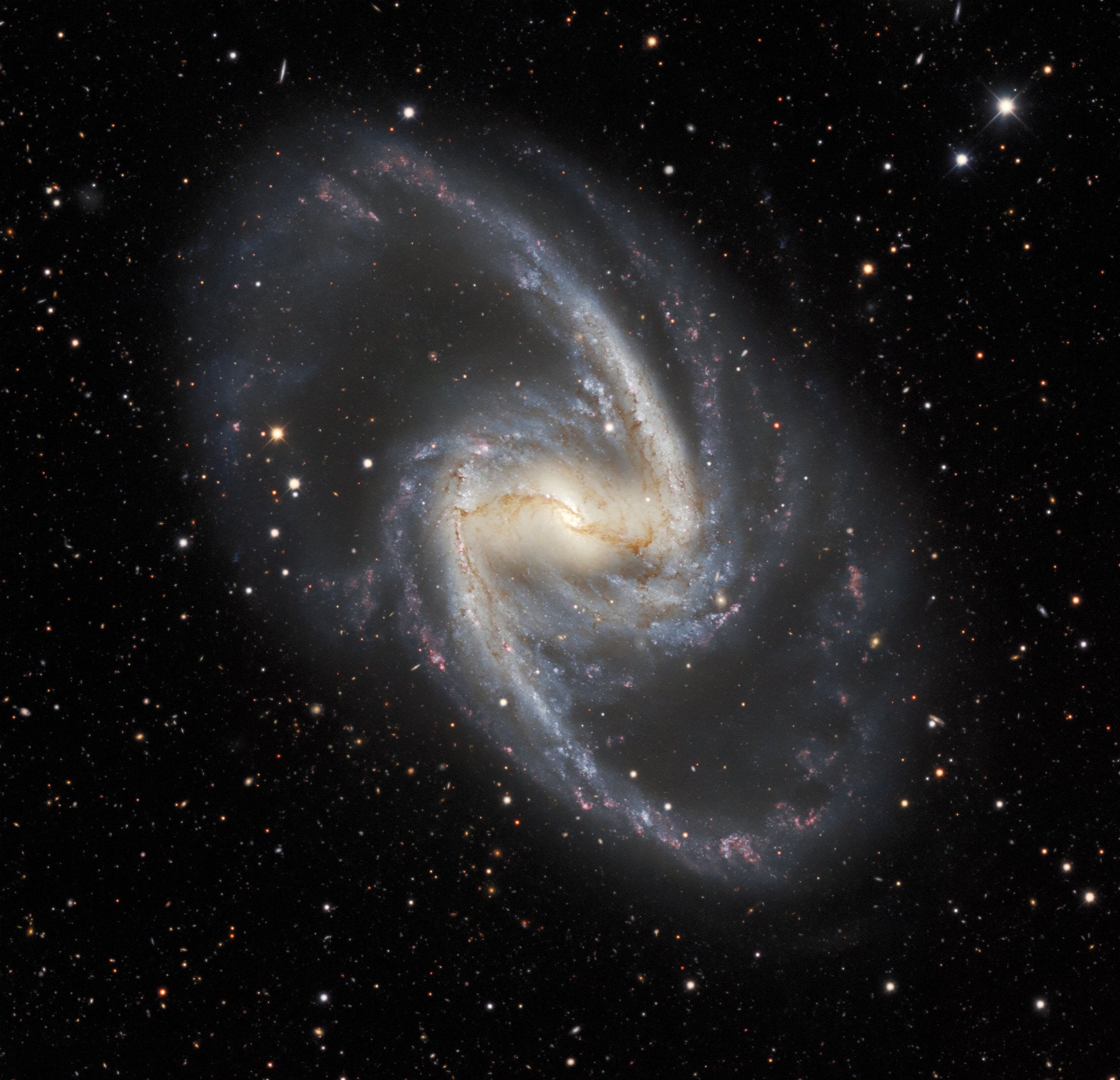
The diffraction spike in the center of NGC 1365 is a telescope artifact caused by an enormous amount of light in a compact region. Credit: NASA, ESA, CSA, STScI, Janice Lee (STScI), Thomas Williams (Oxford), PHANGS Team
The team hoped to learn more about the physical processes that led to the formation of two features that surround the SMBHs at the centers of most galaxies in the Universe: nuclear star clusters and nuclear stellar discs. Such features have been observed for only about a decade in the Milky Way and other galaxies, and were thought to be products of separate formation processes. However, observational surveys found no clear correlation between their masses and sizes, and simulations could not realistically reproduce the processes.
Resolving this mystery is the purpose of the Stellar Feedback in Galaxies and its Effects, or SMUGGLE-Ring, project, an advanced physics framework used in astrophysical simulations to model how stars and stellar feedback shape galaxies. Through their high-resolution hydrodynamical simulation, the team demonstrated that a barred galaxy (like the Milky Way) could naturally form both nuclear star clusters and nuclear stellar discs together, while simulating their growth over billions of years.
For the first time, the simulation directly reveals an evolutionary link between their formation, showing that they grow together. The simulation also shows that the galaxy’s stellar bar plays a central role in this process, funneling gas inward toward the center. As gas accumulates in the center of a galaxy, where the supernovae of dying stars generate shock waves that repeatedly trigger the formation of new stars. Over several billion years, hundreds of millions of solar masses’ worth of stars form in the galactic center.
“Our simulation achieves this by showing how the galactic bar acts like a cosmic conveyor belt, channeling gas inward to feed both structures simultaneously from the exact same reservoir,” explains SungWon Kwak. The results also explain why previous observations failed to find a clear connection between nuclear star clusters and nuclear stellar disks. “The apparent disconnection does not mean that the stars themselves differ fundamentally in age, chemical composition, or motion,” added Dr. Cristina Chiappini, also a scientist from AIP and co-author of the study.
In addition, the simulation showed that the structural relationship between the two processes naturally evolves. During periods of sustained growth, the relative masses and sizes of the cluster and disk begin to differentiate. Despite the shared underlying growth mechanism, the clusters and stellar disks appeared remarkably different when observed at different stages in their evolution. However, the results proved that the dynamics of this co-evolution are even more complex than all that.
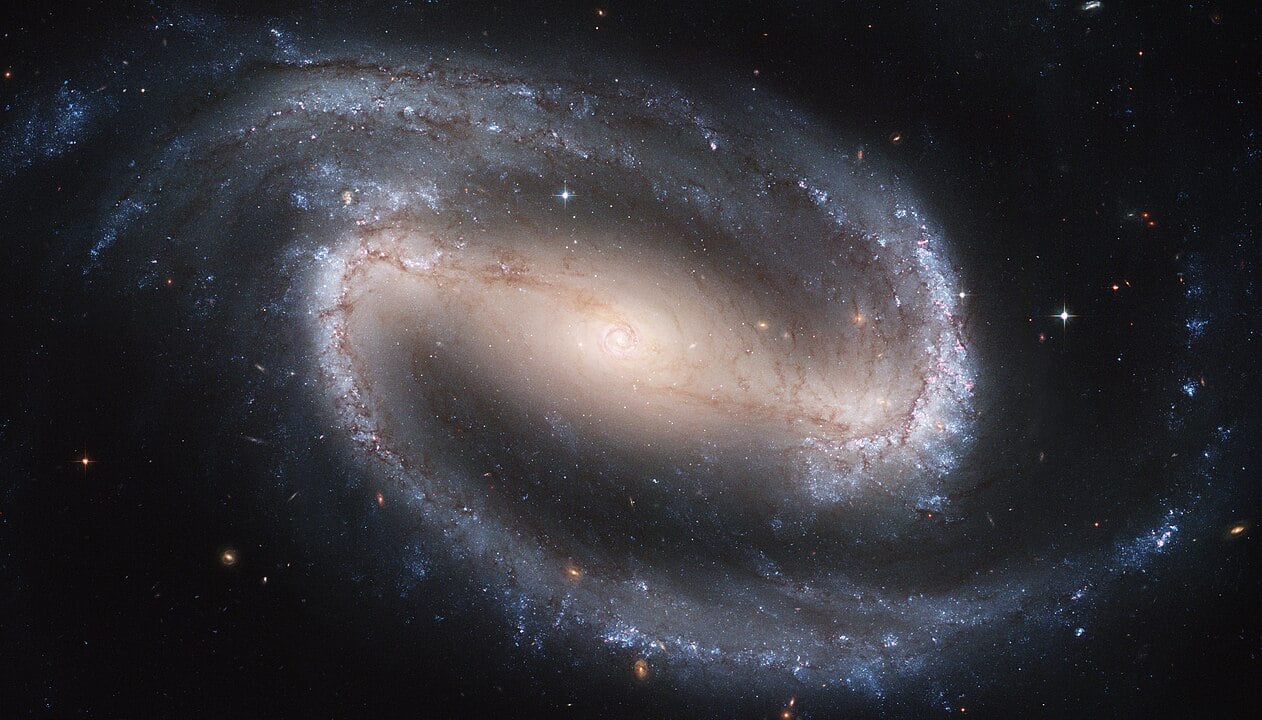 Barred spiral galaxy known as NGC 1300 viewed nearly face-on. It’s thought the Milky Way is a barred spiral like this (Credit: NASA, ESA, and The Hubble Heritage)
At one point in their simulations, a star cluster of 30 million solar masses spiraled into the galactic center and merged with the nuclear star cluster. This was particularly fascinating, since recent observations of NGC 1365 revealed a massive star cluster inside the galaxy’s bar. This cluster is expected to spiral into the galaxy’s center and merge with its nuclear star cluster, causing it to grow in size and mass. This could also affect the mass of the SMBH inside the nuclear star cluster over time.
A key advantage of these types of astronomical simulations is how it allows researchers to observe processes that cannot be seen directly. In addition, simulations allow scientists to monitor the evolution of galaxies over billions of years. From this, they can observe the formation of a galaxy’s stellar bar, trace the inward flow of gas, witness the birth of new stars, and see how the nuclear stellar disk gradually grows outward from the center.
Another interesting part of the team’s simulation was the way they included dark matter, which played a crucial role in the results. As co-author Dr. Ivan Minchev said:
Previous studies rely on fixed background potentials for the galactic bar and dark matter halo, but the realistic dynamical treatment between stars and the dark matter halo using live particles in our model allows us to form a realistic bar that evolves in time and then naturally forms nuclear structures. Furthermore, our model also exhibits a ‘dark gap’ around the bar region, which is found in many observations and is known as evidence of the interaction between stars and dark matter by the rotation of the stellar bar.
These findings could expand our understanding of the connection between galactic components, helping astronomers interpret future observations.
Further Reading: AIP, Astronomy & Astrophysics


