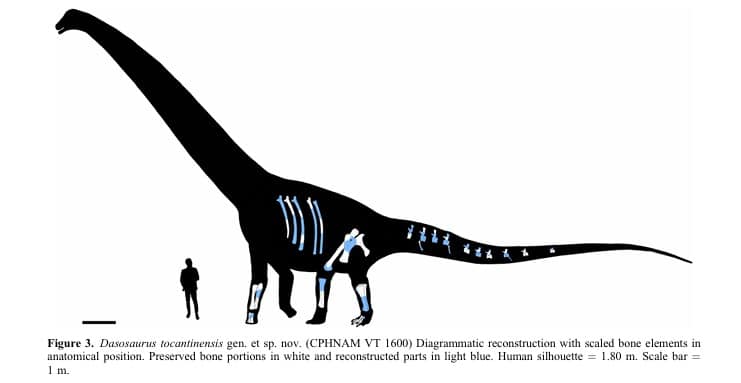
Бразилын Мараньяо мужийн Давинополис хотод төмөр замын терминал барих үед хөрсний найман метрийн гүнээс шинжлэх ухаанд өмнө нь бүртгэгдээгүй аварга том үлэг гүрвэлийн үлдэгдэл олдсон байна.
Барилгын талбайд ажиллаж байсан археологичид эхлээд сүүлийн үеийн амьтны яс гэж таамаглаж байсан ч геологийн тогтоц болон олдворын гүн нь уг амьтан Цэрдийн галавын эхэн үед буюу ойролцоогоор 120 сая жилийн өмнө амьдарч байсныг гэрчилжээ. Dasosaurus tocantinensis хэмээн нэрлэсэн энэхүү 20 метр урттай сауропод үлэг гүрвэлийн олдвор нь Мараньяо мужийн нутаг дэвсгэрээс олдсон хамгийн том олдвор болж байгаа юм. Судлаачид сүүлний нугалм, 1.5 метр урттай дунд чөмөг, хавирга болон мөчдийн ясыг олсон нь тухайн олдворыг харьцангуй бүрэн бүтэн хэмээн дүгнэхэд хүргэжээ.
Эрдэмтдийн хийсэн судалгаагаар Dasosaurus tocantinensis-ийн хамгийн ойрын төрөл зүйл нь өнөөгийн Испанийн нутагт амьдарч байсан нь тогтоогдсон нь гайхшрал төрүүлж байна. Энэ нь эртний Гондвана супер тивийн бүрэлдэхүүнд байх үед уг үлэг гүрвэлийн өвөг дээдэс Хойд Африкаар дамжин Өмнөд Америк тивд нүүдэллэн ирснийг харуулж байгаа аж. Судалгааны багийнхан ясны бичил бүтцэд шинжилгээ хийхэд уг амьтан нь эртний сауроподууд болон титанозавруудын шинжийг хослуулсан өсөлтийн хэв шинжтэй болох нь илэрчээ.
Энэхүү нээлт нь барилгын бүтээн байгуулалт болон палеонтологийн судалгааг уялдуулах шаардлагатайг сануулж байна. Одоогоор Давинополис дахь талбайд үлэг гүрвэлийн үлдсэн ясыг үргэлжлүүлэн малтах ажил хийхээр төлөвлөж байгаа бөгөөд тус олдвор нь тухайн бүс нутгийн эртний амьтдын талаарх ойлголтыг өөрчлөх ач холбогдолтой юм.
Дэлгэрэнгүйг эх сурвалжаас харах
↓Эх сурвалжийг нээх ↓
A construction team building a road-rail terminal in Davinópolis, in Brazil’s Maranhão state, dug into the ground and hit something far older than expected: the bones of a dinosaur that walked the earth some 120 million years ago. Scientists have now named the animal Dasosaurus tocantinensis, a roughly 20-meter-long sauropod whose closest known relative, oddly enough, once lived in what is today Spain.
The discovery, published in the Journal of Systematic Paleontology, amounts to far more than another large dinosaur skeleton pulled from the ground. It forces researchers to reconsider what they thought they knew about the prehistoric animals that once inhabited Maranhão. Specimens of this size and this state of preservation rarely come to light, which is exactly why the team is describing the find as a major discovery rather than a routine addition to the fossil record.
A Giant Unlike Anything Previously Found in Maranhão
Before this discovery, Maranhão’s dinosaur record leaned toward the modest. According to Elver Luiz Mayer, a professor at the Federal University of the São Francisco Valley who helped lead the study:
“It’s the largest known dinosaur for Maranhão, which has other species, but not sauropods like this one; rather, it has smaller ones, such as the diplodocid Amazonsaurus maranhensis, which was about 10 meters long.”
Mayer, whose usual research focus is Quaternary-period mammals, was actually pulled into the project almost by accident: he was contacted in 2021, while working in Pará state, after archaeologists monitoring the Davinópolis site, as required under environmental licensing rules, found bones they initially assumed belonged to more recent megafauna. It was the depth of the find that tipped Mayer off. As he explains it:
“Given its depth of about eight meters, I realized that it was much older. The age of the geological formation was already known from previous research and indicated that it was material from the transition from the Lower to the Upper Cretaceous, about 120 million years ago.”
From there he assembled a multidisciplinary team. The resulting dinosaur specimen, now held at the State Center for Natural History and Archaeology Research in São Luís, is unusually complete. Max Langer, a professor at the University of São Paulo who took part in the study, says:
“Because it includes tail vertebrae, a 1.5-meter femur, ribs, foot bones, and arm and leg bones, this is considered a relatively complete specimen. We believe there are more fossils from this same specimen yet to be excavated at the site.”
An Unexpected Bridge to an Ancient Spain
Perhaps the most striking detail in the study is genealogical rather than anatomical. Dasosaurus tocantinensis‘s nearest known relative lived in the region that is now Spain, then part of a European island chain. Researchers report that the ancestors of the Maranhão species migrated into South America by way of North Africa, sometime between 140 and 120 million years ago, while these landmasses were still fused together within the supercontinent Gondwana.
The dinosaur’ name reflects its home turf rather than its distant cousin: “Daso” comes from the word for “forest,” a nod to the region’s dense woodlands, which early Portuguese colonizers described as a great tangle, “maranhão.” “Tocantinensis” refers to the nearby Tocantins River, close to where the bones were found.

How the Bones Reveal Dinosaur Growth
Bone microstructure analysis, led by researchers Tito Aureliano and Aline Ghilardi of the Federal University of Rio Grande do Norte, found a growth pattern blending traits of older sauropod lineages with features typical of titanosaurs, suggesting some dinosaurs developed their growth mechanisms earlier than previously thought, a clue to how certain species reached such extreme sizes.
Langer notes that construction projects in Brazil can destroy fossil evidence just as easily as they reveal it.
“If we map Brazil’s fossil sites, we’ll see highways and quarries,” he says, stressing that specialized monitoring remains essential but inconsistent. Mayer agrees, calling for closer cooperation between developers and researchers “to reconcile construction projects with federal legislation on fossils.”

Talks are now underway to continue digging at the Davinópolis site, with the rest of Dasosaurus still buried in the ground.
Enjoyed this article? Subscribe to our free newsletter for engaging stories, exclusive content, and the latest news.


Бразилд олдсон 120 сая жилийн үег гүрвэлийн ясыг сонсоод гайхаж байна, энэ их эртний амьтан хэр ийм том байж чадаж вэ? Та энэ тухай юу гэж бодож байна, өөр дэлхийн хаа нэгтээ ийм урт амьтад байсан байж болох юм уу?