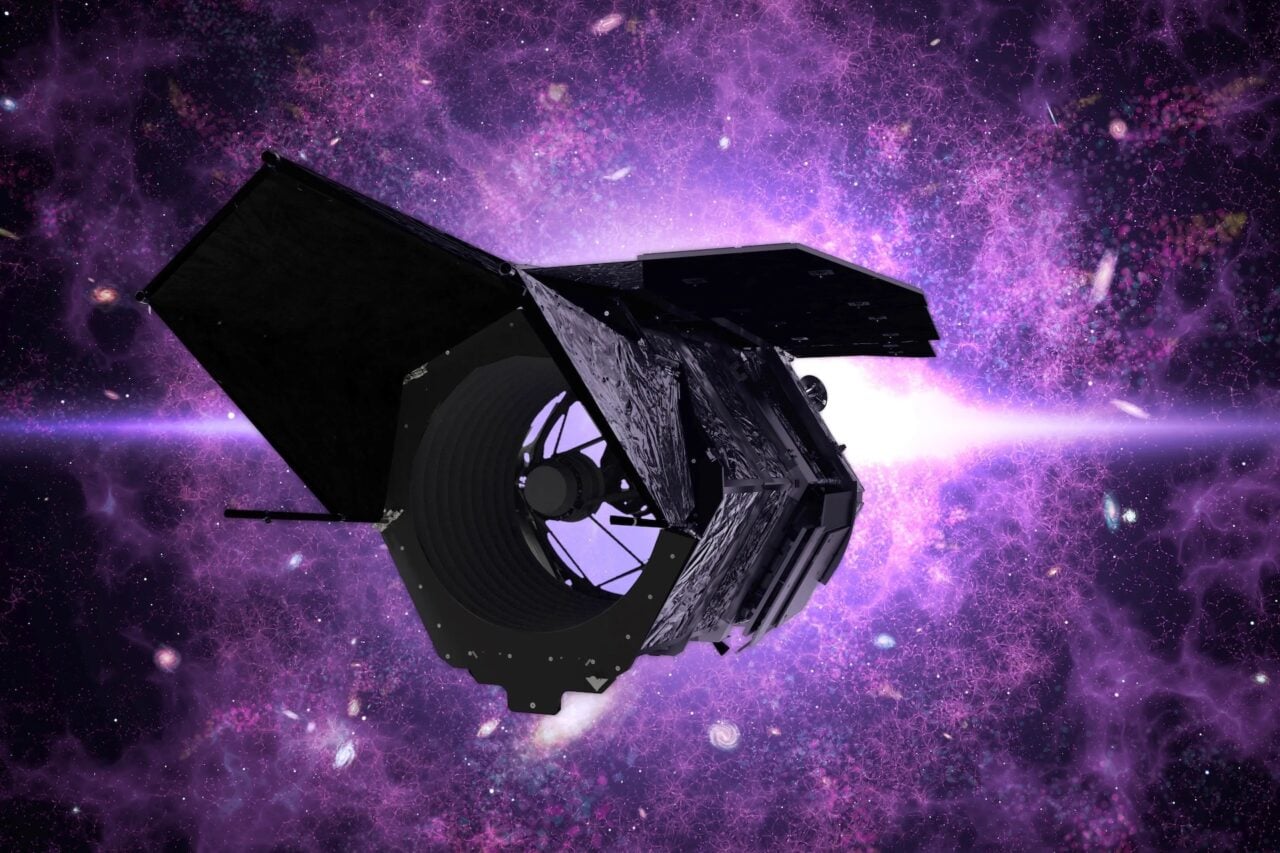
Энэхүү шинэ төхөөрөмж нь Хаббл болон Жэймс Вэбб дурангуудын залгамж халаа болон сансар огторгуйн нууцыг тайлахад чухал үүрэг гүйцэтгэнэ.
NASA-гийн 4 тэрбум долларын өртөгтэй Нэнси Грэйс Романы нэрэмжит сансрын дуран авай (Nancy Grace Roman Space Telescope) ням гарагт Флорида дахь Кеннедийн нэрэмжит сансрын төвөөс SpaceX Falcon Heavy пуужингаар хөөрөхөөр төлөвлөгджээ. Уг дуран авай нь Дэлхийгээс 1.5 сая км-ийн зайд орших Нар-Дэлхийн Лагранжийн хоёр дахь цэгт (L2) байрлаж, сансрын уудам орон зайг ажиглах юм.
Энэхүү дуран нь Хаббл дурангаас 100 дахин илүү өргөн талбайг харах чадвартай, хэт улаан туяаны мэдрэгч бүхий “өргөн өнцгийн” төхөөрөмжөөр тоноглогдсон байна. Түүний үндсэн зорилго нь харанхуй матери, харанхуй энерги болон манай нарны аймгаас гаднах экзопланетуудыг судлахад чиглэнэ. 300 мегапикселийн Wide Field Instrument (WFI) төхөөрөмж нь галактикуудын тархалт, тэдгээрийн хоорондын харилцан үйлчлэлийг нарийвчлан зураглах боломжтой.
Эрдэмтэд уг дурангийн тусламжтайгаар 100 сая одыг олон өдрийн турш ажиглаж, микролинзийн аргаар 2,500 орчим экзопланетийг илрүүлэхээр төлөвлөж байна. Мөн алс холын супернова дэлбэрэлтүүдийг ажиглах замаар орчлон ертөнцийн тэлэлтийн хурдыг хэмжиж, таталцлын сул линзлэх үзэгдлийг ашиглан үл үзэгдэх харанхуй материйн тархалтыг тогтоох юм. Энэхүү судалгаа нь орчлон ертөнцийн хувьсал болон түүнийг бүрдүүлэгч нууцлаг хүчнүүдийн талаарх бидний ойлголтыг цоо шинэ түвшинд гаргах ач холбогдолтой юм.
Дэлгэрэнгүйг эх сурвалжаас харах
Эх сурвалжийг нээх ↓
A revolutionary space telescope is ready to join the ranks of Hubble and Webb, capturing panoramic views of the cosmos to survey millions of galaxies, measure the expansion rate of the universe, and hunt down hundreds of alien worlds.
NASA’s Nancy Grace Roman Space Telescope is set for liftoff on Sunday at 7:26 a.m. ET aboard a SpaceX Falcon Heavy rocket from the Kennedy Space Center in Florida. The launch will be streamed live on NASA’s website, as well as the agency’s YouTube channel. You can also tune in through the feed below.
The $4 billion observatory is equipped with sharp infrared vision, combined with a field of view at least 100 times larger than the Hubble space telescope, according to NASA. Roman is tasked with solving some of the greatest mysteries of the universe: dark matter and dark energy. By surveying massive areas of the sky, the telescope will be able to track how galaxies are distributed throughout the universe and map the invisible dark matter.
Wide-eyed telescope
NASA refers to Roman as Hubble’s wide-eyed cousin. While it has the same sensitivity as Hubble’s cameras, a single Roman image will hold the equivalent detail of 100 pictures from Hubble.
The new observatory has two main instruments: the Wide Field Instrument (WFI) and a Coronagraph Instrument. The 300-megapixel WFI is designed to take extremely sharp images across a huge field and measure very sensitive spectroscopic data.
Like the Webb Space Telescope, Roman captures the universe in infrared light. Webb has a much larger mirror and can look extremely deep into the universe, while Roman can see vast areas of the sky simultaneously.
What is Roman going to do?
Following its launch, the Roman telescope will travel to the second Sun-Earth Lagrange point, or L2, about one million miles (1.5 million kilometers) from Earth. From its high perch, the telescope will have an unobstructed view of the sky while maintaining a relatively stable orientation.
Once it’s up there, Roman has three major scientific missions: investigate dark matter, measure how the universe expands over time, and look for planets beyond our solar system.
Dark matter is the invisible glue that holds the universe together. While it makes up most of the matter found in galaxies and galaxy clusters, scientists are still not quite sure what it is. Since dark matter is invisible, it is nearly impossible to observe. It does, however, take up space and hold mass, so we can see how it interacts with and influences ordinary matter.
Roman will observe how galaxies cluster and how matter bends light through a phenomenon called weak gravitational lensing. The telescope will be used to scan about 12% of the sky high above our galactic plane to look for the lensing effect in millions of distant galaxies. By measuring tiny distortions across those galaxies, Roman may be able to map how dark matter is distributed throughout the universe.
Another mystery that scientists are hoping to resolve using the Roman telescope is the expansion rate of the universe. The universe is expanding at an accelerating rate, and dark energy may be the main culprit speeding it up.
To help gather clues about this mysterious force, Roman will look for supernovae in distant galaxies. The stellar explosions can provide insight into how fast the universe is expanding because they peak at predictable brightness, helping astronomers measure cosmic distances.
Roman will also map how galaxies cluster together in time and space, revealing the potential effects of dark energy. By observing millions of galaxies, the telescope can reveal how the universe evolved over time.
Scientists are also hoping to use the telescope to find an enormous number of worlds beyond our own. Rather than looking at individual nearby stars, Roman will monitor 100 million stars for hundreds of days. The telescope is expected to find about 2,500 exoplanets using a process known as microlensing, using a foreground star to act as a lens.
Its planet-hunting skills are sensitive enough to find planets smaller than Mars and will reveal planets orbiting their host stars at distances ranging from closer than Venus to beyond Pluto, according to NASA. The telescope’s coronagraph is designed to directly image exoplanets by blocking out a star’s light, allowing astronomers to observe much fainter planets.
The Roman space telescope is designed to create an enormous amount of data to help scientists understand how the universe has changed and evolved over cosmic history, providing clues to some of the most vexxing unknowns in astrophysics.


Нэнси Грэйс Романы сансрын дуран хэдий өндөр үнэ хүрсэн ч түүний илүү өргөн, улаан туяаны харагдах чадвар нь бидний орчлонг илүү ихээр ойлгоход туслах шиг байна. Та энэ шинэ дурангийн хамгийн сонирхолтой зорилго нь юу гэж бодож байна вэ? Мөн энэ төсөл бидний амьдралд ямар шинэ нээлтүүд авчрах бол?