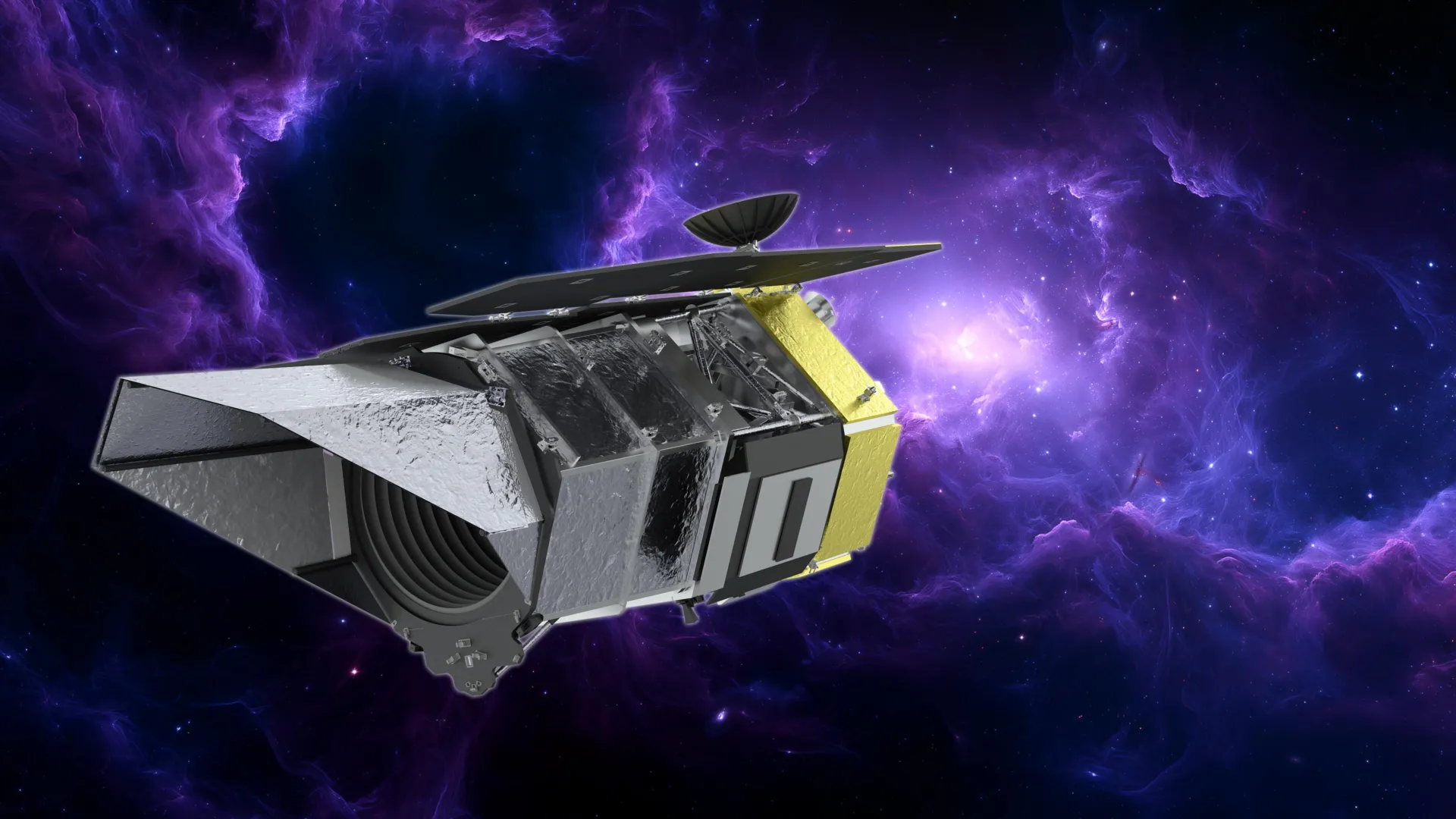
Шинэ үеийн хүчирхэг дуран нь сансар огторгуйн бүтэц болон экзопланетуудыг судлах томоохон дэвшил авчрах төлөвтэй байна.
NASA-гийн Nancy Grace Roman сансрын дуран хөөргөхөд хоёр хоног үлдээд байгаа бөгөөд Жэймс Вэбб дурангийн дараах дараагийн томоохон төсөл болох юм. Энэхүү дуран нь сансар огторгуйн өргөн уудам хэсгийг богино хугацаанд ажиглах зориулалттай бөгөөд 2027 оны нэгдүгээр сараас шинжлэх ухааны үйл ажиллагаагаа эхлүүлэхээр төлөвлөж байна. Hubble дуран 30 гаруй жилийн турш шөнийн тэнгэрийн ердөө 0.1 хувийг ажигласан бол Roman дуран нь ижил нарийвчлалаар бүх тэнгэрийг бүрхэх боломжтой юм.
Аризоны их сургуулийн судлаачид харанхуй матер болон харанхуй энергийн нууцыг тайлахад голлох үүрэг гүйцэтгэнэ. Кинематик линз гэх мэт шинэ аргачлалыг ашиглан эдгээр үл үзэгдэх бүрэлдэхүүн хэсгүүдийн орчлон ертөнцийн тэлэлтэд үзүүлж буй нөлөөг судлах юм. Энэхүү судалгаа нь галактикуудын байршил, шинж чанарыг тодорхойлж, орчлон ертөнцийн хувьсал хөгжлийг зураглахад чиглэнэ.
Дурангийн Coronagraph Instrument хэмээх багаж нь оддын хурц гэрлийг хааж, эргэн тойрон дахь экзопланетуудыг шууд дүрслэх чадвартай. Энэ нь одоо ашиглагдаж буй сансрын дурангуудаас 100-1000 дахин илүү хүчин чадалтай бөгөөд ирээдүйд амьдрал орших боломжтой ертөнцүүдийг эрэх “Habitable Worlds Observatory” төслийн чухал шат болох юм.
Шинжлэх ухааны үйл ажиллагаа эхэлсний дараа цуглуулсан өгөгдлүүд нь олон улсын судлаачдын хүртээл болох бөгөөд хар нүх, галактик үүсэлт, сансрын тоос зэрэг олон чиглэлээр судалгаа хийх боломж бүрдэнэ. Аризоны их сургуулийн баг NASA-гаас батлагдсан есөн тусдаа судалгааны ажлыг удирдан явуулахаар бэлтгэж байна.
Дэлгэрэнгүйг эх сурвалжаас харах
↓Эх сурвалжийг нээх ↓
NASA’s Nancy Grace Roman Space Telescope is now just two days from launch, marking the arrival of the agency’s next flagship astrophysics mission after the James Webb Space Telescope. University of Arizona faculty and students will be watching from Cape Canaveral as Roman begins its journey toward science operations, which are expected to start in January 2027.
Unlike Webb, which was built to study relatively small regions of the universe in extraordinary depth, Roman is designed to survey vast areas of the sky quickly. Both observatories can detect infrared light, giving astronomers the ability to compare and combine their observations. Used together, the two missions could reveal far more about the universe than either telescope could on its own.
A Hubble-Sized Mirror With a Much Wider View
Roman has a 7.9-foot primary mirror, the same diameter as the Hubble Space Telescope’s, along with two major scientific instruments. Its Coronagraph Instrument will block and filter the light from stars so astronomers can study exoplanets and disks around them. Its Wide Field Instrument is designed to match the sensitivity of Hubble’s cameras while imaging an area 100 times larger.
Over more than 30 years, Hubble has observed roughly 0.1% of the night sky. Roman, by comparison, has the potential to survey the entire sky at the same resolution.
That wide view will allow Roman to find rare objects both close to Earth and across enormous cosmic distances. Scientists expect it to capture dying stars, newly discovered worlds, galaxy clusters and many other targets. University of Arizona researchers will contribute to several major areas of Roman science.
Probing Dark Matter and Dark Energy
One of Roman’s main scientific goals is to investigate dark matter and dark energy, two mysterious components that account for nearly all of the universe. Dark matter exerts gravity but does not give off light, while dark energy is associated with the accelerating expansion of the universe.
NASA selected the U of A’s Arizona Cosmology Lab to support two efforts aimed at better understanding these phenomena, including one wide-field science team and one project infrastructure team.
Elisabeth Krause, a professor of astronomy and physics, leads the wide-field science team “Kinematic Lensing with the Roman Space Telescope.” The group received $2 million to develop a cosmological measurement technique known as kinematic lensing.
By combining Roman images with spectroscopic measurements, the researchers hope to study dark matter and dark energy with greater precision than has previously been possible.
Another U of A group will play a leading role in the multi-institutional project infrastructure team “Maximizing Cosmological Science with the Roman High Latitude Imaging Survey.” Tim Eifler, a professor of astronomy and physics, leads the working group responsible for interpreting Roman’s cosmological observations.
Turning Galaxy Surveys Into a Map of the Universe
Roman will identify galaxies across a wide range of distances, determine where they are located, and measure their characteristics. Astronomers will use those observations to build large catalogs and then apply physical models to determine what those catalogs reveal about the structure and evolution of the universe.
Those calculations will require substantial computing power. The NASA Roman Project awarded Eifler’s lab $800,000 for computing resources that will become part of a new university-wide high-performance computing system scheduled to arrive this fall. The lab will also receive another $2.4 million over five years to carry out the science.
“This infrastructure will take us from catalogs to cosmological interpretation,” Eifler said. “We’ll be able to do things like determine how much dark energy and dark matter are in the universe.”
Eifler also serves as co-chair of the cosmology group, which includes more than 1,000 scientists around the world.
“It’s fantastic to rally the community and to organize us around this science case,” he said. “This really is a dream job.”
Directly Imaging Distant Planets
Roman’s Coronagraphic Instrument will use masks, prisms, detectors, filters, and self-flexing mirrors to demonstrate technologies capable of suppressing starlight. By reducing the overwhelming glare of a host star, astronomers can directly image nearby planets and disks that would otherwise be extremely difficult to see.
Direct imaging represents an important step forward in exoplanet science. Nearly all known exoplanets have been discovered indirectly, including through methods that detect the slight drop in a star’s brightness when a planet passes in front of it.
Roman’s coronagraph will instead help astronomers search for planets by blocking the glare from their stars. The instrument is expected to detect planets that are 100 million times fainter than their host stars, a performance 100 to 1,000 times better than existing space-based coronagraphs.
“It will be a crucial pathfinder for a future Habitable Worlds Observatory,” a recommended telescope that would be specifically designed to search for signs of life in other solar systems, said Schuyler Wolff, an associate research professor of astronomy leading the observation planning working group for the Coronagraph Instrument.
Preparing Roman’s Exoplanet Observations
Lunar and Planetary Laboratory director Mark Marley, associate professor of astronomy Ewan S. Douglas, Steward Observatory assistant research professor Ramya Anche, and astronomy postdoctoral research associate Justin Hom also helped develop the Coronagraph Instrument. They will participate in future science through the observation planning working group.
Marley, together with LPL associate professor Ty Robinson and LPL postdoctoral research associate Zarah Brown, will use Coronagraph Instrument data to study the atmospheres of planets beyond our solar system.
Brown has been modeling the climates and spectra of self-luminous giant planets. These worlds are often young and hot enough to emit their own thermal infrared light.
The model predicts atmospheric temperature, composition and clouds, along with the infrared spectrum each object should produce. Those predictions are especially important because most of these planets have never been observed at these wavelengths.
“That predicted spectrum is critical for planning,” Brown said. “Roman’s coronagraph is working with extremely faint, high-contrast targets, so the team has to schedule enough observing time to detect a candidate without burning more of the mission’s limited time than necessary.”
Anche’s team is examining the structure of extrasolar systems, while Hom is leading efforts to identify the best stars for calibrating the Coronagraph Instrument. Hom also leads precursor observing programs with ground-based telescopes, work that is essential for confirming which targets should be selected for future Roman science programs.
Roman Science Begins in January 2027
Once Roman begins science operations in January, its data will be made available to researchers across the scientific community.
The U of A will lead nine NASA-approved investigations using Roman data, bringing in more than $2 million in funding. Researchers will use those observations to investigate additional topics including supermassive black holes, gravitational lenses, galaxy formation, reionization and cosmic dust.

