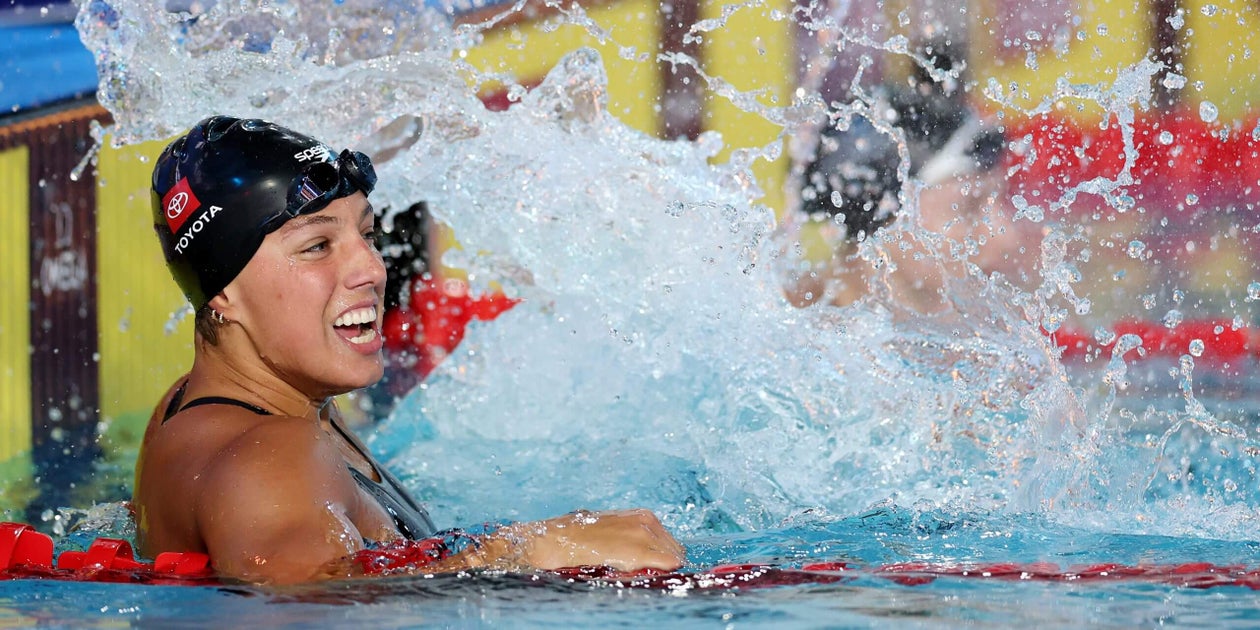
NHL-ийн ирээдүйтэй тоглогчоор нэрлэгдэж байсан Маккензи Сироки хоккейн карьераа орхиж, АНУ-ын усанд сэлэлтийн шигшээ багийн төлөө өрсөлдөхөөр болжээ.
Миннесота-Дулутын их сургуулийн хоккейн багт элсэхээр тохиролцоод байсан Маккензи Сироки 2023 оны долоодугаар сараас эхлэн усанд сэлэлтийн спортод бүрэн шилжсэн байна. Тэрээр 2026 оны наймдугаар сард Ирвин хотод болсон Пан Номхон далайн аварга шалгаруулах тэмцээний 100 метрийн мэлхий сэлэлтийн төрөлд түрүүлж, 50 метрийн зайд мөнгөн медаль хүртжээ. Түүний үзүүлсэн цаг нь тухайн оны дэлхийн чансааны хоёрдугаарт бичигдэх амжилт юм.
Өсвөр насандаа Детройтын ойролцоо хоккейн спортоор хичээллэж, Павел Дацюкийн тоглолтыг шүтэн биширдэг байсан Сирокиг дасгалжуулагчид нь талбай дээрх хөдөлмөрч чанар болон гоол оруулах мэдрэмжээр нь үнэлдэг байв. Тэрээр 2021 онд АНУ-ын 18 хүртэлх насны шигшээ багийн бэлтгэлд уригдаж байсан ч сүүлийн жилүүдэд усанд сэлэлтийн төрөлд өндөр амжилт гарган, АНУ-ын олимпын багт багтах гол найдваруудын нэг болжээ.
Түүний усанд сэлэлтийн дасгалжуулагч Мэтт Кредич тамирчныг хоккейн спортын өвөрмөц дадал, тэсвэр тэвчээрийг усан спортод амжилттай нэвтрүүлснийг онцолсон байна. Сироки одоо Теннессийн их сургуулийн багт хичээллэж байгаа бөгөөд 2028 оны олимпын наадамд оролцохоор шаргуу бэлтгэж байна.
Дэлгэрэнгүйг эх сурвалжаас харах
↓Эх сурвалжийг нээх ↓
IRVINE, Calif. — When McKenzie Siroky touched the wall and saw her time, the doubts born of a massive risk flooded through her. A year earlier, she was committed to play ice hockey for Minnesota-Duluth, the defending NCAA runner-up. Now, in July 2023, she was at her first swim meet in a 50-meter pool, set to take a gap year to train for Olympic Trials, and keenly aware of all she’d given up for goals that now felt foolish.
Racing in a competition at Eastern Michigan University, Siroky finished her 100-meter breaststroke in the morning preliminaries in 1:10.88, short of the 1:10.23 time required to qualify for Trials and far slower than what she’d need to for a chance at making the national team. Used to shorter 25-yard pools — the standard size for high school competition — she had approached the race like a sprint. Siroky felt her biceps burning as the race went on, and her stomach cramped afterward. This was pain she was unaccustomed to in a pool — all for a time not even close to what she needed.
How an Olympic swimming hopeful got her start in hockey
Peter Baugh and Lauren Morales-Jones
She cried in the hallway upon leaving the pool deck. She called her aunt, lamenting her decision to move on from hockey. The idea of trying the race again in that evening’s finals felt like too much.
Wanting to get away, Siroky and a teammate drove 30 minutes back to her hometown of Livonia, Mich., and stopped for brunch. As Siroky prepared to order, she noticed a man in a white USA Swimming shirt. On the back, written in black marker, was a note and autograph from 1996 Olympic gold medalist swimmer Sheila Taormina. The former Olympian, coincidentally, had been best friends with Siroky’s late mother, Michele, who died of brain cancer in 2017.
“Never give up on your dreams!” the note read.
“It was a sign from my mom,” Siroky says now. “One hundred percent.”
Siroky phoned Taormina and told her about the shirt and her difficult morning. They talked through a strategy for finals: Build through the race rather than try to sprint. Siroky followed that plan, and her time dipped to 1:09.14, more than a second under the Olympic Trials cut.
“Ever since then, I haven’t doubted,” she says.
Now 21, Siroky has emerged as the top women’s sprint breaststroker in the U.S. and one of the best in the world. At August’s Pan Pacific Championships in Irvine — Team USA’s biggest meet of 2026 — she won the 100-meter breaststroke and took silver in the 50, a race set to debut on the Olympic stage in 2028. Her times in each event rank her as the second fastest in the world this year.
Heading into her junior year at Tennessee, Siroky not only has a chance to make the next U.S. Olympic team but could also medal, as an individual and as part of the Americans’ 4×100 medley relay team. With 2016 Olympic gold medalist Lily King retired and 2021 gold medalist Lydia Jacoby missing qualification in 2024, Siroky isin position to become the new face of American breaststroke, despite only being a full-time swimmer for less than four years.
“I think it’s exciting just to see her results if you take it in a vacuum,” says Greg Meehan, the USA Swimming national team director. “But I think when you really understand the results and how little background she has, her ceiling is almost unlimited.”
Siroky’s successful pivot from a college prospect on the ice to an international presence in the pool is unprecedented. Through it all, she’s carried her mother with her — and brought her own hockey flair to a very different sport.
Sitting in a VIP tent and overlooking the Woollett Aquatics Center pool, where she would win relay gold at Pan Pacs later that August evening, Siroky pulled out her iPhone and opened it to a folder titled “sports vids.” It didn’t take her long to find what she was looking for: a clip of her in a shootout, copying one of Pavel Datsyuk’s moves to perfection.
“It worked every time,” says the ex-winger, who used to watch highlights of the Hall of Famer before her games.
Growing up near Detroit, Siroky and her siblings loved Datsyuk and the Red Wings, but they spent far more time playing the sport than watching. In the Michigan winters, they would skate on the frozen creek behind their house or do skill work on patches of black ice in the driveway. Some of Siroky’s favorite childhood memories involve honing her shot with her three older brothers.
“Our parents would literally have to beg us to come inside,” she says.
Siroky’s interest in her favorite sports stems from her family. Her mom — a breaststroker and freestyler — swam at Michigan State. Siroky’s uncles, meanwhile, played hockey, with her three older brothers following suit. Siroky was on a team by early elementary school.
Hockey became Siroky’s focus, with swimming only a factor during summer and high school seasons. She describes herself as maniacal on the ice, unafraid of battling for pucks in the corners.
“She was good around the net, had a scoring touch,” said David Mitchell, who coached Siroky at Stevenson High School, where she played on the boys team her junior and senior years. “She earned the respect of her teammates by how hard she worked.”
McKenzie Siroky was a Minnesota-Duluth commit for hockey, playing in camps alongside future Olympians, before giving it up for swimming. (Junfu Han / USA Today Network)
Siroky made it onto Team USA’s radar for the Under-18 World Championship roster, receiving an invite to a 2021 camp used to evaluate players. She did not make the final roster, but many of her competitors at the event went on to make the 2026 U.S. Olympic team that won gold. Her locker was next to Tessa Janecke, who had five points in seven games in Milan.
In the years since she moved on, even as her swimming has led her to new heights, Siroky misses her old sport. She keeps a stick and gear in her Tennessee apartment. Once she even went to an open skate near campus.
“Every time I went to the rink (growing up), it was just somewhere where my heart was happy,” she says. “I never got to the rink and felt like I wasn’t at peace.”
She appreciated that every hockey game was different, a new outlet for creative plays and unique outcomes. Swimming, meanwhile, is built on repetition — a 100 breaststroke is always the same distance and takes a similar amount of time to complete.
Then there’s the dressing room. Siroky loved the camaraderie before a game, how she could chat with teammates while throwing on gear: “Armoring up,” she calls it. She finds the nervous energy as swimmers try to squeeze into tech suits far less fun.
The different environment makes her enthusiasm jump out. After winning the 100 breaststroke at Pan Pacs, she threw her arms into the pool with glee, causing a mini tidal wave in her lane. “Let’s go!” she yelled, then flexed her left arm as she looked toward the Team USA family section, where her grandmother, brother and younger sister cheered. A few minutes later, talking to reporters, Siroky said she wanted “to get out and rip a hockey celly, but I don’t have a stick.”
As Matt Kredich, her coach at Tennessee, says: “It’s not hard to know that she’s a hockey player.”
On Dec. 2, 2022, Kredich received an email from Taormina, the Sirokys’ family friend and ex-Olympian.
“Wanted to touch base with you to let you know about a swimmer in Michigan who’s a hidden gem,” wrote Taormina, a multi-sport star herself, having followed up her Olympic swimming gold by competing in Olympic triathlon (2000 and 2004) and modern pentathlon (2008).
Siroky’s times in short-course (25-yard) pools suggested she could make Olympic Trials if she tried long-course (50 meters) events, the format for major international competition. After her senior high school swim season, she decided it was time to see. She decommitted from Duluth.
Siroky was fast enough for Tennessee to recruit her, but she hadn’t reached times that typically earned full scholarships from the program, Kredich says. The fact that she had never trained year-round — as well as the tip from Taormina — made it easy for the coach to make an exception.
“We, in some ways, took a chance on her,” he says. “But it was a very educated guess.”

“When you really understand the results and how little background she has, her ceiling is almost unlimited,” Greg Meehan, USA Swimming’s director, says of Siroky. (Maddie Meyer / Getty Images)
Siroky took a gap year after finishing high school to acclimate to full-time swimming. She trained for the 2024 Olympic Trials with her high school coach in Michigan, then finished seventh at the meet, establishing herself as a swimmer on the rise.
“Any doubts that I might have had were long gone by then,” Kredich says.
To Meehan, watching Siroky learn how to win “is probably more important” than times themselves. She did that at Pan Pacs, out-touching Tang Qianting — who won three medals at the 2024 Olympics — to take first in the 100 breaststroke, then delivering a massive relay split in the Americans’ victorious medley relay.
Kredich, who has worked with Siroky for two college seasons, sees someone with frequent opportunities to learn and improve. In his words, “she has 10 percent or less of the experience of most of the people that she’s competing against.”
Away from the pool, the swimmer and coach connected quickly. Both have dealt with unconscionable losses: Siroky with her mother and Kredich with his son Ben, who died at age 24 in August 2023 after being struck by an impaired driver. Those loved ones are a frequent source of conversation.
“For both of us, we believe the relationship we had with our loved one didn’t end the day that they died,” Kredich says. “We need to tell their stories and bring them to life.”
Adds Siroky: “That’s the power Matt and I can share with each other.”
As she entered the competition area ahead of the 50-meter breaststroke at Pan Pacs, Siroky didn’t make a beeline to the starting blocks. Instead, she galloped along the wall of spectators, high-fiving fans as if she were celebrating with hockey teammates after a goal.
She says she wishes she could enter wearing a hockey helmet and gloves. Her younger sister, Andrea, says the family has discussed preparing custom Siroky hockey jerseys to cheer her on at the 2028 Olympic Trials. That feels fitting for someone whose hockey energy still burns strong.
“She brought that here (to swimming),” says Barbara McKenzie, Siroky’s grandmother. “Everyone is so solemn, and here’s McKenzie, jovial and everything.”
When she arrives at the pool, she sits quietly, headphones in, and visualizes her plan for the day. Sometimes before races, she incorporates her old hockey hand-eye coordination warm-ups — juggling and tossing a lacrosse ball against a wall — to get her mind and body in sync.
Siroky also takes out boxing gloves before her races and punches a kickboard, held by a coach, to help herself feel explosive. Meehan, asked to assist once at Pan Pacs, nearly stumbled the first time Siroky’s gloves, moving together as if doing the breaststroke, hit the board.
Even in the sharp movements and brash entrances, there’s room for serenity. Siroky prays before every race for her own health and for those around her. While walking to her lane, she crosses herself and points to the sky. She takes three deep breaths — straight from her belly, just as her mom taught her — before climbing onto the blocks.
She stands tall, gazes over the water and makes time for one final breath. Then, when the starting buzzer sounds and she launches forward, she feels calm.

