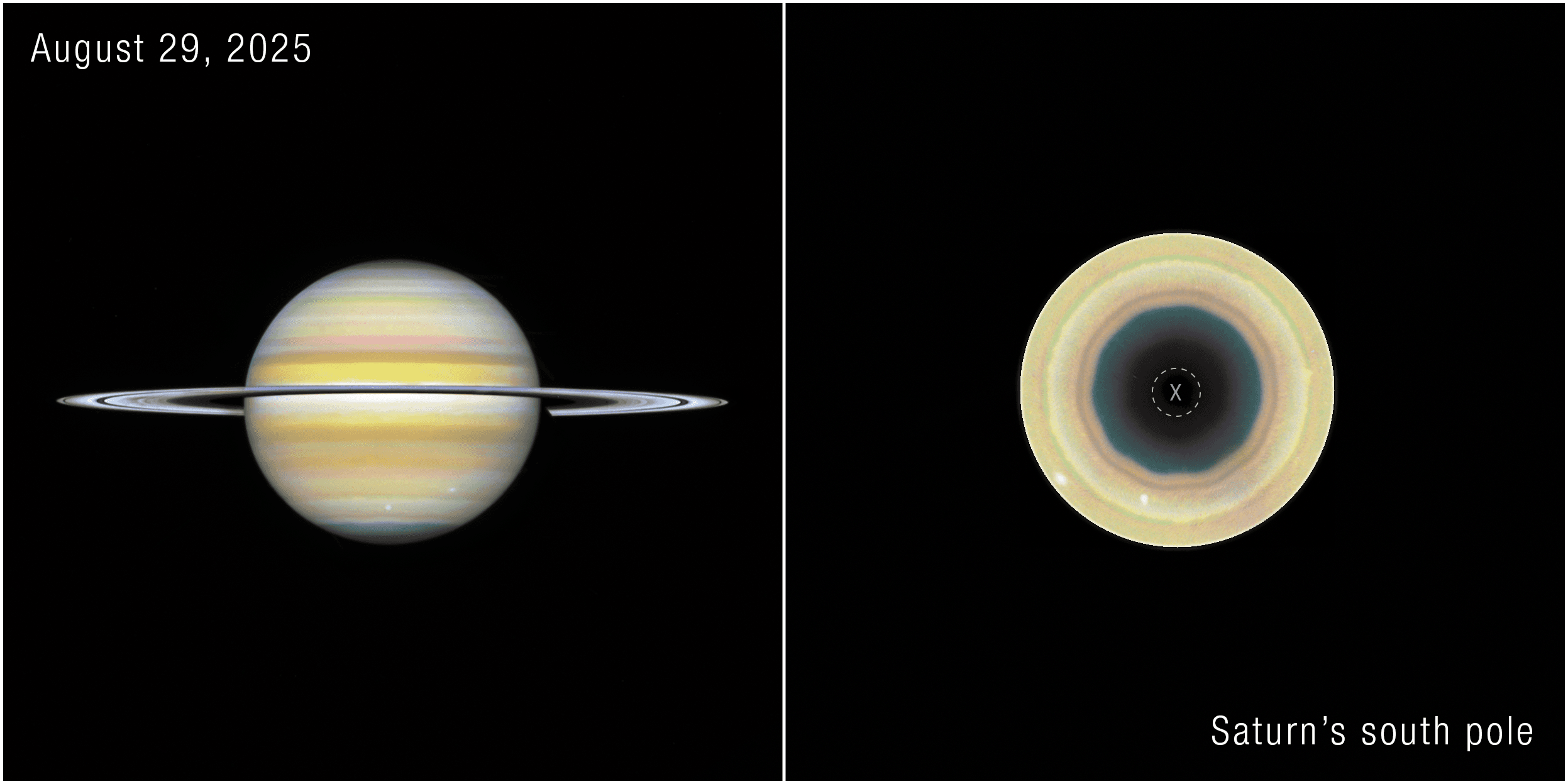
Одон орон судлаачид Санчир гаргийн өмнөд туйлын бүсэд агаар мандлын сонирхолтой полигон тогтоцыг ажигласнаа Science Advances сэтгүүлд нийтэлжээ.
Олон улсын судлаачдын баг Hubble Space Telescope-ийн тусламжтайгаар Санчир гаригийн өмнөд туйл орчимд арван тал бүхий “декагон” буюу арван өнцөгт дүрсийг илрүүлсэн байна. Тус гаригийн хойд туйлд 44 жилийн өмнөөс ажиглагдсан алдартай зургаан өнцөгт дүрстэй төстэй энэхүү тогтоц нь үүлэн давхаргын ер бусын хэв маягийг харуулж байна. Санчир гариг нь хатуу гадаргуугүй тул энэхүү дүрсүүд нь хатуу биет бус, харин агаар мандлын үзэгдэл болох нь тогтоогджээ.

Шинээр илэрсэн декагоны тал бүр нь ойролцоогоор 16,800 километр урттай буюу Дэлхий ван гаригийн диаметрээс ч том хэмжээтэй байна. Уг бүсэд секундэд 116 метр хурдлах хүчтэй тийрэлтэт урсгал ажиглагдсан хэдий ч, декагон хэлбэрт дүрс нь секундэд ердөө 2.5 метрийн хурдтайгаар шилжиж байгаа нь эрдэмтдийн анхаарлыг татаж байна. Энэхүү тогтоцыг 2023 оны зургуудаас улбаалан 2025 он хүртэлх ажиглалтын мэдээлэлд үндэслэн баталгаажуулжээ.
Эдгээр геометрийн дүрсүүд хэрхэн үүсдэг талаарх шинжлэх ухааны нэгдсэн тайлбар одоогоор гараагүй байна. Гэхдээ судлаачид эдгээрийг хүчтэй тийрэлтэт урсгалаар хязгаарлагдсан, агаар мандлын асар том долгионуудын илрэл байж болзошгүй хэмээн таамаглаж байна. Энэхүү үзэгдлийг далайн эрэг дагуух долгионтой зүйрлэж болох бөгөөд агаар мандлын хийн долгионууд нь гаригийг бүсэлсэн тийрэлтэт урсгалын нөлөөгөөр ийнхүү хэлбэржин тогтдог байх магадлалтай юм.
Дэлгэрэнгүйг эх сурвалжаас харах
↓Эх сурвалжийг нээх ↓
A team of astronomers discovered a strange polygonal atmospheric structure on Saturn near the planet’s south pole. This 10-sided shape, known as a decagon, joins one of the gas giant’s most famous features: a hexagon near the north pole that was first observed 44 years ago. Images of the new decagon were captured by the Hubble Space Telescope, and the discovery was recently published in the journal Science Advances.
The formations at both the north and south poles aren’t solid structures, like a wall or a rock formation. Saturn doesn’t even have a defined solid surface like Earth’s crust. If you were to descend through the atmosphere of the ringed planet, the pressure and density would progressively increase, but you would never reach a “ground” on which to land. Instead, what astronomers have witnessed are patterns formed by clouds, albeit very unusual ones.
Each side of the decagon measures approximately 16,800 kilometers, which is a few thousand miles longer than the diameter of Earth. Near the feature is a jet stream reaching speeds of 116 meters per second, or nearly 260 miles per hour. By way of comparison, a Category 5 hurricane—the most intense storm level possible on Earth—is defined by winds above 157 miles per hour. Interestingly, although the jet stream circulates at tremendous speed, the decagon pattern shifts at a mere 2.5 meters per second—less than 6 miles per hour.
The south pole feature appears to have formed recently. For decades, scientists have been searching for a counterpart to the famous northern hexagon. However, major missions that observed the planet have previously not been able to find an equivalent, long-lasting structure in the south. The search was further complicated because, due to Saturn’s tilt, its southern hemisphere was not clearly visible from Earth for many years.
The first clues of the decagon came from ground-based observations, some by amateur astronomers. As the images accumulated, it became evident that something strange was happening in Saturn’s southern cloud bands. Data from the Hubble Space Telescope made it possible to trace the pattern back to images taken in 2023. Monitoring continued, and by 2025 its 10 vertices had become much more clearly defined, confirming the presence of a new polygonal feature in the ringed planet’s atmosphere. Science, however, hasn’t settled on an explanation for how these structures came to be.
Various hypotheses have been proposed since the discovery of the north polar hexagon. One is that the polygons are the visible manifestations of enormous atmospheric waves confined by powerful jet streams. You can think of these as similar to ocean waves, which are not simply objects traveling across the ocean but rather disturbances propagating through the water.
A wave’s behavior changes depending on the space in which it moves and the boundaries it encounters. On Saturn, waves of atmospheric gases may be encountering jet streams that confine them, in a sense, like the edge of a beach. Except in this case, the “beach” wraps all the way around the planet.

