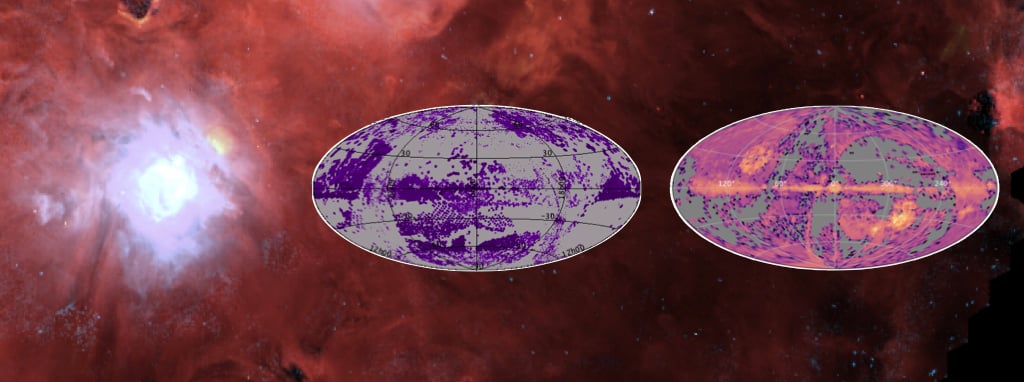
Энэхүү шинэ мэдээллийн багц нь олон улсын хамтарсан судалгааны хүрээнд од, галактик болон хар нүхнүүдийн талаарх өмнө байгаагүй дэлгэрэнгүй мэдээллийг шинжлэх ухааны нийгэмлэгт нээлттэй болгож байна.
Sloan Digital Sky Survey (SDSS) төсөл нь сансар огторгуйн олон спектрт дүрслэл болон спектроскопийн судалгааны 20 дахь (DR 20) багц мэдээллийг олон нийтэд танилцууллаа. Энэ нь SDSS-V үе шатны гурав дахь томоохон нийтлэл бөгөөд дэлхийн хоёр хагас бөмбөрцөгт хийгдсэн олон долгионы урттай, олон үе шаттай ажиглалтын үр дүнг нэгтгэжээ. Судлаачид энэхүү мэдээллээр дамжуулан оддын тогтоц, од хоорондын орчин болон алс холын галактикуудын физик процессыг илүү нарийвчлалтай судлах боломжтой болж байна.
Шинэ багцад 2025 оны хоёрдугаар сарын 2-ныг хүртэлх хугацаанд цуглуулсан спектроскопийн мэдээллүүдийг багтаасан бөгөөд үүнд өмнөд хагас бөмбөрцгөөс авсан анхны оптик спектрүүд багтаж байна. Түүнчлэн SPIDERS хөтөлбөрийн хүрээнд рентген цацраг ялгаруулдаг идэвхтэй галактикийн цөм, галактикийн бөөгнөрөл болон идэвхтэй оддын олон зуун мянган тодорхойлолтыг eROSITA сансрын дурангийн судалгаатай уялдуулан нийтэлжээ.
Black Hole Mapper (BHM) болон Milky Way Mapper (MWM) төслүүдийн хүрээнд 500,000 орчим хар нүх болон 1.5 сая одны 3 сая гаруй спектрийн мэдээллийг шинэчилсэн байна. Үүнээс гадна Local Volume Mapper (LVM) төслөөр дамжуулан устөрөгчийн үүл, гараг эрхсийн мананцар болон ойр орчмын галактикуудын судалгааны мэдээлэл нэмэгджээ. Судлаачид нийт 18 төрлийн нэмэлт каталогийг боловсруулсан нь мэргэжлийн одон орон судлаачид болон оюутнуудад сансар огторгуйг илүү гүнзгий ойлгох боломжийг олгож байна.
Төслийн удирдлагууд энэхүү мэдээллийн санг зөвхөн мэргэжилтнүүдэд төдийгүй олон нийтэд ашиглахад хялбар байдлаар боловсруулснаа онцолсон байна. Одоогийн байдлаар эрдэмтэд дараагийн DR21 болон DR22 багц мэдээллийг бэлтгэх ажилдаа ороод байгаа бөгөөд судалгааны цар хүрээ өсөхийн хэрээр илүү хүчирхэг тооцоолон бодох төхөөрөмж шаардлагатай байгааг тэмдэглэжээ. Судалгааны албан ёсны тайлан “Astrophysical Journal Supplement Series” сэтгүүлд долдугаар сарын 30-нд хэвлэгдсэн байна.
Дэлгэрэнгүйг эх сурвалжаас харах
Эх сурвалжийг нээх ↓
The Sloan Digital Sky Survey (SDSS), the largest multi-spectral imaging and spectroscopic redshift survey of the cosmos, has just made its twentieth data release (DR 20). It is also the third release of the survey’s fifth phase (SDSS-V), representing a massive operational expansion of the legacy established with prior releases. This milestone provides an unprecedented look at the stars, the interstellar medium (ISM), and distant galaxies that make up the cosmos.
By mapping the local and distant Universe, astronomers and cosmologists hope to gain a better understanding of the physical processes governing the cosmos. When it first started in 2000, the SDSS was an optical/spectral survey of the Northern Hemisphere conducted solely by the 2.5-meter Sloan Foundation Telescope. This latest release has accelerated the SDSS’s transition into a massive international project of multi-wavelength, multi-epoch optical and infrared observations of both hemispheres by multiple observatories.
DR 20 contains multiple catalogs of objects such as black holes, stars, and interstellar gas, along with stunning imagery and tools for navigating the massive dataset. It also expands SDSS’s efforts by delivering the first optical spectra from the Southern Hemisphere, all-sky panoptic spectroscopy from both hemispheres, and part of the panoptic spectroscopic map planned for the ongoing SDSS-V survey.
Artist impression of baryonic acoustic oscillations. Credit: Swinburne University/Sam Moorfield/WiggleZ Team
Features
Like previous data releases, the DR20 includes newly reduced spectroscopic data from the Baryon Oscillation Spectroscopic Survey](https://www.sdss4.org/surveys/boss/) (BOSS) obtained through February 2nd, 2025, from both hemispheres, combined with spectroscopic data from all previous SDSS phases. The preprint of the official academic record appeared on July 30th in the Astrophysical Journal Supplement Series. As Dr. Anne-Marie Weijmans, a researcher at the University of St Andrews and the SDSS Data Products Coordinator, said in an SDSS press release:
We want everyone to make use of the SDSS data products, whether they are a professional astronomer doing their research, a student learning how to work with data, a teacher looking for classroom material, or someone who is just interested in astronomy in general. That is why we have so many different platforms for people to interact with the data, and we take care to provide numerous examples and tutorials for each of these. The data should not just be publicly available but be publicly usable.
“This data release provides some spectacular SDSS-V data that we are sure people will make excellent use of,” added Dr. Juna Kollmeier, a Staff Scientist at Carnegie Science and the Director of SDSS-V. “But we aren’t stopping here. We just spent a week talking about what will go into DR21 and DR22! We’re going to need bigger computers!”
Contents
Among the many items featured in the new release, there’s the aforementioned first SDSS-V stellar and extragalactic optical spectra of the Southern Hemisphere, taken as part of BOSS. Second, the DR20 identifies hundreds of thousands of X-ray-emitting active galactic nuclei (AGN), galaxy clusters, and active stars, taken as part of the SPectroscopic IDentification of ERosita Sources (SPIDERS) program. This was coordinated with the second release of the eROSITA X-ray All-Sky Survey (eRASS DR2).
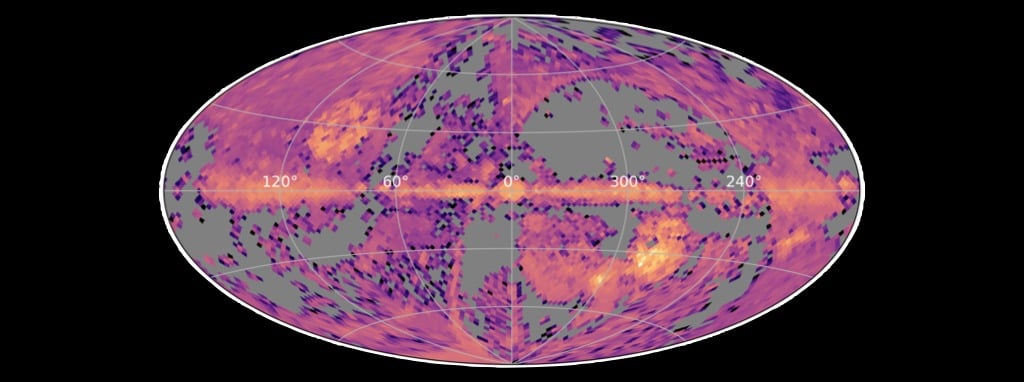 Density of stars in the Milky Way targeted by the Milky Way Mapper (MWM) program in SDSS-V. Credit: SDSS-V/Ilija Medan/University of Toronto
The release also includes updated data for the Black Hole Mapper (BHM) and Milky Way Mapper (MWM) projects, which also cut across other SDSS-V programs. The former includes the spectra of about 500,000 stellar, intermediate, and supermassive black holes, and over 3 million spectra of 1.5 million stars, respectively. It also includes updated information on the Local Volume Mapper (LVM) project, including spectra of hydrogen clouds, planetary nebulae, and nearby galaxies.
In addition, DR20 includes eighteen new or updated Value-Added Catalogs (VACs) that allow for specialized scientific research. As Dr. Emily Griffith, an NSF Postdoctoral Fellow from the University of Colorado Boulder and spokesperson for the SDSS-V collaboration, summarized in an SDSS press release:
DR20 represents an enormous leap in the scale of SDSS data products — today we release over three million spectra of stars and galaxies along with 18 value-added catalogs. It’s the product of years of work by a dedicated, international team of astronomers. We’re excited to share DR20 with the world and see what the community discovers with it.
Further Reading: SDSS


Асар их хэмжээний мэдээлэл цуглуулсан нь сонирхол татам санагдлаа, энэ шинэ багц мэдээллээр манай одоо үеийн судлаачид юу хамгийн их сонирхох бол? Хар нүх, галактикуудын талаар илүү нарийвчлалтай мэдлэг авах боломжтой болох нь үнэхээр гайхалтай байна! Мэдээж, ирээдүйн судалгаанд энэ мэдээлэл ямар үр дүнд хүрэх бол?