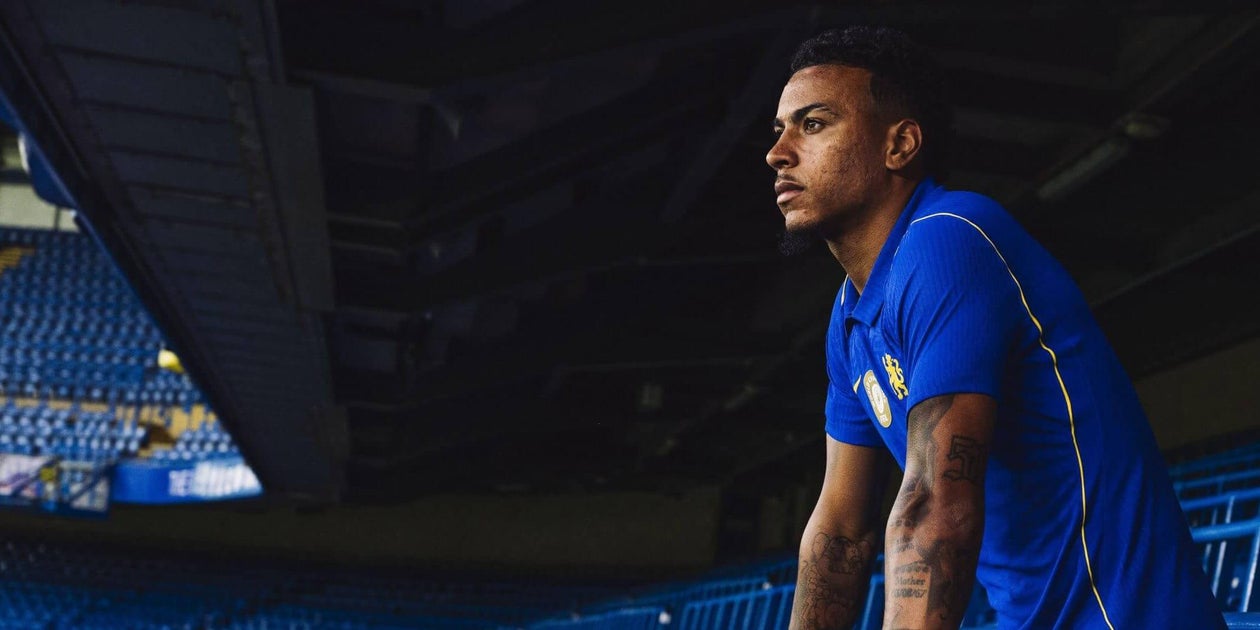
Английн хөлбөмбөгийн түүхэн дэх хамгийн өндөр буюу 117 сая фунт стерлингийн үнэтэй шилжилт хийсэн Морган Рожерс өөрийн хөлбөмбөгийн үндэс суурь болсон бага насны дурсамжаа мартаагүй байна.
Таван настайгаасаа Халас Хокс багт хөлбөмбөгийн анхны алхмаа хийсэн Морган Рожерс тухайн үедээ үе тэнгийнхнээсээ эрс ялгарч, 62 гоол оруулсан амжилтаар карьераа эхлүүлж байжээ. Хожим Вест Бромвич Альбион багийн академид элссэн тэрээр 16 насандаа үндсэн багийн бүрэлдэхүүнд дебют хийж, улмаар Манчестер Сити, Мидлсбро болон Астон Вилла багуудад тоглохдоо ур чадвараа улам ахиулсан юм.
Энэ зун Челси багт нэгдсэн тэрээр шинэ багийнхаа төлөөх анхны хоёр тоглолтод оролцохдоо нэг гоол, нэг оновчтой дамжуулалт бүртгүүлж, гараагаа амжилттай эхлүүлээд байна. Хаби Алонсогийн удирдлага дор тоглож буй 24 настай хагас хамгаалагч нь өдгөө Английн шигшээ багийн гол тоглогчдын нэг болж, Дэлхийн аварга шалгаруулах тэмцээний хагас шигшээд тоглосон туршлагатай тоглогч болон төлөвшжээ.
Хэдийгээр өндөр үнийн дүнтэй од болсон ч Рожерс анхны дасгалжуулагч агсан Боб Хикманыг хүндэтгэн дурсаж, өсвөрийн багийнхаа шагнал гардуулах ёслолд видео мэндчилгээ илгээх зэргээр төрөлх багтайгаа холбоотой хэвээр байна. Түүнийг бага наснаас нь бэлтгэсэн дасгалжуулагчид Морганыг хөдөлмөрч, ухаалаг, дасгалжуулагчийн мөрөөдлийн тоглогч байсан хэмээн онцолжээ.
Дэлгэрэнгүйг эх сурвалжаас харах
↓Эх сурвалжийг нээх ↓
The story can be traced back to the council-run park, with its faded white markings and weather-beaten goalposts, where an ordinary boy with extraordinary talent came into view almost 20 years ago.
Up the hill, past the cemetery and through the metal gates, word quickly got round that the then five-year-old Morgan Rogers was on another level to the other kids playing on the pitches of Halas Hawks Under-Sevens in the Stourbridge & District Youth Football League.
“Morgan was different to everybody else,” recalls Brian Wilkes, a club stalwart and long-standing committee member. “He was stronger. He knew how to shield the ball. And he had a tremendous shot — if there was a penalty shootout, we had to put an adult in the goal (against him) because it wasn’t fair on the other kids.”
Photographs from the time offer a glimpse into Rogers’ early life, taking his first steps on the journey that has brought him to Chelsea this summer as the most expensive footballer in the English game.
One picture shows a schoolboy Rogers at the Hawks’ annual presentation evening, wearing a tie in their red and blue colours. Others show him, aged six, in a tracksuit top with ‘MR’ on the breast. Or there are snaps of his trophies from the 2009-10 season – one for the most man-of-the-match awards, another as the team’s leading scorer.
“He joined us in 2008 and scored 62 goals in his first season,” says Wilkes. “Even from 20 or 30 yards, he could strike the ball so cleanly. The manager moved him into defence for his second season, and he still managed to get 42 goals.”
Morgan Rogers’ first pitch at Homer Hill on the outskirts of Birmingham (Daniel Taylor/The Athletic)
The scene is Homer Hill, in the Cradley district of Halesowen, West Midlands, just a misplaced kick from the primary school, Colley Lane, where Rogers’ childhood affinity to local club West Bromwich Albion never stopped him trying to re-enact the stepovers of Cristiano Ronaldo, his first football hero, in the playground.
Albion’s ground, The Hawthorns, is just a few miles away — England’s highest stadium, at 168 metres above sea level. Homer Hill, as the name suggests, is also at no little altitude, and bitterly exposed to the elements when winter arrives. Which might explain why another picture of the six-year-old Rogers shows him wrapped up warm in a woolly hat.

Rogers, aged six, in his Halas Hawks kit (Halas Hawks)
A few miles in the other direction is Stourbridge, the town where a young Jude Bellingham used to line up for one of the Hawks’ neighbours.
“They’re good friends now,” says Pauline Hickman, another long-standing part of the club’s operation. “The No 9 bus route takes you from Halesowen to Stourbridge. So, during the World Cup, we nicknamed Morgan and Jude as ‘The No 9 Boys’.”
Did they ever face each other in a Hawks-Stourbridge derby? It seems feasible, though nobody here seems absolutely certain. Bellingham, of course, was quickly snapped up by Birmingham City’s academy, whereas Rogers was only at Hawks for two years before West Brom invited him to join their youth system.
In 2017, Jude Bellingham and Morgan Rogers took this photo together while playing for England U15s 📸🔙
9 years later, they’re at the World Cup together ❤️👏 pic.twitter.com/OqbdAwfG8R
— Football on TNT Sports (@footballontnt) June 3, 2026
He also had an offer from Birmingham’s Aston Villa at the same time but, looking back, the following years were really the making of Rogers.
“He was always a very intelligent and articulate lad,” says Mike Scott, then one of the coaches at West Brom. “We used to say to him, ‘You’ll be a good coach one day’, because he was so intelligent. He really understood the game and, for a boy of that age, he was very curious; always asking questions.”
Scott, now head of academy coaching at Birmingham City, was one of several West Brom coaches who were instrumental in the youngster’s development, from under-nines up to the age of 17.
“He was always classed as one of our elite players,” says Scott. “There was a period, around the age of 13 and 14, when he slowed a little as he went through his growth. Then everything suddenly clicked.”
By the age of 15, Rogers was not only in the England Under-16s squad, while still taking his GCSEs at school, but also training with West Brom’s first team.
“I remember saying to him, ‘You need to make sure it doesn’t go to your head’,” says Scott. “You get some young players who train with the first team and think they have made it. Not Morgan, though. He was always very focused.
“At 16, he started the season with the under-18s and, in the first fixture, he scored two at Newcastle. It was too easy for him. The following game, we played Liverpool, and it was too easy for him again.
“After that, he went up to the under-21s, but he’d still play in the FA Youth Cup, and he was never one of those players who’d struggle if they were asked to come back down (an age level). He would just be the best player.
“We played Lincoln on the way to the 2019 FA Youth Cup semi-finals, and he must have beaten five players for one goal. Then we were drawn against Arsenal, with Bukayo Saka, in the fifth round and Morgan came into his own again.
“In the quarter-finals, against Everton, he was the standout player again. Then we played Manchester City in the semis, and that was probably one of the games that convinced City to think, ‘OK, we’re going to put in a bid for him’. They had been trailing him for a long time.”

Morgan Rogers’ abilities were evident at West Brom as a teenager (Nick Taylor/Liverpool FC via Getty Images)
Academy reports from the time detail the player’s “fantastic mentality”, making his West Brom first-team debut at the age of 16 – an 82nd-minute substitute in a February 2019 FA Cup fourth-round tie against Brighton & Hove Albion – and winning various trophies, including the National Schools Cup, with Sandwell Academy, the secondary school that runs a football education programme in tandem with the club.
That attitude has served Rogers well during the following years, signing for City shortly after his 17th birthday, then moving on to Middlesbrough and truly blossoming after a February 2024 move to Villa, launching his senior England career in the process.
“He’s the best player I’ve ever had the pleasure to work with and see develop,” Scott concludes. “And the kid has earned what has come his way, playing in a World Cup semi-final and being worth all that money, because he had that drive from a young age. He was a coach’s dream, really.”
In this corner of the Midlands, a lot of the people who know the Rogers family talk about the positive influence of his parents, Deborah and Howard, a former firefighter who was known as ‘H’ to his colleagues at Brierley Hill fire station during 30-plus years in the job.
Among the tattoos on Rogers’ left arm, there are the dates of his parents’ birthdays, as well as those of his brothers, Daniel and Ash. Scott recalls there being an “excellent and supportive” family network. Rogers himself has talked about how “my parents did everything for me … they took me to every camp, every game, every training session”.
Well done fire fighter Howard Rogers completing thirty years service today with the wmfs. pic.twitter.com/1BaRo9ktXc
— Brierley Hill Fire Station (@WMFSBrierleyH) July 7, 2016
As for the other influences in his life, Rogers made sure to pay tribute when he heard that Bob Hickman, his first coach at Halas Hawks, had passed away in April. Bob was Pauline’s husband, one of the Hawks’ driving forces since the club’s formation in 1980.
“The football family has kept me going,” Pauline tells The Athletic. “Then my son, Rob, came in with his phone one day and said, ‘Mum, you better sit down, I’ve got something to show you.’ It was Morgan’s Twitter account. He’d heard what had happened and posted three little hearts.
“He was in Italy at the time with Villa, preparing for the Europa League quarter-final against Bologna, and it meant the world to me that he still found the time to remember Bob.”
She and Bob were season-ticket holders at Villa Park.
“I’d always wear something from Halas Hawks to games,” she says, pointing to the club’s badge on her shorts. “So when Morgan started playing for Villa, I wanted to tell everyone in the ground, ‘We coached him!’ I was so proud, and I’m still proud, even though he’s now at Chelsea. To me, he’s still got Bob’s spirit with him.”

Morgan Rogers in his old Halas Hawks kit (Halas Hawks)
The funeral took place on the day of the Europa League final.
“Morgan scored,” says Pauline, recalling Villa’s 3-0 win over German club Freiburg in Istanbul. And now she can smile. “We all said, ‘That’s for Bob’.”
A picture is emerging of a 24-year-old who has never forgotten his roots. Rogers even interrupted his holiday last year to send a video message, via his mum, to the Hawks’ end-of-season awards event.
“He wanted the kids to know that he remembered being in their position, sitting at the presentation, and that if they put in the hard work and had a bit of luck, they could also live their dreams and achieve what he had done,” says Wilkes. “We showed it five times over one weekend, to around 650 players and 1,500 parents, and it got a standing ovation each time.”

Pauline Hickman and Brian Wilkes were significant figures in Rogers’ development at Halas Hawks (Daniel Taylor/The Athletic)
This weekend, Rogers is set to take on Premier League champions Arsenal, who also showed serious interest in signing him over the summer. Instead, he went to Chelsea, linking up again with Cole Palmer, a close pal from their days in City’s academy. He has settled in seamlessly: Xabi Alonso’s team have won their first two Premier League fixtures, scoring seven goals in the process, and the wearer of their No 17 shirt has been at the heart of it, starting both and contributing a goal and an assist.
As for Halas Hawks, they established themselves as the largest junior club in the area, running 52 teams for boys and girls aged six to 17, before merging last year with semi-professional Halesowen Town of the Southern League Premier Division (Central), which is six rungs below the Premier League.
Halesowen, like Chelsea, used to have their own ‘Shed’ terrace at their home ground, The Grove, but junior matches are still played at Homer Hill, where a dedicated team of volunteers store their equipment in a small red-brick building by the side of the main pitch.
It is, in short, a classic scene of grassroots English football.
“If there’s a game on, you’ll see all the little stalls by the side of the pitch,” says Pauline. “That’s how they get their money — selling coffee and tea. It’s a world away from £60million transfers in the Premier League.”

Rogers celebrates scoring his first official Chelsea goal at Fulham last week (Mike Hewitt/Getty Images)
Or, indeed, £117million in Rogers’ case. It’s mind-boggling money – a transfer record for a British player – and a shame, perhaps, that the team where everything began won’t see a penny of it.
“When Morgan left West Brom to go to Manchester City, it was for £4million,” says Wilkes. “So we wrote to City asking if they would consider providing us with a percentage of the transfer fee. It was tongue-in-cheek. We weren’t expecting anything — ‘We’ll try it on’, we thought — so we asked for something really silly, like 0.0001 per cent. It would have worked out at £400. But we got nothing back. No reply, nothing. Not even a bag of balls, which would have been a godsend at our level.”
Maybe Chelsea could spare a few balls. Rogers’ first involvement at Halas Hawks, aged five, was in the Little Kickers section. David Davis, the former Wolverhampton Wanderers (another local pro club) and Birmingham defender, is also an ex-Hawk, as is Josh Marsh, a striker for fourth-tier Crewe Alexandra.
Halas, in case you are wondering, is the medieval word for Halesowen, the town where future Manchester United, Leeds United and England winger Lee Sharpe also grew up. There aren’t too many Chelsea fans here. But it is fair to say a new hero has emerged in a part of the Midlands that, until now, has been better known for its industry — chain-making, mostly — and being one of the country’s biggest towns (population: 60,000) without a railway station.
“We see so many boys and girls wearing England shirts these days with ‘Rogers’ and No 17 on the back,” says Wilkes. “Even as a five-year-old, you could see how comfortable he was with the ball. And that has never changed.
“What you see now with Chelsea and, before that, Villa, he did that with us.”


Морган Рожерс бага насандаа л амжилт гаргахыг харуулсан хүүхэд байжээ. Тэр өндөр үнэтэй од болсон ч үндэс сууриа мартаагүй нь сайхан санагдаж байна, та ямар тусламж үзүүлэхийг хүсэж байна?