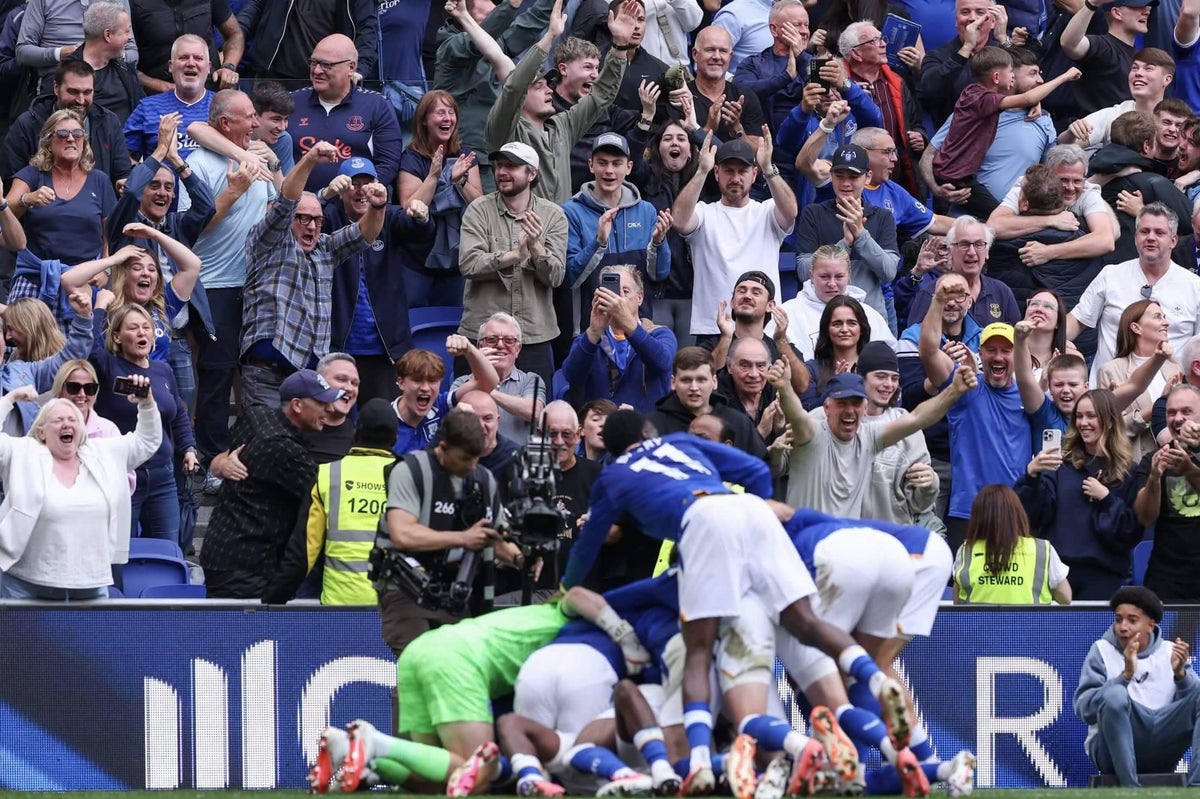
Эвертон тоглолтын нэмэлт цагт Эйнсли Мейтленд-Найлсын гоолын ачаар Манчестер Юнайтедтай 2-2-ын харьцаатай тэнцэж, нэг оноо авлаа.
Хилл Дикинсон цэнгэлдэх хүрээлэнд болсон тоглолтод Эвертон хоёр удаа хожигдож явсан ч эцсийн мөчид тэнцээг авч чадлаа. Манчестер Юнайтедын эсрэг тоглолтод Брайан Мбеумо гоолдож, Эвертоны хаалганд эхний гоолыг оруулсан юм. Тоглолтын 66 дахь минутад Жек Грилиш талбайд гарч ирсэн нь Эвертоны довтолгоонд шинэ боломж нээв. Улмаар нэмэлт цагийн зургаа дахь минутад Эйнсли Мейтленд-Найлс хүчтэй цохилтоор тооны харьцааг 2-2 болгон тэнцүүлжээ.
Менежер Дэвид Мойес тоглолтын дараах ярилцлагадаа баг нь хүнд нөхцөл байдлыг даван туулах чадвартай ч, өөрийн талбайдаа хожил байгуулах шаардлагатай байгааг онцлов. Эвертоны хувьд трансферийн цонхны сүүлийн өдрүүд хүндхэн өрнөж, бүрэлдэхүүний гүн дутагдалтай байгаа нь ажиглагдаж байна. Тус клуб энэ улирлын эхний гурван тоглолтод хожигдоогүй ч, бүрэлдэхүүний өөрчлөлт болон клубийн удирдлагын асуудлаас үүдэн хөгжөөн дэмжигчдийн дунд эргэлзээ үүсээд байгаа юм.
Эвертон 2024 оны арванхоёрдугаар сард “The Friedkin Group”-ийн мэдэлд шилжсэнээс хойш шинэ эринийг эхлүүлэхийг зорьж байгаа ч үр дүн нь тогтворгүй хэвээр байна. Шинэ цэнгэлдэх хүрээлэндээ нүүж ирсэн ч багийн тоглолтын хэв маяг болон бүрэлдэхүүний сонголт нь шүүмжлэл дагуулсаар байна. Хэдийгээр багийн дотоод уур амьсгал ээдрээтэй байгаа ч тоглогчид талбай дээр бууж өгөхгүй тэмцсээр байгааг Дэвид Мойес онцлон тэмдэглэв.
Дэлгэрэнгүйг эх сурвалжаас харах
↓Эх сурвалжийг нээх ↓
This season, The Athletic is running a new series called Our League, where we will attempt to tell some of the stories of the richest and most watched football league in the world, taking in the brilliance, talent, glitz, controversy, grift, venality and jamboree.
Perhaps we will follow the controversies, perhaps we will find an issue to dissect, or perhaps we will go in search of meaning. Maybe we will pick a fun-looking game, just for the hell of it. It might be serious or frivolous, but, over the course of the season, we promise to write about every club and try to explain how it feels to actually be there. No filter.
Sunday at Hill Dickinson Stadium, and it is Everton against themselves, Everton against the world. In this thoroughly modern setting — red brick, dockland steel, food carts hawking wood-fired pizza and Brazilian barbecue — an old-school story is played out. It is a blue wall of blocking and clearing until the wall crumbles and the muttering starts. It is disjointed beyond belief, a wrestling match between dismay and elation. Finally, it is a whip-crack of defiance.
Full time brings a competing vision; banks of empty seats with an echo of disillusion and the fans who are still there belting out a refrain of “It’s a grand old team to play for; it’s a grand old team to support.” An hour or so later, a man is walking away from the ground in a replica shirt, black jeans and white trainers, saying “This f***ing club” to nobody in particular, and there can be no mistaking what he is getting at.
Everton moved to Hill Dickinson Stadium in 2025 (Carl Recine/Getty Images)
Entering the sixth minute of added time, Everton are both losing 2-1 to Manchester United and straddling a knife-edge. After a bruising week of self-flagellation and soul-searching, they have grappled and fought. They are toothless, striving, flailing. They have gone behind, eked a way back and then gone behind again: like an ache in their bones. And then there is one more heave and a scorching second equaliser. At the precise moment of giving up, ‘this f***ing club’ refused to.
The day could go one of two ways, or so it seemed before kick-off: Everton buckle, the crowd turns, things get ugly; or Everton stick two fingers up and roar.
“I honestly don’t know what to expect,” a supporter called Glenn says, clutching a burger from Bramley Bites on Regent Road, ketchup caressing his lower lip. It is noon, two hours until the game, and what lies ahead feels like a holding of breath. “Normally I have an idea of what might happen … this could be anything.”
In the end, it is a mishmash of fretting and frailties and obduracy. If mutiny was in the air, it is blown away by the hurricane of sound which greets a stunning goal from Ainsley Maitland-Niles to make it 2-2. Everton taste despair and then wipe it from their mouths.
But this is not supposed to be what they are, not now, not railing against their owners, not relying on David Moyes, their manager, not forever hangdog, not always the underdogs.

Everton fans get ready for a tense 90 minutes (George Caulkin/The Athletic)
“I would say we’re pretty good at it,” Moyes tells reporters afterwards, when asked about his team and their tradition of facing down adversity. “But I don’t want us to be in those moments. I want us to be a club which is building and ambitious, which is trying to challenge the top teams.”
Three games into the league season, they are not that, but they are still standing, still unbeaten. And they are still Everton, right to the core.
No club have spent more time perching on the highest rung of English football than Everton. In this respect, they are a model of consistency; being here is part of their identity. Alongside Arsenal, Manchester United, Chelsea, Tottenham Hotspur and Liverpool, the latter their great intra-city rivals, they are ever-presents in the 34-year-old Premier League, although at this point, the idea of consistency mutates into something else. The purpose of them being here is less easy to explain.
Everton have won the title nine times, only one behind Manchester City, but not since 1987. Their finishing positions in the 20-team division over the past seven seasons read like an exercise in futility: 12th, 10th, 16th, 17th, 15th, 13th, 13th. They have been consistent at circling the drain, veering towards disaster but never quite arriving, hapless but never completely helpless. From a points deduction to a curdling of promise, bad decisions have been endemic.

Everton welcomed Manchester United on Sunday (Carl Recine/Getty Images)
This shrivelled existence was meant to have ended with a change of direction which was officially ratified by the Premier League in December 2024. Texas-based The Friedkin Group (TFG), which also owns Roma of Serie A, was the adult in the room – finally! – and spoke about “leading Everton into an exciting new era both on and off the pitch,” and about restoring the club “to its rightful place in the Premier League table”.
Everton’s departure from gorgeous, ramshackle Goodison Park — their home since 1892 — was another signal of new beginnings. Yet, a year on, they are in an unfamiliar location and a familiar situation, with fans despairing at how being here can have come to this. As a contributor to The Blue Room podcast put it last week, “We just all feel duped, don’t we?, that another false dawn has happened. And how many more are we going to have?”
Last season ended with no wins in the final seven games as a chance of European qualification slipped away, a momentum-sapper which seeped into a discomforting summer. Their recruitment strategy felt like self-sabotage, encompassing the £65million departure of Iliman Ndiaye to Manchester City and a proposed — hastily aborted — sale of Harrison Armstrong to Nottingham Forest which drew a rebellious response from supporters who sang about having “a riot on your hands” if the teenage midfielder was allowed to leave.

An Everton fan shows off his pin badge collection ahead of Sunday’s match (Carl Recine/Getty Images)
A head-spinning, on-off-on-definitely-off saga in the final hours of the transfer window on Tuesday which saw Folarin Balogun, the United States international striker, fly to Merseyside from Monaco of France’s Ligue 1 and then fly back again – while the club posted about doughnuts on social media – left Everton with one senior striker and only 18 first-team outfield players (when many of their top-flight rivals have 22 or 23). On Friday, Moyes was asked whether he possessed enough playing depth for a Premier League season. His answer was blunt: “I would say no.”
It has brought a fracturing, a splintering. The 1878s, a group of supporters who organise displays and tifos on matchdays, announced they would be “standing down for the foreseeable future” because “we do not feel that our fanbase’s ambitions and the club’s ambitions align”; and it has since emerged that TFG is seeking fresh investment, which may or may not mean a full sale.
Back to The Blue Room and a (rhetorical) question for the ages: “It’s just an absolute circus, isn’t it?”
The club’s tweet about doughnuts — with accompanying message, “One more year” — screamed Premier League football in 2026; contrived, very meta and with an eye on going viral.
To understand it, you need to understand that among the gluttonous offerings on sale at Everton’s new stadium last season was the Toffee Doughnut, a calorific monstrosity complete with blue icing. This was withdrawn from sale in August.
Yet the doughnut is not, in fact, back for one more year. It has been replaced by the Toffee Treat, a cookie.
The online post was actually a convoluted reference to Jack Grealish, the England international, who has returned to Everton for a second season on loan from Manchester City. This subtlety got a little lost on the fans at 10.10pm on September 1, as the world burned with less than an hour of the transfer window left. The most liked reply on X remains: “Only club in the Prem to have one striker and one full-back and announce f***ing donuts.”
Inside the stadium’s expansive club shop on Sunday, Maureen Clancy, 48, is holding up a ‘Grealish, No. 10’ replica shirt and pondering options; it can be hers for a piddling £98 ($132). “I want to believe, but I feel like we’ve seen this movie before and too many times,” she says. Over by a converted shipping container selling Budweiser for £5.95 a pint (“This Bud’s Blue”), Sam, who has the club crest tattooed on his left ankle, says, “In six months, we’ve gone from dreaming about the Champions League to the same old s***.”

Grealish replica shirts will likely be popular at the Everton club shop this season (George Caulkin/The Athletic)
On March 21, Everton beat Chelsea 3-0 here, leaving them eighth in the table and only three points behind fifth-placed Liverpool with those seven games remaining.
The dispiriting run that followed left Moyes vulnerable, but the Scot, who first managed the club between 2002-13 before leaving for the Manchester United job, has now become a figure of reassurance. Shortly before the transfer deadline, Moyes was asked whether he had a message for fans. His reply: “I’d say their manager’s an Evertonian.” It was the poetry of a life-jacket.
The headline on Moyes’ programme notes for the Manchester United match reads, “We need to be strong and pull together,” which is a long way from the club motto Nil satis nisi optimum — nothing but the best is good enough. Everton are barely that. After 30 minutes, they have an xG figure of 0.01. Their best moment of the first half comes late, with a clattering tackle by Jarrad Branthwaite on Marcus Rashford. A blast of noise: “EVERTON, EVERTON, EVERTON!”

The now infamous Toffee Treat (George Caulkin/The Athletic)
Their world feels very small, a case of getting through. It scarcely opens up when Bryan Mbeumo drives inside from the right to score; 0-1, with an emphasis on the nil.
Grealish’s introduction in the 66th minute offers alternatives. Five years ago, when he signed for City from Aston Villa for £100million, he was Britain’s most expensive footballer, and he plays with a rich man’s confidence. He brings swagger and quality. He brings the hope of something else.
United are far from exhilarating, far from compelling and better duly, belatedly, narrowly arrives, which ensures that Moyes is pleased, but with a caveat.
“Was it a big moment today? Yeah, it was a big moment to get back into it when you’re in the last minute,” he says. “It didn’t feel as big for me, because I wanted to win and I felt as if we were capable of winning. It made me happy to get the point, but I need to win my home games.”

Everton and England goalkeeper Jordan Pickford celebrates a hard-earned point (Michael Regan/Getty Images)
How does he prevent negativity snaking into his dressing room, infiltrating and infecting? How does he maintain standards?
“There’ll be no excuses from any players for what’s gone on,” Moyes says. “The players all agreed. We said, ‘No, we won’t be walking off, shaking our heads if we’re players short or we’re down. It’ll be completely the opposite reaction’. The players have hugely bought into it.”
It is classic Moyes and, for better or for worse, it is classic Everton.
For much of the past few days, it has felt like the worst, but in the 96th minute, when the ball lands at the feet of Maitland-Niles and he unleashes carnage, releases decibels, it feels like the best. Despite it all, the best doesn’t feel too bad.
In their new home, the past clings to Everton; restless, a bad joke, craving more, loud, glorious. It feels unsustainable, but here they are, this f***ing club, somehow sustaining it.

