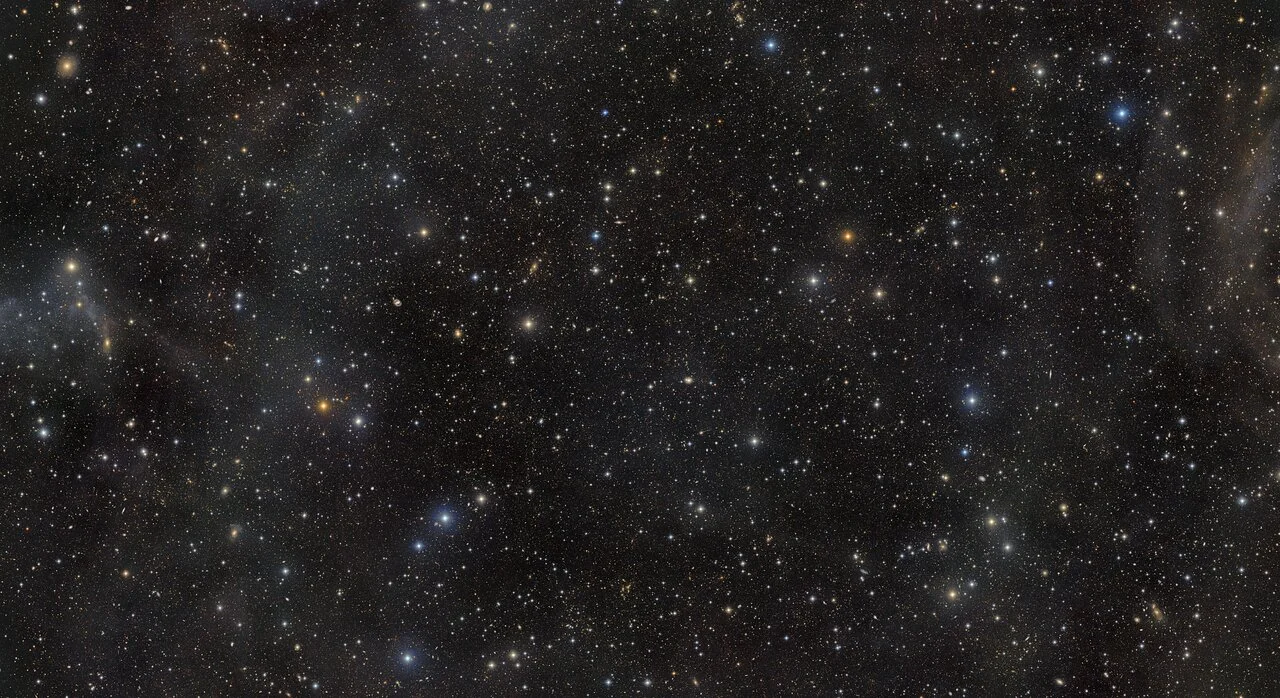
Дэлхийн хамгийн хүчирхэг дижитал камер ашиглан одон орон судлаачид сансрын хувьслыг судлах боломжтой COSMOS талбарын хамгийн тод зургийг бүтээв.
Vera C. Rubin ажиглалтын төв нь өөрийн Legacy Survey of Space and Time (LSST) камерыг ашиглан COSMOS талбарыг урьд өмнө байгаагүй нарийвчлалтайгаар ажиглалаа. Энэхүү ажиглалт нь 3.2 гигапикселийн хүчин чадалтай LSST камерын шинжлэх ухааны судалгаанд зориулан гаргасан анхны каталог болон дүрслэл юм. Уг талбар нь олон арван жилийн турш олон улсын дурангуудаар судлагдсан тул шинэ багаж хэрэгслийг турших, хэмжилтийг харьцуулах чухал жишиг цэг болдог.
Шинэ дүрслэлд хагас сая гаруй галактик болон 50,000 гаруй од багтсан бөгөөд эдгээрийг зуу зуун тусдаа ажиглалтыг нэгтгэн бүтээжээ. Үүнд мушгиа, зууван болон хоорондоо нэгдэж буй гажиг хэлбэртэй галактикууд зэрэг олон төрлийн сансрын биетүүд дүрслэгдсэн байна. Сүүн зам галактикийн хавтгайг чиглүүлэлгүйгээр ажиглалт хийснээр сансрын тоос, хийн саадгүйгээр хол зайд орших галактикууд болон орчлон ертөнцийн бүтцийг илүү тод харах боломж бүрджээ.
Rubin ажиглалтын төвийн дэд захирал Фил Маршалл COSMOS талбарын өмнөх судалгаануудын баялаг сан нь LSST-ийн шинжлэх ухааны туршилтын талбар болоход үнэтэй хувь нэмэр оруулна гэдгийг онцоллоо. Энэхүү зураг нь 2005 оны дөрөвдүгээр сараас 2026 оны нэгдүгээр сар хүртэлх хугацааны ажиглалтыг нэгтгэсэн Early Data Preview 2 (EDP2) төслийн хүрээнд гарчээ.
Ирэх жилүүдэд тус талбарт дахин дахин ажиглалт хийснээр супернова болон бусад түр зуурын хувьсах биетүүдийг илрүүлж, нарийвчлан судлах боломж нээгдэнэ. Энэхүү үйл ажиллагаа нь ажиглалтын төвийн ирэх арван жилийн турш хийх өргөн хүрээтэй судалгааны эхлэл бөгөөд шинжлэх ухааны багаж хэрэгслийг баталгаажуулах чухал үе шат юм. Бол Блум захирлын хэлснээр, тус ажиглалтыг Чилийн Кокимбо бүс нутгийн ард иргэдэд зориулж буй бөгөөд энэ нь одон орон судлалд олон арван жилийн турш дэмжлэг үзүүлсэнд нь талархсан хэрэг юм.
Дэлгэрэнгүйг эх сурвалжаас харах
Эх сурвалжийг нээх ↓
The COSMOS field, or Cosmic Evolution Survey Deep Field, is one of the most famous patches of the Universe observed by astronomers. Located in the constellation Sextans, this region was photographed by the Hubble Space Telescope (HST) in segments from 2003 to 2005 using its Advanced Camera for Surveys (ACS). With support from ground-based and other space-based telescopes, the resulting images were then stitched together to create a stunning picture of cosmic evolution.
The Vera C. Rubin Observatory looked in and around this field not long ago and captured the most detailed view to date of the hundreds of thousands of galaxies, stars, and celestial environments therein. This marks the first time the Observatory’s Legacy Survey of Space and Time (LSST) Camera – the most powerful digital camera in the world – produced an image and catalog for scientific research. Rubin’s sensitivity and high resolution are already giving astronomers a powerful new view of this famous cosmic landmark.
Astronomers have studied the COSMOS field for more than two decades, directing many of the world’s leading telescopes to observe it in different wavelengths (optical, radio, ultraviolet, X-rays, etc.). Because it is so well studied, it has served as a reference point for testing new instruments, comparing measurements, and combining observations. Now, Rubin has visualized it using its combination of depth, wide-field coverage, and ability to make repeated observations.
“The COSMOS field is a very important one for LSST science,” said Phil Marshall, the Deputy Director of Rubin Observatory at the SLAC National Accelerator Laboratory. “Its wealth of prior observations, and its repeated targeting both during commissioning and as one of the LSST’s deep fields, will make it very valuable as a testing ground for scientists as they get ready to take on the survey data.”
In this respect, the LSST Camera will complement earlier observations and add a dynamic view, enabling astronomers to study distant galaxies and track how the Universe has changed over time. The image was released to coincide with Rubin’s Early Data Preview 2 (EDP2), the first phase of Rubin’s Data Preview 2 release that combines Rubin’s observations obtained between April 2005 and January 2026 as part of its science validation period. Said Bob Blum, Director of the Rubin Observatory at NSF NOIRLab:
The COSMOS deep image is just the beginning for Rubin in this region. Repeated visits to the field over the next few years will demonstrate the power of our survey design for discovery by providing our science community with a huge number of transient and variable objects like supernovae and other explosive transients for follow-up and detailed study.
The new image was created by stacking hundreds of individual observations made by the 3.2-gigapixel LSST Camera and contains more than half a million galaxies and more than 50,000 individual stars. It also features many types of galaxies, including barred spirals with arms, smooth ellipticals, faint red galaxies, and distorted merging galaxies. The stars in the image are those located in the Milky Way and lie along the line of sight.
However, these are a minute fraction of the stars avoided by the LSST Camera by looking away from the crowded plane of the Milky Way. This kept the image from being obscured by the galactic disk and the clouds of dust and gas in the interstellar medium (ISM). This allows observatories to obtain sharper views of the cosmos, seeing further into space and farther back in time. As a result, astronomers can study galaxies and the structure of the Universe during different periods of its evolution.
While the EDP2 is just a preview of what the ten-year LSST survey will observe, it has scientific value all on its own. In addition to providing an in-depth view of the many objects in the COSMOS field over time, it gives scientists the opportunity to test and validate Rubin’s tools and data products and prepare for the long-term survey ahead. As Blum added:
As we celebrate the start of science with Rubin Observatory, our thoughts are with our staff and the community of Chile impacted by the recent devastating storms in the region of Coquimbo and beyond. Our priority is to ensure the well-being of our staff in the region and support the community where we live and work. This image marking the start of LSST science is dedicated to the people of the region of Coquimbo and is a small token of our gratitude for their decades of support for astronomy and the AURA Observatories in Chile.
Further Reading: Vera C. Rubin Observatory

