
Харь гарагийн дэвшилтэт иргэншил компьютерын тооцооллын хүчин чадлыг дээд зэргээр ашиглах үед сансарт ялгарах дулааны өвөрмөц дохиог одон орон судлаачид илрүүлэх боломжтой байна.
arXiv цахим хуудсанд нийтлэгдсэн шинэ судалгаанд дурдсанаар, хэт дэвшилтэт иргэншил компьютерын үр ашгийг нэмэгдүүлэхийн тулд “Слышийн цагираг” (Slysh halo) хэмээх бүтцийг ашиглаж болзошгүй юм. Энэхүү онол нь В. И. Слышийн “дэвшилтэт иргэншлийн технологи нь хүйтэн нөхцөлд илүү үр ашигтай ажилладаг” гэсэн санааг үндэслэжээ. Термодинамикийн хуулиар тооцоолол хийх явцад ялгардаг хаягдал дулаан нь температурын хязгаарлалтаас хамаардаг бөгөөд Ландауэрын зарчмын дагуу компьютер хүйтэн орчинд ажиллах тусмаа илүү өндөр бүтээмжтэй байдаг.
Слышийн цагираг нь одны эргэн тойронд тархсан, хэт өндөр бүтээмжтэй компьютеруудын бөмбөрцөг хэлбэрийн бүтэц юм. Ийм систем нь эрчим хүчээ одноос авч, гүн сансрын хүйтэн температурыг ашиглан үйл ажиллагаагаа явуулдаг байна. Судлаачийн үзэж буйгаар, 5-30 Кельвиний температурт ажиллах эдгээр систем нь хэт улаан туяа эсвэл субмиллиметрийн долгионы мужид сул дулааны цацраг ялгаруулах төлөвтэй байна.
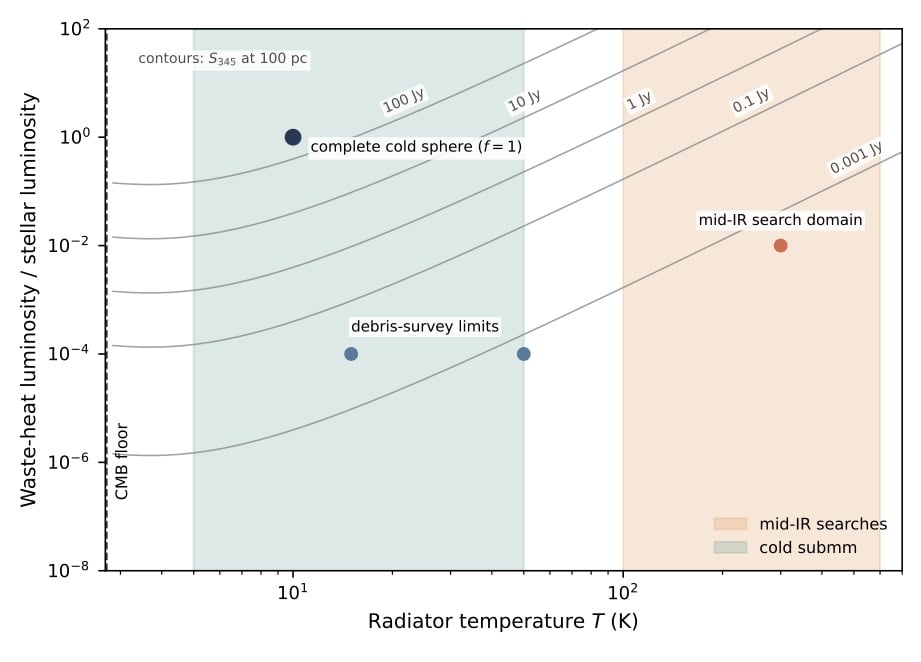
Энэхүү дулааны дохиог илрүүлэхэд зарим бэрхшээл тулгарч болох юм. Жишээлбэл, оддын эргэн тойронд байдаг хог хаягдлын үүл ч мөн ижил долгионы мужид гэрэл ялгаруулдаг тул ялгахад хүндрэлтэй. Гэсэн хэдий ч Слышийн цагираг нь хог хаягдлын үүлнээс ялгаатай нь нарийн зурваст дулаан ялгаруулах магадлалтай бөгөөд 100 гэрлийн жилийн зайнаас илрүүлэх боломжтой гэрэлтэлттэй байна.
Одоогийн ALMA зэрэг телескопуудын хүчин чадал нь ийм төрлийн сансрын дохиог илрүүлэх хязгаарт хүрээд байна. Ирээдүйд хэт улаан туяа болон субмиллиметрийн долгионыг ажиглах илүү дэвшилтэт телескопууд ашиглалтад орсноор харь гарагийн иргэншлийн ул мөрийг хайх боломж улам бүр нэмэгдэнэ. Хэрэв бид ойр орчмын одод ийм цагираг илрүүлэхгүй бол, энэ нь тухайн бүсэд дэвшилтэт иргэншил байхгүй байх магадлалыг зааж болох юм.
Дэлгэрэнгүйг эх сурвалжаас харах
Эх сурвалжийг нээх ↓
Love it or hate it, Artificial Intelligence (AI) is likely here to stay. Its ravenous need for computational power has overwhelmed chip manufacturers and power companies alike. While our current AI obsession is likely a bubble ready to burst, we won’t simply stop using computers. Since their first invention, computers have continued to grow more powerful, and our civilization has grown ever more dependent upon them. Computation defines our civilization. Perhaps computational power is what defines any advanced civilization. If that’s the case, then the most advanced civilizations in the universe would push computing to its most powerful and efficient state.
That’s the idea behind a new paper on the arXiv. In it, the author argues that hyper-efficient computers would be central to any alien civilization. The author further argues that this would give their star systems a distinct signature, which he calls a Slysh halo. The term is named after V. I. Slysh, who first argued that advanced civilization is best served cold. If you can get your technology to operate at supercool temperatures, then it will likely be more efficient.
Computers are a good example of this. All non-reversible computations generate waste heat. Thanks to the laws of thermodynamics, this means there is a level of inefficiency to these computations. Our current computer data centers generate so much heat they need cooling systems to keep from melting. More efficient computer chips can be cooled by ambient room temperature, but they are generally less powerful. The limit to computing efficiency is defined by Landauer’s principle, which states that the maximum efficiency of any non-reversible computation is proportional to its operating temperature. The colder the computation, the more efficient it will be. For example, an optimal computer at 10 Kelvin is thirty times more efficient than an optimal computer at a room temperature of 300 Kelvin.
An optimal Slysh halo would have a distinct signature. Credit: Michael Garrett
A Slysh halo is optimal computing taken to the extreme. Highly efficient computers are scattered in a wide sphere around a civilization’s star. They are close enough to the star to capture light for power but distant enough to operate at the cold temperatures of deep space. How exactly the civilization achieves this feat is left as an exercise for the reader. The key here is that all those computers would still have some radiant heat. The question is how that heat signature would appear to us.
The author argues that the most likely operating temperature for a Slysh halo is between 5 and 30 Kelvin. This means that it would emit waste heat in the far infrared or submillimeter spectrum. There are, however, a couple of caveats. One is that many stars have a halo of debris around them, such as the Sun’s Oort cloud. This debris emits light in the submillimeter range as well. Another is that really efficient computing is diffuse. The waste heat it emits would be faint compared to the star. That said, a fully optimal Slysh halo would be bright enough to detect at 100 light-years, and the Slysh computers would likely emit heat at a single narrow band, unlike a debris halo.
The brightness of a hypothetical Slysh halo puts it right at the edge of current telescopes such as ALMA. We could start combing through observations we already have to look for one of them. And as more advanced far-infrared and submillimeter telescopes come online, we’ll have an even better chance.
If we don’t see a Slysh halo around some nearby star, then we could say that the presence nearby alien civilizations does not compute…
Reference: Garrett, Michael. “Slysh haloes: the waste heat of cold computing as a submillimetre technosignature.” arXiv preprint arXiv:2608.31153 (2026).

