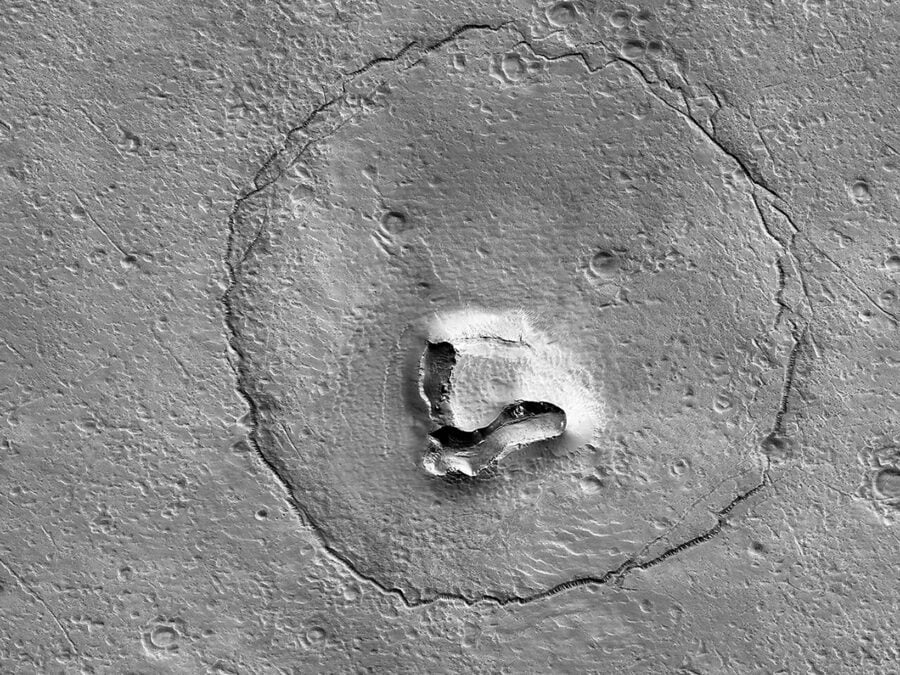
Эрдэмтэд Ангараг гарагийн гадаргуугаас баавгайн нүүртэй төстэй геологийн тогтоцыг илрүүлсэн нь хүний тархины хээ болон хэлбэрийг таних зуршилтай холбоотой үзэгдэл юм.
2022 оны арванхоёрдугаар сарын 12-нд NASA-гийн Mars Reconnaissance Orbiter аппарат Ангарагийн өмнөд өндөрлөгийн дээгүүр нисэн өнгөрөхдөө нэгэн толгодын зургийг авчээ. HiRISE камерын тусламжтайгаар авсан уг зурагт хоёр нүх, V хэлбэрийн хамар болон дугуй хүрээ бүхий дүрс тодрон гарсан нь баавгайн нүүрийг санагдуулж байв. Аризоны их сургуулийн гариг судлаач Альфред Макьюэний тайлбарласнаар, энэ нь геологийн гурван өөр үйл явц давхцсаны үр дүнд үүссэн тогтоц юм. Тодруулбал, дугуй хүрээ нь дарагдсан солирын тогоо, хамар нь галт уулын эсвэл шаварлаг нүх, нүднүүд нь геологийн хотгорууд байх магадлалтай ажээ.
Энэхүү үзэгдлийг парейдоли буюу тодорхой бус дүрсээс танил хэлбэр дүрсийг олж харах танин мэдэхүйн хариу үйлдэл гэж үздэг. Хүний тархины түр зулайн хэсэгт байрлах нүүр царайг таних бүс нь орчин тойрноо хурдан таньж мэдэх хувьслын явцад хөгжсөн тул ийнхүү өөр гарагийн чулуулгаас ч хүний эсвэл амьтны нүүрийг “олж хардаг” байна. Үүнтэй төстэй тохиолдол 1976 онд Viking 1 аппаратаар илэрч байсан ч хожим нь өндөр нарийвчлалтай зургаар энгийн толгод болохыг нь тогтоосон байдаг.
Ангараг гараг дээрх геологийн тогтоцууд нь зарим тохиолдолд шинжлэх ухааны чухал ач холбогдолтой байдаг. Тухайлбал, 2024 оны наймдугаар сард ESA-гийн ExoMars Trace Gas Orbiter аппаратын илрүүлсэн инээмсэглэж буй хүний царай мэт харагдах давсны орд нь Ангараг дээр ус байсныг батлах эрдсийн ул мөр юм. Эдгээр хлоридын давсны орд нь хоёр, гурван тэрбум жилийн өмнө Ангараг гараг дээр гол мөрөн, нуур байсныг илтгэдэг бөгөөд эдгээр нь бичил биетэн оршин тогтнох боломжтой байсан эсэхийг судлахад чухал ач холбогдолтой. NASA болон ESA байгууллагууд 2028 онд ExoMars Rosalind Franklin хөлгийг эдгээр байршилд илгээж, бичил биетний ул мөрийг хайхаар төлөвлөж байна.
Дэлгэрэнгүйг эх сурвалжаас харах
↓Эх сурвалжийг нээх ↓
On December 12, 2022, NASA’s Mars Reconnaissance Orbiter passed 251 kilometers above the southern highlands of Mars and photographed a hill.
Ordinarily, there would have been little reason to notice it. The HiRISE camera, operated by the University of Arizona, has been imaging the Martian surface since 2006 and has produced tens of thousands of shots of rock, dust, and crater rims.
This one was different.
Two dark pits sat where eyes might be. Between them, a pale ridge narrowed to a point like a snout, while a near-perfect circular crack wrapped around the whole structure and framed it like a head.
It looked, unmistakably, like a bear.
The Geology Behind the Bear Face NASA’s Camera Caught on Mars
“There’s a hill with a V-shaped collapse structure (the nose), two craters (the eyes), and a circular fracture pattern (the head),” wrote Alfred McEwen, the University of Arizona planetary scientist who leads the HiRISE team, in January 2023.
There is a plausible geological origin for each feature. McEwen suspects the circular fracture is what remains after loose material settled over a buried, long-since-filled impact crater, while the V-shaped nose is likely a volcanic or mud vent. The surrounding collapse structure marks where lava or mud once flowed outward.
The image resolves objects roughly 78 centimeters across.
At that scale, the coincidence is complete: three unrelated geological processes produced features that, from 251 kilometers up at 14:29 local Mars time on a northern winter afternoon, with the sun sitting about 39 degrees above the horizon, arranged themselves into a face.
There is a name for the effect. Pareidolia is the same cognitive reflex that turns car headlights into startled eyes or a water stain into a religious icon, and the human brain has a dedicated region, the fusiform face area in the temporal lobe, that activates in response to face-like patterns regardless of whether an actual face is present.
That system evolved to detect faces quickly, at a distance, in poor light.
For most of human evolutionary history, recognizing a face a half-second faster could have been the difference between spotting a predator and missing it. The trade-off is a hair-trigger pattern-recognition system that finds faces in orbital photographs of volcanic rock on another planet.
From the 1976 Viking Photo to a Smiley Made of Ancient Salt
Mars has pulled this trick before.
In 1976, NASA’s Viking 1 orbiter photographed a mesa in the Cydonia region that, at low resolution, looked like a carved human face staring up at space. It fueled decades of speculation, until higher-resolution images from later missions, including HiRISE, resolved it as an ordinary mesa that had caught the light at a specific angle. The face was never there.
A more recent Martian face came with genuine scientific weight attached.
In August 2024, scientists working with ESA’s ExoMars Trace Gas Orbiter used its Colour and Stereo Surface Imaging System, CaSSIS, to map chloride salt deposits in Terra Sirenum, a cratered region in Mars’ southern hemisphere. Among the deposits they cataloged was one shaped like a smiley face: a ring of dried salt with two small craters positioned where eyes would be. The researchers identified 965 deposits in total, ranging from 300 to 3,000 meters wide.
The smile is incidental. The salt is what interests planetary scientists.
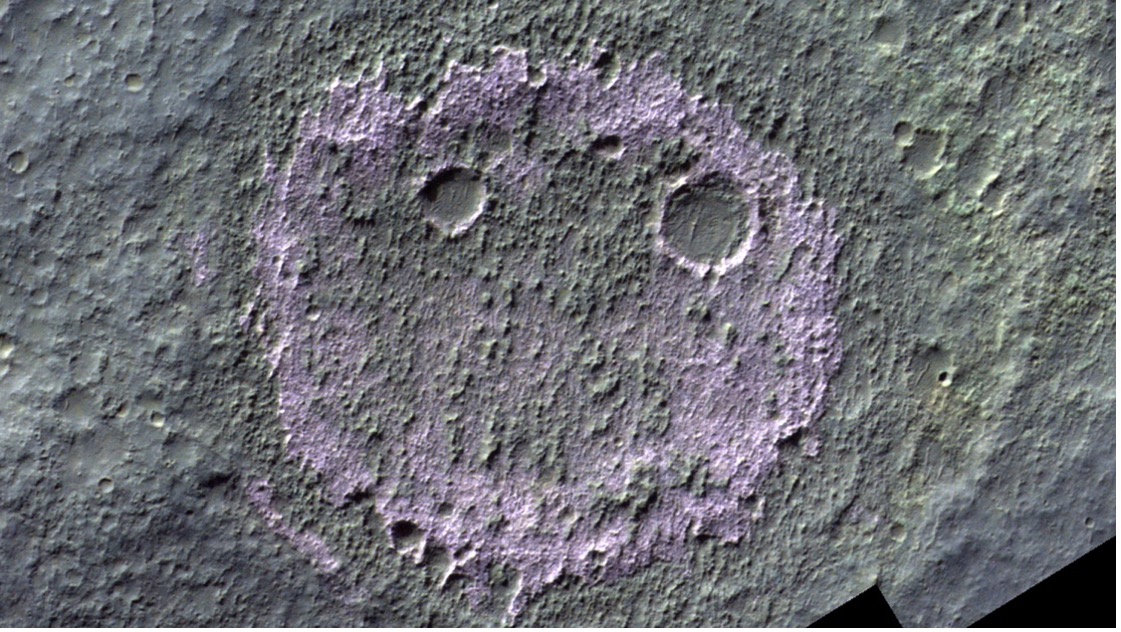
These chloride deposits are the mineral fingerprints left behind as water disappeared from Mars. The planet lost its magnetic field and could no longer hold its atmosphere, causing water to evaporate, freeze, or become trapped beneath the surface. What remains are concentrated salts that crystallized out of the last shallow ponds and lakes as they dried up, deposits dating back roughly two to three billion years, to a period when Mars still had rivers, lakes, and possibly oceans.
Very salty water can remain liquid at temperatures as low as -40°C, well below the freezing point of fresh water.
That makes briny remnants like those in Terra Sirenum the sort of extreme environment where microbial life, if it ever existed on Mars, could have persisted the longest as the planet dried out. The research, published in Nature Scientific Data, describes chloride deposits as markers for early Mars’ aqueous past with direct implications for understanding Martian habitability, and NASA and ESA plan to send the ExoMars Rosalind Franklin rover to these locations in 2028 to search for signs of microbial life.
Why Mars Keeps Producing These Images
The bear and the smiley are hardly the only faces Mars has offered up.
A jellyfish spotted in later HiRISE data turned out to be a cosmic ray striking the camera’s sensor directly. A formation that looked like a human thigh bone photographed in 2014 was a wind-sculpted rock, while apparent mushroom clusters visible in other surface images have ordinary geological explanations.
What connects all of them is the camera.
HiRISE is currently the highest-resolution imaging system ever sent to orbit another planet, capable of resolving features less than a meter across from an altitude of roughly 300 kilometers. It has been operating continuously since 2006 and systematically photographing a surface that covers more than 144 million square kilometers. With that much imagery, at that level of detail, the occasional accidental face is close to inevitable.
The bear in the southern highlands carries no biosignature, no water history, and no mission target.
It is three geological features that happened to line up under a specific sun angle on a December afternoon, photographed by a camera pointed at a hill.
Enjoyed this article? Subscribe to our free newsletter for engaging stories, exclusive content, and the latest news.

