Шинээр олдсон 142,000 жилийн настай олдвор эртний хүмүүсийн анатомийн онцлог болон амьдралын хэв маягийн талаарх ойлголтыг шинэчилж байна.
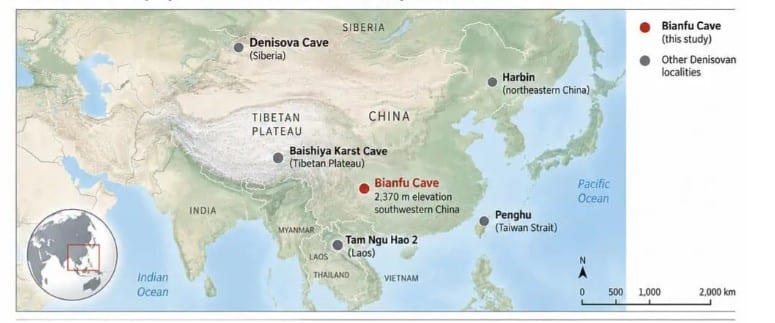
Хятадын Юньнань мужийн Бяньфү агуйгаас олдсон 4.5 см урт шууны яс болон гавлын ясны хэлтэрхий нь Денисовын хүний хувьслын түүхэнд чухал байр суурь эзэлж байна. Ойролцоогоор 134,000-аас 142,000 жилийн өмнө амьдарч байсан энэхүү олдворыг Nature сэтгүүлд нийтлэгдсэн хоёр судалгаагаар баталгаажуулжээ. Тус агуйн дулаан уур амьсгал ДНХ-ийн бүтцийг устгасан тул судлаачид масс спектрометрийн аргаар эртний уургийн шинжилгээ хийж, уг яснуудыг Денисовын хүн болохыг тогтоосон байна.
Шууны ясны үений гадаргуу нь неандертальчуудтай төстэй том хэмжээтэй боловч хэлбэр болон хүзүүний геометр нь орчин үеийн хүнтэй илүү төстэй байгаа нь Денисовын хүн өвөрмөц хувьслын замаар хөгжсөнийг харуулж байна. Мөн хоёр толгойт булчингийн бэхлэгдэх цэг нь өөр байрлалтай байгаа нь гарыг дээш эргүүлэх хөдөлгөөнд илүү давуу тал олгодог байж болох ч булчингийн масс болон хүчний талаар нарийн дүгнэлт хийхэд хүндрэлтэй юм. Энэхүү олдвор нь Денисовын хүний мөчдийн анатоми нь неандертальчуудыг хуулбарлаагүй, харин өөрийн гэсэн онцлогтой байсныг илтгэж байна.
Агуйгаас олдсон 1,366 ширхэг чулуун зэвсэг болон буга, зэрлэг үхрийн ясан дээрх гэмтэл, зүсэлтүүд нь тэднийг зүгээр нэг сэг зэмээр хооллогчид бус, харин идэвхтэй анчид байсныг нотолж байна. Археологич Хао Ли болон бусад судлаачид эдгээр олдворууд нь Денисовын хүмүүс хэрхэн амьдарч, багаж хэрэгслээ хэрхэн бүтээж байсныг тодорхойлох ховор боломжийг олгож байгааг онцолжээ. Энэхүү нээлт нь Денисовын хүн төрөлхтний хувьслын салшгүй хэсэг болохыг улам бүр тодотгож байна.
Дэлгэрэнгүйг эх сурвалжаас харах
↓Эх сурвалжийг нээх ↓
A broken piece of forearm bone, barely 4.5 centimeters long, has given scientists something they never had before: a Denisovan radius. Found alongside skull fragments, teeth, stone tools, and tens of thousands of animal bones in a cave in southwestern China, the fossil belonged to an adult or near-adult who lived roughly 134,000 to 142,000 years ago.
Denisovans have always been an odd case in human evolution, a lineage identified not from a skeleton, but from DNA pulled out of a single pinky bone back in 2010. Since then, the fossil record has grown only slowly. Most of it comes through teeth and jaw fragments, with a skull and two leg bones added just last month. Those leg bones suggested the Denisovans were remarkably tall, with one individual estimated at close to 1.9 meters and about 91 kilograms.
In two new studies, both published in Nature, researchers add a forearm bone, cranial fragments, and an entire archaeological assemblage from Bianfu Cave in Yunnan Province to that slowly growing picture. Together they start to sketch out how Denisovans moved, hunted, and lived.
A Forearm Caught Between Two Human Lineages
The radius fragment includes the radial head, where the bone meets the elbow, and the radial tuberosity, where the biceps tendon attaches. According to the researchers, its joint surface is unusually large, a trait more reminiscent of Neanderthals, while its outer shape and the geometry of its neck look closer to modern humans.
The location of the biceps attachment also stood out. Positioned differently from where it sits in most modern humans, the configuration could boost the biceps’ leverage during supination, the rotating motion that turns the palm upward. That doesn’t mean the individual necessarily had unusually powerful arms, the fragment simply can’t speak to muscle mass.
What it does show is that Denisovan limb anatomy followed its own path rather than mirroring that of Neanderthals, their closest known relatives. It’s a pattern that echoes an earlier finding of the original Denisovan pinky bone found its dimensions sat within modern human variation, distinct from Neanderthal fingers.
Proteins Step In Where DNA Fails
DNA would settle the question of which fossils belong to which lineage. Not here. Bianfu Cave’s age and warmth destroyed any genetic material in the bones.
“These conditions were unsuitable for DNA preservation,” geneticist Qiaomei Fu explained to Scientific American.
So the team turned to ancient proteins instead, which survive far longer than DNA and can still reveal a fossil’s species and evolutionary relationships. After sorting through more than 60,000 bone fragments and narrowing the field down to 22 candidates worth testing, researchers ran mass spectrometry on each one, a process that identified three fragments, the radius and two skull pieces, as human.

Further protein analysis then tied those bones, along with two teeth, to the Denisovan lineage, since all five carried a collagen variant already known from other Denisovan fossils, and since protein-based evolutionary trees grouped them with Denisova 3, the Siberian individual whose genome first defined the population.
A Hunter’s Cave, Not A Scavenger’s
Beyond the fossils, the cave yielded 1,366 stone artifacts, most of them simple flakes, scrapers, notches, and choppers, which together suggest a toolmaking style that favored speed and economy over careful shaping. The animal bones told a similar story: deer and wild cattle dominated the remains, and because so many of them bore cut marks, impact scars, and fractures consistent with deliberate butchery and marrow extraction, the evidence points toward active hunting rather than opportunistic scavenging.
“We have many sites, but we often don’t know who is the maker of these tools,” as archaeologist Hao Li put it to National Geographic.

Bianfu Cave is different, because fossils and artifacts turned up close enough together to make the Denisovan connection unusually solid. Evolutionary geneticist Svante Pääbo, who had no role in the research, told National Geographic he found the technological insights fascinating, adding that direct evidence of how Denisovans actually lived has been a long time coming.
Enjoyed this article? Subscribe to our free newsletter for engaging stories, exclusive content, and the latest news.

