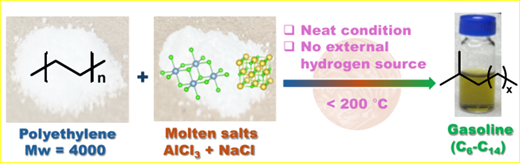
Oak Ridge National Laboratory-ийн эрдэмтэд полиэтилен хаягдлыг хямд өртөгтэй хайлмал давсны тусламжтайгаар шатахуун болон дизель түлшний молекул болгон задлах үр ашигтай технологийг боловсруулжээ.
Полиэтилен нь гялгар уут, хүнсний сав баглаа боодол зэрэг өдөр тутмын хэрэглээнд өргөн ашиглагддаг ч молекулын урт гинжин холбооны улмаас дахин боловсруулахад хүндрэлтэй байдаг. Судлаачид хөнгөн цагаан хлорид агуулсан хайлмал давсыг ашигласнаар 200 хэмээс доош температурт химийн урвал явуулж, хуванцрыг түлшний төрлийн нүүрсустөрөгчийн молекул болгон задлах боломжтойг тогтоожээ. Энэхүү арга нь уламжлалт пиролизийн процессоос ялгаатай нь үнэт металлын катализатор, органик уусгагч болон гадны устөрөгч шаарддаггүй давуу талтай юм.
2025 оны дөрөвдүгээр сарын 7-нд Journal of the American Chemical Society сэтгүүлд нийтлэгдсэн уг судалгаагаар, хайлмал давсан дахь хөнгөн цагааны нэгдлүүд нь хүчиллэг орчныг бүрдүүлж, хуванцрын молекулын гинжийг таслахад хэрхэн нөлөөлдгийг нарийвчлан судалсан байна. Эрдэмтэд Oak Ridge-ийн Spallation Neutron Source төхөөрөмжийг ашиглан урвалын явц дахь устөрөгчийн изотопуудын зан төлөвийг ажиглажээ. Туршилтын үр дүнд полиэтиленийг ойролцоогоор 60 хувийн гарцтайгаар шатахуун төст бүтээгдэхүүн болгон хувиргасан байна.
Гэсэн хэдий ч уг технологи нь одоогоор хөнгөн цагаан суурьтай давс чийг шингээх хандлагатай байдаг тул системийн тогтвортой байдлыг хангах сорилттой тулгарч байна. Цаашид судлаачид хайлмал давсыг хамгаалах болон ялгах процессыг сайжруулах зорилгоор галоген эсвэл нүүрстөрөгчийн материал ашиглах чиглэлээр судалгаа хийж байгаа бөгөөд уг технологид патент авахаар мэдүүлжээ.
Дэлгэрэнгүйг эх сурвалжаас харах
↓Эх сурвалжийг нээх ↓
A team of researchers has found a new way to transform common plastic waste into fuel-like products without using extremely high temperatures. The method could help tackle polyethylene waste, one of the most widespread and difficult-to-recycle plastics, by turning it into gasoline-like and diesel-like compounds.
The process was developed by scientists at Oak Ridge National Laboratory and works at temperatures below 200 degrees Celsius, producing fuel molecules from plastic without relying on precious metal catalysts, organic solvents or added hydrogen.
Polyethylene is everywhere. It is used in plastic bags, food containers, cutting boards and many other everyday products. But once these items are thrown away, recycling them can be complicated because the material is made of long chains of carbon and hydrogen atoms that are difficult to break down.
Many existing plastic conversion methods require very high temperatures and complex chemical systems. The Oak Ridge team wanted to find out whether molten salts could offer a simpler and more efficient alternative.
A New Way to Turn Plastic Into Fuel Molecules
The new method relies on molten salts containing aluminum chloride. When heated, these salts become liquid and create a special environment where chemical reactions can take place. They also act as catalysts, helping break polyethylene into smaller hydrocarbon molecules similar to those found in fuels.
According to Oak Ridge National Laboratory, the process converted polyethylene at temperatures below 200 degrees Celsius (392 degrees Fahrenheit) and produced a gasoline yield of around 60%. By comparison, pyrolysis, one of the common approaches used to break down plastics, generally requires temperatures between 450 and 500 degrees Celsius (842 and 932 degrees Fahrenheit).
Another difference is that the new technique avoids several materials often needed in plastic-to-fuel processes.
“Unlike traditional techniques for converting polymer to fuel, the new process did not require noble-metal catalysts, organic solvents or external hydrogen,” said Zhenzhen Yang, an ORNL staff scientist and co-corresponding author of the study.
Liqi Qiu, a postdoctoral researcher at the University of Tennessee, Knoxville, who carried out most of the experiments, described the method as an “efficient and selective polyethylene-to-gasoline conversion.” The researchers said commercially available inorganic salts were enough to drive the reaction.
Aluminum Breaks Plastic Chains
The study,published in the Journal of the American Chemical Society on April 7, 2025, also explored in greater detail what happens inside the molten salt mixture during the transformation. Polyethylene is made of very long molecular chains, and researchers found that aluminum sites in the molten salts create acidic conditions that help cut those chains into smaller hydrocarbon molecules.
To follow the reaction, scientists used deuterium, a heavier form of hydrogen, as a marker. They then used neutron scattering at Oak Ridge’s Spallation Neutron Source to observe how hydrogen and its isotopes behaved during the process.
“The polymer contains a lot of hydrogen,” said Sheng Dai, an ORNL Corporate Fellow and co-corresponding author of the study. “Neutrons are ideal at discerning light elements including hydrogen and its isotopes, such as deuterium.”

The structure of the original polyethylene influenced the type of fuel produced. Simpler chains tended to create gasoline-like compounds, while more complex chains produced diesel-like materials.
The scientists also studied the aluminum catalyst using soft X-rays at Lawrence Berkeley National Laboratory’s Advanced Light Source. They combined those results with other methods, including nuclear magnetic resonance, X-ray diffraction, gas chromatography-mass spectrometry and computer simulations, to better understand the chemical process.
A Solution With a Technical Barrier
The research builds on decades of work with molten salts at Oak Ridge. Scientists at the laboratory have studied these materials since the 1960s, including during the Molten Salt Reactor Experiment, before exploring their potential for converting plastic waste into useful products.
Molten salts can remain stable in difficult chemical environments, which makes them interesting for industrial applications. However, the current process still has a problem: the aluminum-based salts easily absorb water, which can affect the stability of the system.
Researchers are now looking for ways to better protect the molten salts and improve the separation process. Possible approaches include using halogens or carbon-based materials to make the system more stable.
“This advance may be promising for industry,” said Qiu, pointing out that plastic waste is widely available and that aluminum molten salts are inexpensive.The research team has also applied for a patent covering the technology.
Enjoyed this article? Subscribe to our free newsletter for engaging stories, exclusive content, and the latest news.

