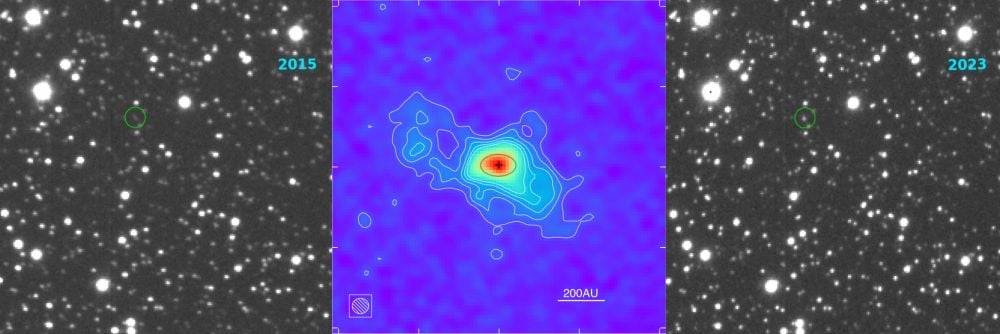
Эрдэмтэд “Сакурай” хэмээх одод тохиолдож буй ховор үзэгдлийг ажиглаж, уг од нь [Wolf-Rayet] төрлийн одны шинэ үе шатанд шилжсэнийг тогтоожээ.
“Сакурай” объект нь үндсэн дарааллын одоос улаан аварга од, улмаар цагаан одой од болон хувирч, мөхлийн ирмэгт ирээд байсан “зомби” од юм. Гэвч 1996 онд сонирхогч одон орон судлаач Юкио Сакурай уг одны гелийн бүрхүүлийн хүчтэй дэлбэрэлтийг илрүүлснээр, тус од дахин халалт, тэлэлтийн үе шатанд орсон байна. Сүүлийн 30 жилийн хугацаанд уг од зургаа дахин илүү халуун болж, одон орон судлаачдад одын хувьслын үйл явцыг бодит цаг хугацаанд ажиглах ховор боломжийг олгож байна.
Monthly Notices of the Royal Astronomical Society сэтгүүлд нийтлэгдсэн шинэ судалгаагаар, “Сакурай” объект нь одоогоор [WCL] ангиллын Wolf-Rayet төрлийн одны шинж чанарыг үзүүлж байгааг тогтоожээ. Энэ нь жинхэнэ Wolf-Rayet ододтой ижил спектрийн шинж тэмдэгтэй боловч хамаагүй бага масстай, ойролцоогоор 0.6 нарны масстай объект юм. Судлаачид Very Large Telescope болон түүний FORS2 спектрографийг ашиглан уг одны агаар мандлын тэлэлт болон химийн найрлагыг шинжилсэн байна.
Манчестерийн Их Сургуулийн профессор Альберт Зейлстра болон түүний багийнхан “Сакурай” объектын дахин халалт нь урьдчилсан загваруудад таамаглаж байснаас илүү аажмаар явагдаж байгааг тэмдэглэжээ. Энэхүү үзэгдэл нь үхэж буй оддын түр зуурын идэвхжлийн үеийн физик процессыг судлах, онолын загваруудыг шалгах чухал ач холбогдолтой юм. Уг од ирэх арван жилүүдэд үргэлжлүүлэн агшиж, халах төлөвтэй байгаа бөгөөд эцэстээ дахин тогтвортой цагаан одой од болох эсвэл гариг хоорондын мананцар болон хувирах магадлалтай байна.
Дэлгэрэнгүйг эх сурвалжаас харах
Эх сурвалжийг нээх ↓
Stars go through a host of changes as they evolve, but most of the time, those changes play out on astronomical timescales. Supernovae are an exception to this, but they’re rare, and most stellar changes take millions or billions of years to play out. Not so with one star named Sakurai’s object.
Sakurai’s object is a star that has shifted identities, and is often described as ‘born again.’ It was a main sequence star that swelled up and became a red giant. After that, its evolution continued and it became a white dwarf, a zombie star that radiates only remnant heat. Then it experienced a powerful and late thermal pulse known as a helium shell flash. As a result, the star swelled up and heated up again.
Sakurai’s object is named after amateur astronomer Yukio Sakurai, who spotted the pulse in 1996. It’s very rare to watch a star go through something like this on human timescales. In 30 years, it has become six times hotter due to a helium flash. And the spectacle is not over, according to researchers.
Sakurai’s Object is in the Sagittarius constellation and is undergoing a helium flash. These events have rarely been observed, making Sakurai’s Object an important object for astronomers studying stellar evolution. It was a zombie star prior to the flash, a white dwarf. Now, it’s heating up and expanding. Eventually, it will become a white dwarf again. Image Credit: By ESO, cropped by Sn1per – https://www.eso.org/public/images/potw1531a/ (cropped from File:White Dwarf Resurrection.jpg), CC BY 4.0, https://commons.wikimedia.org/w/index.php?curid=46477464
New research in Monthly Notices of the Royal Astronomical Society says Sakurai’s object has entered a new stellar phase and is a [Wolf-Rayet] type star. The research is “The emergence of a [WC] star in Sakurai’s object,” and the lead author is W. Marcolino from Observatorio do Valongo in Rio de Janeiro, Brazil.
“Sakurai’s object provides a rare opportunity to observe stellar evolution on human time-scales,” the authors write. “Since its born-again event and detection in 1996, its evolution has been extensively monitored, and recent optical spectroscopy has suggested the emergence of [WR]-type emission features.”
[WR]-type stars are not true Wolf-Rayet stars. The brackets denote a different type of star entirely, but with the same emission-line spectral signature as true WR stars. They’re also known for their strong stellar winds, like true WR stars. The main difference are their masses. [WR] type stars are far less massive than true WR stars. Sakurai’s object is only about 0.6 solar masses, whereas as WR stars are far more massive and can explode as supernovae.
“Most stars evolve so slowly that major changes take place over timescales far longer than a human lifetime,” said co-author Professor Albert Zijlstra from Jodrell Bank Centre for Astrophysics at The University of Manchester. “As a result, we usually have to piece together snapshots of stellar evolution by comparing different stars at different stages of their lives.”
“Sakurai’s Object offers something far rarer,” Zijlstra added. “It is one of the very few stars known to have changed dramatically within just a few decades, giving us the opportunity to watch stellar evolution unfold in real time.”
The researchers worked with observations from the Very Large Telescope and its FOcal Reducer/low dispersion Spectrograph 2 (FORS2), coupled with models of expanding stellar atmospheres.
Different models reflect different types of stars, and in this work, the researchers plotted their data against different stellar models to determine which type of star they are looking at. Establishing links between temperature and emission lines is the key to this.
“Several observed emission lines arise in a [WR]-type stellar wind, establishing the central star as a [WR] object,” the researchers explain.
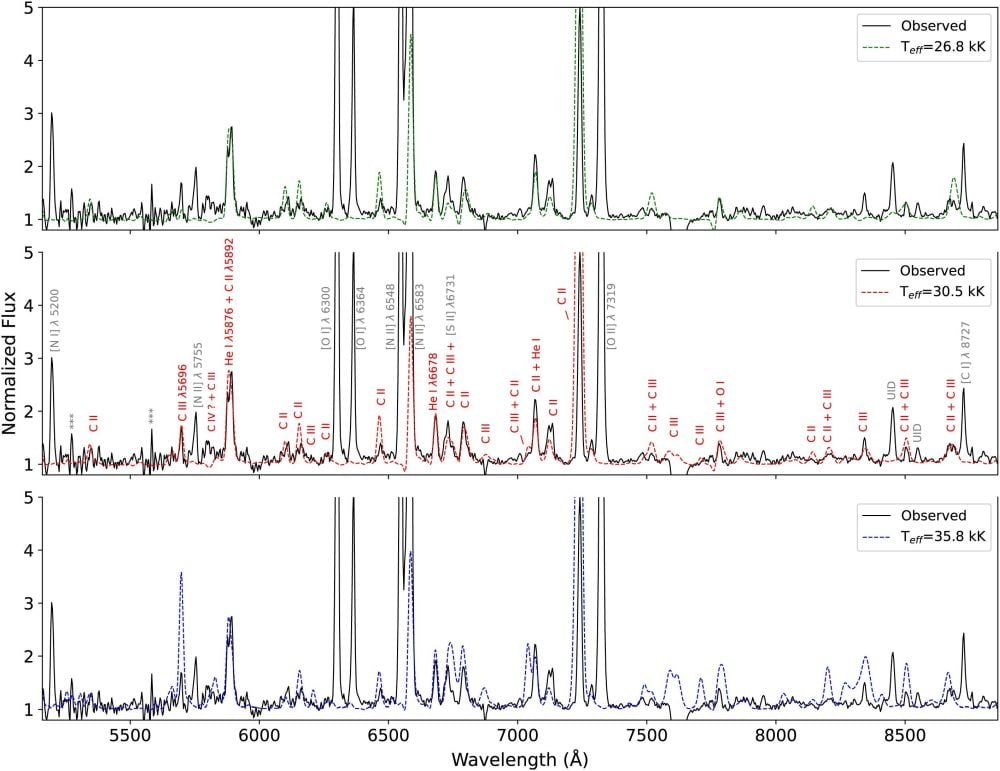 In these panels, the black solid line represents the VLT/FORS2 spectrum of Sakurai’s object. The green, red, and blue dotted lines show different synthetic Wolf-Rayet spectra with different temperatures. “Our fits rule out temperatures above 36 kK and below 27 kK. Our best model is depicted in the middle panel,” the authors write. They also point out that doubly-ionized carbon (CIII) is stronger at higher temperatures. Image Credit: Marcolino et al. 2026. MNRAS.
“The relative intensities of several optical emission lines are reasonably reproduced by our synthetic spectra, indicating that most originate from C ii–iii and He i,” the researchers explain. “Our results support a [WCL] classification for Sakurai’s Object…”
A WCL is a Wolf-Rayet-type star that’s dominated by carbon and oxygen lines. The L stands for “late-type” which signifies lower temperatures and weaker winds than WCE, which are early type stars.
It took patience to reach this understanding of Sakurai’s Object. As a WCL star, it’s a prolific dust producer, mostly carbon. After its outburst in 1996, it was shrouded in thick gas and dust and became difficult to observe optically. It’s still shrouded, but astronomers studied the dust composition and temperature over time, leading to this conclusion.
Sakurai’s Object is currently re-heating. This offers an ongoing opportunity to test stellar models against observations.
“One of the key questions is how quickly Sakurai’s Object should recover after its dramatic eruption,” Professor Zijslstra said. “Our measurements show that the star is reheating more gradually than some earlier models predicted. That gives us an important way of testing which theories best describe what happens when a dying star briefly springs back to life.”

“Continued spectroscopic monitoring of SO remains essential. Born-again objects provide a rare opportunity to observe stellar evolution in real time and place unique constraints on Very Late Thermal Pulse evolution and the emergence of hydrogen-deficient central stars,” the authors conclude.
Sakurai’s Object has an interesting evolution ahead of it. It will keep contracting and heating in the coming decades. Eventually, it should stabilize as a white dwarf again. But there’s still a possibility for more activity. These pulses or instabilities are not a certainty; the born again star may be on a steady trajectory to white dwarfdom. In that case, it will steadily come to resemble the many gorgeous planetary nebula we love to gaze at.
Along the way, astronomers and astrophysicists will learn a lot.
“As we continue to monitor the star over the coming years, we expect to learn much more about this remarkable phase of stellar evolution,” Professor Zijlstra concluded.

