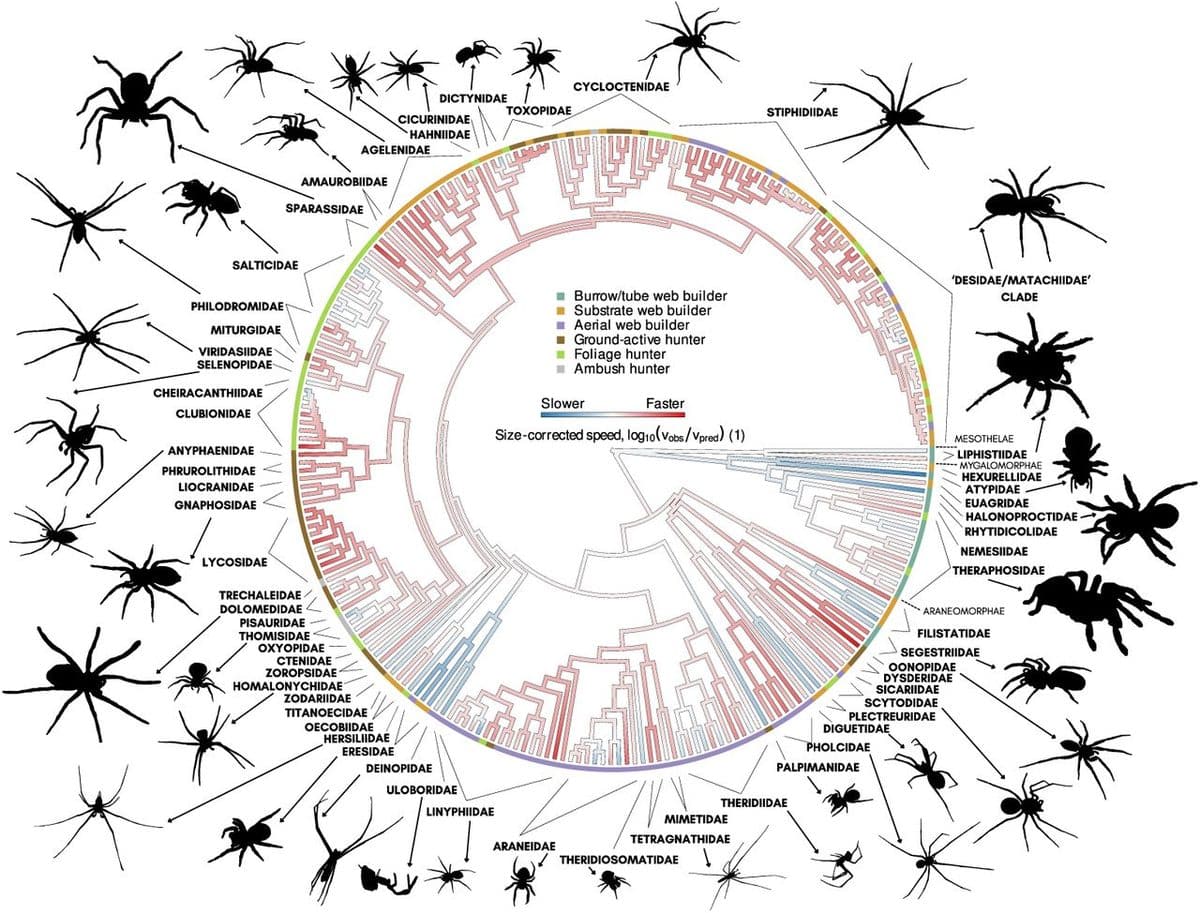
Их Британийн Imperial College London-ийн судлаачид 258 төрлийн аалзыг харьцуулан судалсны дүнд Австралийн ойн бүсэд амьдардаг Heteropoda jugulans нь хамгийн өндөр хурдтай болохыг тогтоожээ.
Судлаачид аалзны хөдөлгөөн болон биеийн бүтэц хоорондын уялдаа холбоог ойлгох зорилгоор 64 овогт багтах 258 зүйлийн аалзыг судалж, хөдөлгөөний хурдыг нь хэмжсэн байна. Туршилтын явцад Австралийн Квинсленд мужийн ойд амьдардаг Heteropoda jugulans аалз секундэд 3.59 метрийн хурдтай гүйж, өмнөх дээд амжилтыг эвдсэн нь тогтоогджээ. Энэ үзүүлэлт нь өмнө нь дэлхийн хамгийн хурдан аалзаар тооцогдож байсан Мороккогийн цөлийн аалзны 1.7 м/с хурдыг хоёр дахин барагдуулсан амжилт юм.
Шинжлэх ухааны багийг удирдсан Шрея Кучибхотла нарын судлаачид аалзны хурд нь биеийн хэмжээ болон бүтцээс хэрхэн хамаарч байгааг нарийвчлан шинжилжээ. Судалгаагаар хамгийн хурдан аалзнууд нь биеийн хэмжээтэйгээ харьцуулахад урт хөлтэй байдаг нь хурдлах чадварт гол нөлөө үзүүлдэг болохыг тогтоосон байна. Мөн маш жижиг биетэй аалзнууд хүртэл өөрийн хэмжээндээ харьцангуй өндөр хурдыг үзүүлж чаддаг болохыг судалгааны үр дүн харуулжээ.
Судлаачид аалзны амьдрах орчин буюу мод эсвэл газар амьдардаг байх нь гүйх хурдад шууд нөлөөлдөггүй гэж дүгнэв. Мөн бүх аалз амьд үлдэхийн тулд хурд шаарддаггүй бөгөөд олон зүйл нь тороо ашиглах эсвэл олзоо хүлээн отох зэрэг өөр стратегийг ашигладаг байна. Энэхүү судалгаа нь аалзны төрөл зүйлүүдийн хөдөлгөөний механикийг илүү гүнзгий ойлгох боломжийг бүрдүүлж байгаа юм.
Дэлгэрэнгүйг эх сурвалжаас харах
↓Эх сурвалжийг нээх ↓
A spider discovered in Australia has just claimed an unexpected world record, it is officially the fastest spider ever measured. The Heteropoda jugulans, a huntsman spider also known as the jungle huntsman, can reach a speed of 3.59 metres per second, a performance that easily surpasses previous records.
The discovery was made by a team of researchers from Imperial College London after comparing the movements of hundreds of species. Their goal was to understand why some of them are able to move so quickly and which physical features give them such an advantage.
They are often associated with patience and stillness, especially when they wait for prey inside their webs. However, some species are highly active hunters capable of remarkable bursts of speed when chasing prey or escaping threats.
With this research, scientists wanted to move beyond individual observations. They studied a wide range of species from different parts of the world to better understand the relationship between their speed, body structure and movement.
An Australian Huntsman Spider Takes The Speed Record
The new speed champion is Heteropoda jugulans, a species found in the forests of Queensland, Australia. This spider, which weighs around three grams, was recorded moving at a maximum speed of 3.59 metres per second.
According to data published on BioRxiv, this performance is far above the previous official record of 1.7 metres per second. That record belonged to Cebrennus rechenbergi, a Moroccan desert one famous for using a unique escape technique in which it rolls across the sand to move quickly.
The difference between the two species is significant. The Australian huntsman does not rely on rolling movements but instead runs using its eight long legs. Researchers found that its body appears perfectly adapted for this type of movement, combining muscular power with a lightweight structure.
Despite its impressive ability, Heteropoda jugulans is not a large animal. Its achievement shows that extreme speed is not only linked to body size but also depends on how an animal’s body is built.
258 Spiders Tested, One Became The Fastest
To identify the world’s fastest spider, researchers did not focus on only a few well-known species. They carried out a large comparison involving 258 different spider species belonging to 64 families.
As explained by the study led by Shreyas Kuchibhotla and his team, 162 living specimens were collected during missions in the United Kingdom, North America, southern Europe and Australia. Additional measurements were also gathered from specialised animal collections and other research laboratories.

Each eight-legged predator was weighed before being tested on A4 or A3 grid paper to accurately measure its speed. Some species moved naturally, while others needed gentle encouragement. Researchers used a soft brush for spiders that were reluctant to move and short bursts of compressed air for some mygalomorph spiders that were less likely to flee.
This approach allowed scientists to create one of the most detailed comparisons of the creature movement ever assembled. The results showed that speed does not simply depend on whether a web-building creature is large or small.
Why Some Spiders Run Faster Than Others?
After collecting the speed measurements, the study team looked at the physical characteristics that could explain why some outperform others. One of the main factors identified was leg length.
The fastest spiders generally have longer legs compared with their body size. This feature allows them to cover more distance with each movement and improves their efficiency when running.
The study also revealed surprising examples among extremely small ones. The researchers said that the orange goblin spider, Oonops pulcher, weighs only around 0.1 milligrams but can still move at more than 20 centimetres per second.

Scientists also found that having thinner legs does not necessarily make a spider faster. Likewise, its lifestyle, whether it lives mainly in trees or on the ground, does not appear to directly determine its running ability.
For slower spiders, speed is not always necessary for survival. Many species rely on other strategies, such as building webs or waiting for prey in ambush.
Enjoyed this article? Subscribe to our free newsletter for engaging stories, exclusive content, and the latest news.

