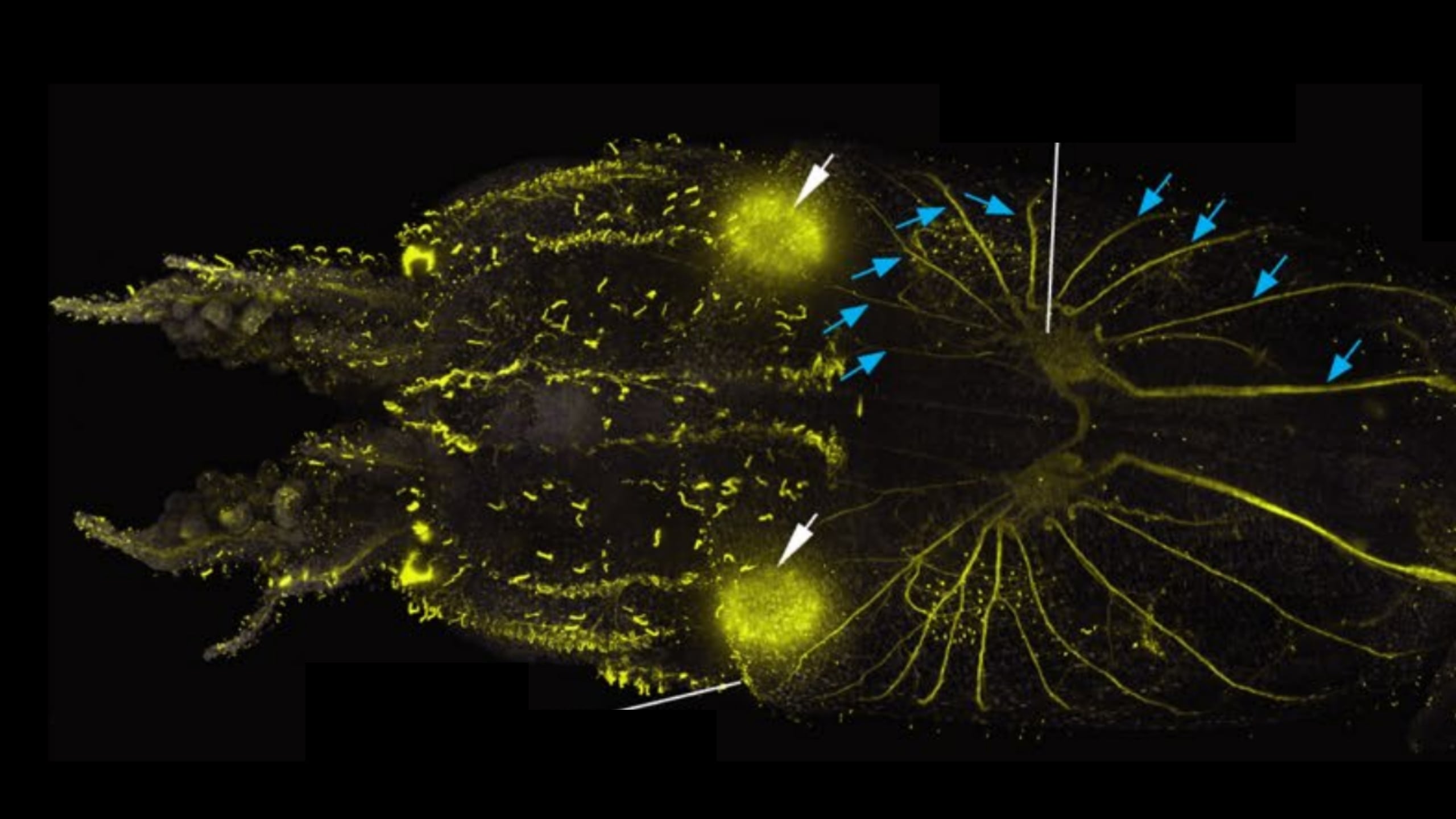
Эрдэмтэд далайн амьтдын арьсан дээрх үсэрхэг эсүүд нь хүний дотоод чихний сонсголын эсүүдтэй төстэй бүтэцтэй бөгөөд усны хөдөлгөөнийг мэдэрдэг болохыг илрүүллээ.
Current Biology сэтгүүлд нийтлэгдсэн судалгаагаар, далайн Doryteuthis pealeii хэмээх амьтны биеийн гадаргууг усны давалгаа болон хөдөлгөөнийг мэдрэх чадвартай, үсэрхэг бүтэцтэй эсүүд бүрхдэг болохыг тогтоожээ. Хүн болон бусад сээр нуруутан амьтдад ийм эсүүд нь зөвхөн дотоод чихэнд байрлаж, дууны долгионыг хүлээж авдаг бол далайн амьтдад эдгээр нь биеийн гадаргуу дээр тархсан байдаг аж. Case Western Reserve их сургуулийн судлаач Брайан Макдермотт болон түүний баг гэрлийн микроскопийн тусламжтайгаар эдгээр эсийн байршил, хэлбэр хэмжээг нарийвчлан судалсан байна.
Судалгааны үр дүнд далайн амьтдын арьсан дээрх эсүүд нь усны урсгалын өөрчлөлт, ойр орчмын амьтдын хөдөлгөөнийг хүлээн авах чиглэлээр төрөлжсөн, өөр өөр урттай үсэрхэг багцууд болохыг илрүүлжээ. Энэхүү нээлт нь зөвхөн далайн амьтдын амьдрах орчиндоо дасан зохицох механизмыг тайлаад зогсохгүй, хүний сонсгол алдагдах эмгэг болон сонсголын эрхтний үйл ажиллагааг ойлгоход чухал ач холбогдолтой юм.
Макдермоттын тайлбарласнаар, хүний сонсгол алдагдах тохиолдлын ихэнх нь чихний доторх үсэрхэг эсүүдийн гэмтэлтэй холбоотой байдаг тул далайн амьтдын энэхүү бүтцийг судлах нь эмнэлгийн салбарт шинэ боломж нээж болзошгүй байна. Энэхүү судалгаа нь хэдэн зуун сая жилийн хувьслын ялгаатай амьтдын хоорондох сонсголын эрхтний ижил төстэй талыг шинжлэх ухааны түвшинд нотолсон нь анхаарал татаж байна.
Дэлгэрэнгүйг эх сурвалжаас харах
↓Эх сурвалжийг нээх ↓
The skin of a squid, surprisingly, has much in common with an organ inside your ear.
As reported in a new study in Current Biology, scientists have found that squid are covered in cells with little hair-like structures, similar to those inside human ears, which detect information carried by passing waves.
For humans, these little hairs help us to interpret sound waves from a melody or a voice, or the honk of an impatient driver.
For squid, it’s all the little details carried in water movement: the twitch of nearby prey, the rumble of a distant shore, the pull of a current.
Until now, scientists had no idea that squid were totally studded with these hair cells – and the discovery may be able to tell us something about our own hearing equipment.
Brian McDermott from Case Western Reserve University is an otolaryngologist – a scientist who studies inner ears, noses, and throats.
As a medical researcher, he started out trying to understand human hearing and deafness. But by tracing the lineage of the specialized hair cells that bring music to our ears, he has now arrived at the longfin inshore squid (Doryteuthis pealeii): an animal separated from humans by hundreds of millions of years of evolution.
“Squid are cephalopods with a diverse population of hair cells on the surface of their bodies, which may yield insights not only into how these fascinating animals detect water movement to survive, but also into how hearing and deafness occur in humans,” McDermott says.
Before we go further, it’s probably important to note that the hair cells we’re talking about here have nothing to do with the hair that grows from follicles in your skin. In all vertebrates, except fish, hair cells exist only within organs in our ears (remember the fish part – we’ll come back to that).
For vertebrates that live on land, hair cells are crucial to hearing. They line the inner surface of the cochlea, which is a spiral-shaped, fluid-filled organ that, from the outside, looks a lot like a snail.
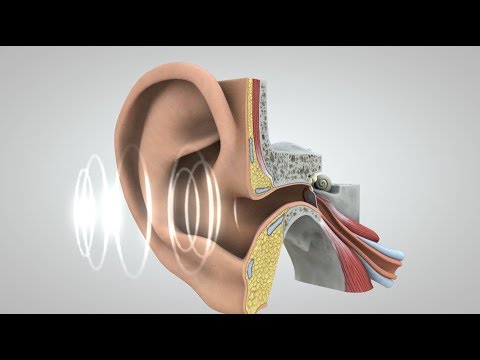
If someone hears a sound, it’s typically because waves in the air have traveled into their ears, vibrating their eardrums and a succession of tiny bones that then translate this movement into waves in the cochlear fluid.
It’s these fluid waves that the hair cells of a human ear are attuned to. As the ‘hairs’ wave about within the cochlear fluid, their movement is translated by the cell into a message that can be sent on to the brain. It’s at this point that we perceive sound.
Inside a human ear, not all hair cells are identical. Some have bundles of long hairs, which are much better at picking up low-pitched sounds, while some have short hairs, ideal for high-pitched frequencies.
Here’s where fish come in. Fish, unlike many other vertebrates, have hair cells on the outside of their bodies, in an organ called the lateral line.
Other sea creatures – including squid – have lateral lines too. When you spend your whole life underwater, the waves in your surroundings are already transmitted by fluid.
Unlike us landlubbers, marine animals don’t have to translate the waves from air to fluid: their hair cells can pick up that motion directly from the source.
But in fish, the ‘hairs’ are more or less the same length.
Squids, on the other hand, seem to have evolved diverse, specialized hair cells much like our own.
He and his team mapped the entire bodies of several hatchling squid using light-sheet microscopy, which makes the squids’ hair cells light up in pictures.
“Unexpectedly, we identified hair bundles organized in two patterns: previously
described linear arrays and broad regional fields that have not been explicitly reported in squid or fish, which we term lateral line fields,” the team reports.
“Anatomical positions and corresponding variation in hair bundle lengths suggest some lateral lines detect distinct stimuli.”
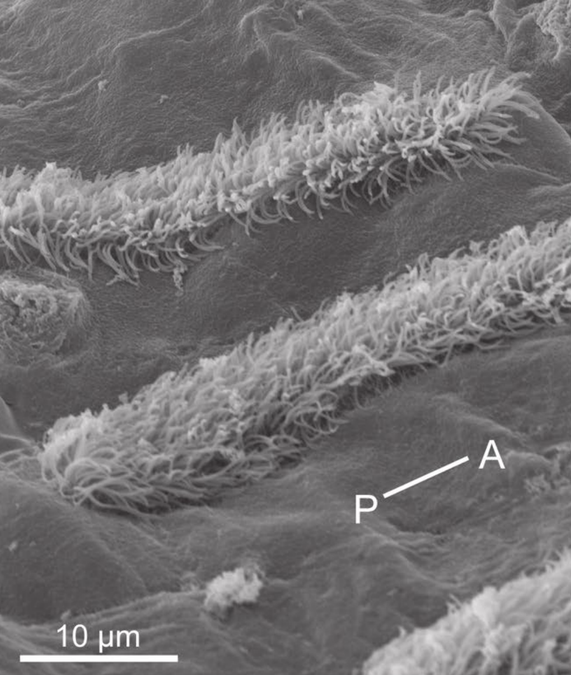
For instance, on the squid’s mantle, hair bundles were very short compared to those on the head lateral line.
“Our results show that the whole squid’s surface is elaborately ornamented with varied lateral lines that likely register specific types of local water movements,” the team concludes.
It’s pretty fascinating stuff in its own right, but McDermott’s interests are primarily medical. He believes squid could be useful models for understanding how human hearing works, or, in some cases, doesn’t.
“Often, when a child is born deaf or a hearing person loses their hearing, it is the hair bundle that has been damaged,” McDermott said.
“So, studying the squid’s hair bundle holds promise for understanding how hearing loss occurs.”
The research has been published in Current Biology.
This article was fact-checked by Rachel Garner and edited by Peter Dockrill. While we pride ourselves on our process, we are only human. If you spot a mistake, please let us know.

