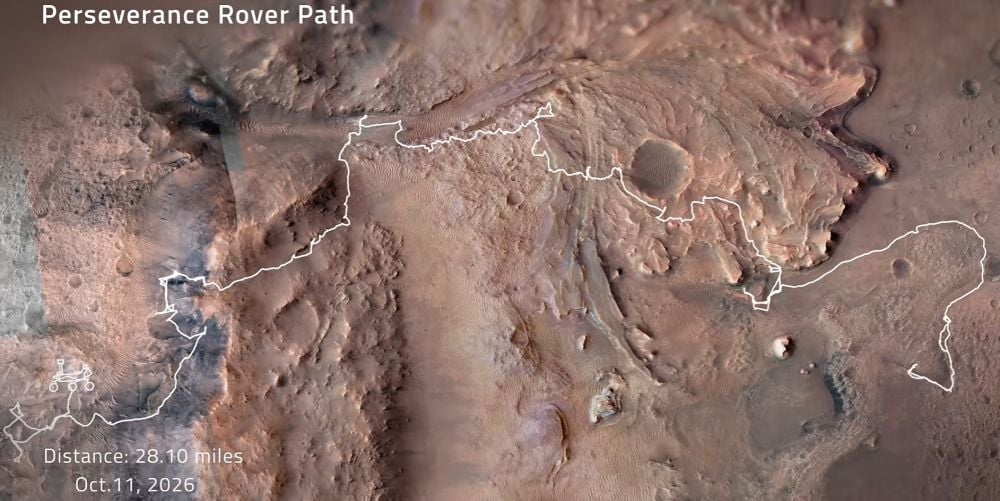
NASA-гийн Perseverance ровер Ангараг гараг дээр 5.5 жилийн хугацаанд 45.22 км замыг туулж, өмнөх бүх рекордыг эвдлээ.
2021 оны хоёрдугаар сарын 18-нд Ангараг гарагийн Jezero тогоонд газардсанаас хойш Perseverance нийт 45.22 км замыг туулсан нь NASA-гийн өмнөх Opportunity роверын 15 жилийн турш туулсан 45.16 км-ийн амжилтыг давсан үзүүлэлт юм. Энэхүү амжилт нь роверын бие даасан жолоодлогын AutoNav систем болон түүний дэвшилтэт технологийн үр дүн гэдгийг төслийн удирдагч Стивен Ли онцоллоо. Анхны даалгаврын төлөвлөгөөнд ердөө 20 км (12.4 миль) зам туулахаар заасан байсан ч ровер энэ хэмжүүрийг хол давжээ.
Одоогоор “Lac de Charmes” бүсэд ажиллаж буй Perseverance нь эртний чулуулгуудаараа алдартай “Idubi” нэртэй цэгийг чиглэн явж байна. Эрдэмтэд тус газраас тунамал чулуулаг төдийгүй халуун усны нөлөөгөөр үүссэн флюорит бүхий магмын чулуулгуудыг илрүүлсэн нь Ангараг гараг дээр эрт цагт гидротермаль үйл ажиллагаа явагдаж байсныг нотлох чухал баримт болж байна. Энэхүү гидротермаль системүүд нь амьдралын ул мөр, тэр дундаа бичил биетний үлдэгдлийг хадгалан үлдээсэн байх магадлалтай тул астробиологийн судалгаанд онцгой ач холбогдолтой юм.
AutoNav систем нь газрын зураглалыг 3D хэлбэрээр бүтээж, өөрөө замыг сонгох замаар нэг өдөрт 412 метр хүртэлх замыг туулах боломжийг олгодог. 2026 оны аравдугаар сарын 11-ний байдлаар роверын нийт аяллын 90 орчим хувийг энэхүү бие даасан систем гүйцэтгэжээ. Цаашид нарны хурц гэрлийн нөлөөг даван туулах программ хангамжийн шинэчлэл хийгдсэнээр роверын өдөрт туулах зай улам нэмэгдэх төлөвтэй байна.
Ангараг гарагаас цуглуулсан 29 дээжийг эх дэлхийд авчрах төлөвлөгөө одоогоор санхүүгийн болон техникийн шалтгаанаар тодорхойгүй байгаа ч Perseverance-ийн судалгааны ажил 2028 оныг дуустал үргэлжлэх юм. Энэхүү урт хугацааны аялал нь Ангараг гараг дээрх амьдралын эртний ул мөрийг илрүүлэх хүн төрөлхтний зорилгод томоохон хувь нэмэр оруулсаар байна.
Дэлгэрэнгүйг эх сурвалжаас харах
Эх сурвалжийг нээх ↓
After five-and-a-half years on Mars, NASA’s Perseverance Rover has set a distance record for travel on another world. Since landing in Mars’ Jezero Crater, an ancient paleolake, on February 18, 2021, Perseverance has travelled 45.22 km, or 28.10 miles. That puts it slightly ahead of NASA’s Opportunity rover, which travelled 45.16 kilometers (28.06 miles) during its mission. It must be noted, however, that Perseverance took only 5.5 years to travel this far, while Opportunity required almost 15 years.
Comparing the plutonium-powered Perseverance to the solar-powered Opportunity is unfair. But in any case, Perseverance deserves recognition for this milestone.
“The original mission called for no more than 12.4 miles of driving. We’ve blown well past that…” – Steven Lee, Perseverance and Curiosity project manager, JPL/NASA.
Perseverance is currently in a region named “Lac de Charmes,” which is off the western end of Jezero Crater. It reached its new milestone while heading toward a feature named “Idubi,” a scientific target notable for its ancient rocks. On Earth, there are no rocks as old as these because they’ve all been destroyed by plate tectonics.
Perseverance has found igneous rocks, a surprising result considering that scientists expected to find mostly sedimentary rocks. In fact, a primary reason Jezero Crater was chosen as the mission’s landing site is because sedimentary rocks are good at preserving evidence of ancient life. While the rover found plenty of sedimentary rocks, it found igneous rocks, along with fluorite, which forms when rock interacts with heated water. This is evidence of hydrothermal activity, and scientists are hoping Perseverance will find more traces of ancient hydrothermal systems at Idubi.
Perseverance captured this backward-looking image on the day it set its new distance-travelled record. The date was Oct. 11th 2026, or on the 2006th Martian sol of its mission. Image Credit: NASA/JPL-Caltech
Perseverance’s skill at travelling long distances rests on more than just its power source. It also has an autonomous navigation system called AutoNav. AutoNav continuously takes images of the terrain and creates a 3D map of hazards. It uses this information to plot its own course. It can do this while travelling close to its top speed, and as a result, it can travel up to 412 meters (1,351 feet) in one Martian day.
Spirit and Opportunity were the first rovers to use AutoNav, though theirs wasn’t as sophisticated. Those twin rovers used their first-generation AutoNav to travel about 5% of their total distance, while Perseverance has relied on it for about 90% of its travelled distance. (Sojourner used a limited form of hazard detection, but nothing as sophisticated as AutoNav.)
Steven Lee is the project manager for Curiosity and Perseverance at NASA’s Jet Propulsion Laboratory in Southern California. “It is an honor to be working on Perseverance at a moment when the technology has evolved to the point that drives like these are routine,” Lee said in a press release. “The original mission called for no more than 12.4 miles of driving. We’ve blown well past that, and with all mobility systems fully operational and favorable extended-ground-life test results, we expect Perseverance to keep adding to this record for many years to come.”
Perseverance is on its extended mission now, which began this month. The mission will have the rover exploring the rim of Jezero Crater until about the end of 2028. Throughout its primary mission, software updates have given its AutoNav increasing sophistication, and that should continue through its extended mission.
“The rover that broke this record did so by making its own decisions about the path,” said Mark Maimone, the deputy team chief of Perseverance’s robotic operation. “Given the autonomy to just go, Perseverance is a better driver than the one that landed, and we’re not done. Our newest software teaches Perseverance to steer less and roll more, and to check its own position against orbital maps mid-drive.”
The glare from the Sun is the next obstacle to be overcome with the rover’s AutoNav system. The Sun’s glare places limits on the rover’s operations, and by overcoming that, the rover’s daily maximum distance travelled will grow.
“The next frontier is sunlight itself,” Maimone said. “Glare in the navigation cameras is why we park by mid-afternoon if we’re driving toward the Sun, and if we can teach the rover to see past those artifacts, every rover that follows gets a longer working day.”
The distance records themselves are remarkable, and they illustrate NASA’s growing prowess in robotic exploration. But the real payoff is the increased science operations. The further it can travel in less time, the more geologic targets Perseverance can explore. And after all, Perseverance studies Martian geology in order to meet the objectives of its astrobiological mission.
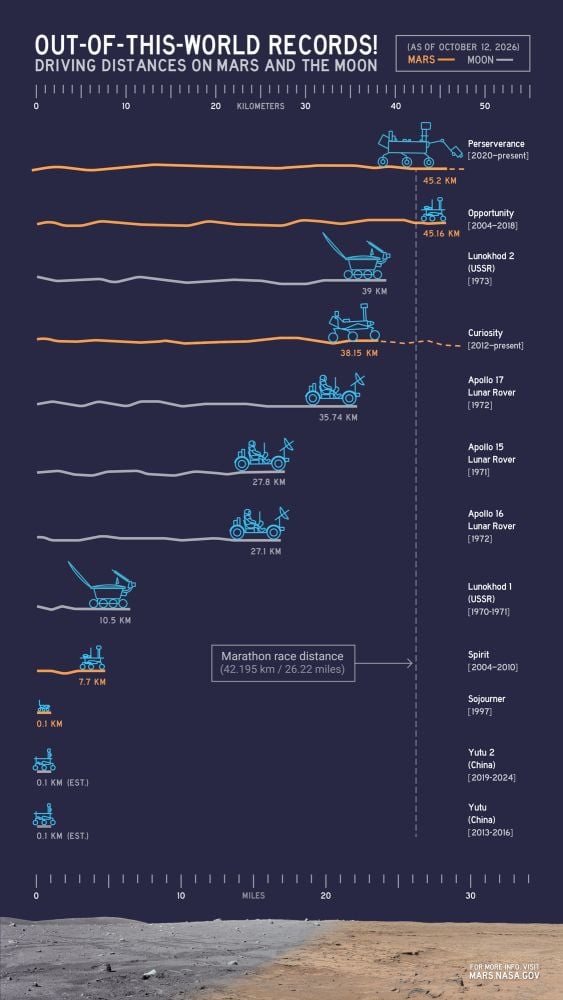 This infographic shows how far various rovers have travelled on the surface of Earth’s Moon and Mars. Only Perseverance and Curiosity are still operational and moving across the surface; the figures shown for those two are distances driven as of Oct. 11, 2026. Image Credit: NASA/JPL-Caltech
Among the mission’s highlights, which are partly attributed to its AutoNav capabilities, Perseverance has discovered potential biosignatures, and may yet discover ancient hydrothermal systems. Hydrothermal systems are like a ‘Holy Grail’ in astrobiology because they provide water, heat, and chemistry important for life. Hydrothermal systems may also contain fossilized evidence of ancient, simple life, in the form of microscopic structures, organic molecules, and even microbial mats.
The only sad part of Perseverance’s mission concerns the samples it’s gathered. Perseverance has cached 29 samples of Martian rock and regolith as part of a future Mars Sample Return mission. That mission was to be a cooperative endeavour between NASA and the ESA, but as of now, there’s no firm commitment to the mission. It’s currently deemed to expensive, and there are many unanswered questions about its potential success.
While Perserverance’s AutoNav represents an impressive feat beyond the capabilities of previous rovers, the system also inspires an even more capable future. It’s easy to imagine a future mission using AutoNav and AI to coordinate multiple rovers and even UAVs to coordinate the study of specific, hard-to-reach yet scientifically important targets on Mars and elsewhere. Think caves, elevated outcrops, and other challenging terrain.
But for now, we can enjoy Perseverance’s accomplishments, which bring us closer to potentially, hopefully, finding conclusive evidence of ancient life on Mars.

