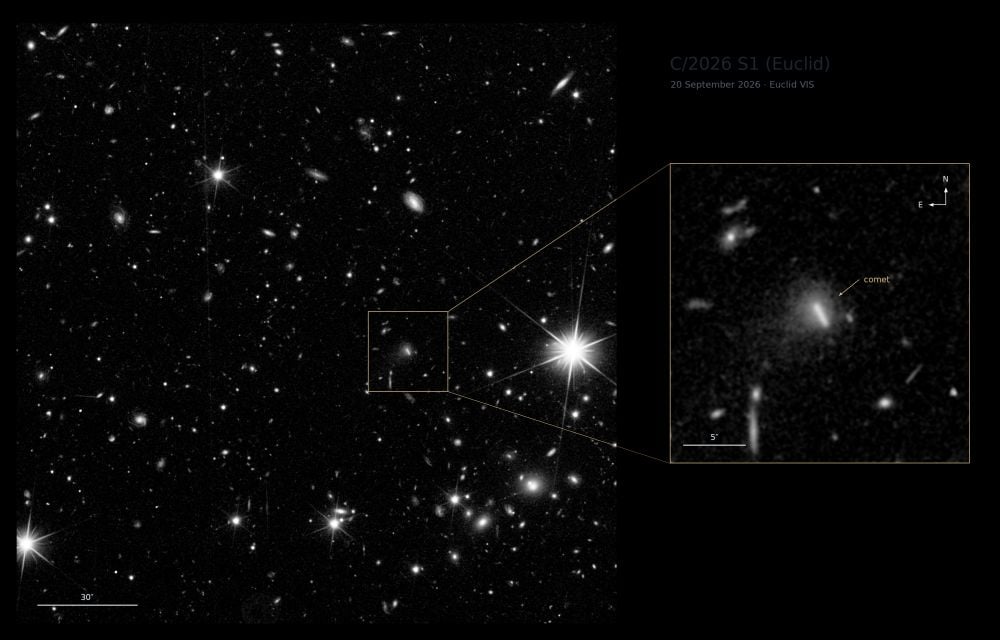
Алс холын галактикуудыг судлах зорилготой тус дурангийн шинэ программ хангамжийн тусламжтайгаар Нарны аймгийн үл мэдэгдэх биетийг санамсаргүйгээр олжээ.
ESA-ийн Euclid сансрын дуран нь үндсэн зорилго болох тэрбум гаруй галактикийг ажиглах явцдаа анх удаагаа сүүлт од илрүүлэв. 2023 оны долоодугаар сарын эхээр хөөргөсөн тус дуран нь 10 тэрбум жилийн тэртээх түүхийг судлах замаар орчлон ертөнцийн тэлэлт болон харанхуй энергийн мөн чанарыг тодорхойлох зорилготой юм. Хэдийгээр уг дуран нь галактикийн гүн зураглал авахаар бүтээгдсэн ч 2026 оны есдүгээр сарын 16-наас 24-ний хооронд хийсэн ажиглалтаар Нарны аймаг дахь хурдан хөдөлгөөнтэй биетийг олж илрүүлсэн нь гэнэтийн амжилт боллоо.
Энэхүү нээлтийг Хельсинкийн их сургуулийн Микко Понтинений боловсруулсан шинэ программ хангамжийн тусламжтайгаар хийжээ. Euclid консорциумын Нарны аймгийн биетүүдийг судлах ажлын хэсгийнхэн уг программ нь олон зураг дамнан хурдан хөдөлж буй “зураас” буюу сүүлт одны ул мөрийг илрүүлсэнийг баталгаажуулсан байна. Цаашдын шинжилгээгээр уг биет нь тоос, хий ялгаруулж буй идэвхтэй сүүлт од болох нь тогтоогджээ.
C/2026 S1 (Euclid) нэртэй уг сүүлт од нь Дэлхийгээс 1.3 тэрбум км орчим зайд, Бархасбадь болон Санчир гарагийн орбит хоорондын зайд оршиж байна. Энэ нь олон мянган жилийн хугацаанд нэг удаа бүтэн тойрог зам үүсгэдэг урт хугацааны сүүлт од юм. Уг биет нь галактикийн хавтгайг даган хөдөлдөг бусад биетүүдээс ялгаатай нь галактикийн дээрүүр нуман хэлбэрээр хөдөлдөг тул Euclid-ийн ажиглалтын талбарт санамсаргүйгээр өртсөн байна.
Эрдэмтдийн мэдээлснээр, Euclid дуран нь тоосжилт ихтэй тул Сүүн зам галактикийн хавтгайг ажиглахаас зайлсхийдэг. Гэсэн хэдий ч Драко одод орших “Euclid Deep Field North” талбарт хийсэн ажиглалт нь Нарны аймгийн биетүүдийг судлах чухал туршилт боллоо. Энэхүү нээлт нь сансрын дурангуудын хамтын ажиллагаа болон ирээдүйн судалгааны ажлыг уялдуулахад үнэтэй туршлага болж байна.
Дэлгэрэнгүйг эх сурвалжаас харах
Эх сурвалжийг нээх ↓
The ESA’s Euclid Space Telescope has discovered its first comet, a result that’s not part of its primary mission. The telescope was launched at the beginning of July, 2023, and its mission is to observe about 1.5 billion galaxies out to redshift z=2, which corresponds to seeing around 10 billion years into the past. The goal is to measure the redshift of a massive amount of galaxies, to shed light on the expansion history of the Universe and the force that drives it, dark energy.
The space telescope has observed other comets, but this is the first time it’s discovered one. The comet was found in multiple images captured between September 16th and 24th, 2026. For a telescope built to take deep images of distant galaxies, discovering a rapidly moving comet in the Milky Way is a surprising bonus.
The comet didn’t announce its presence. The discovery relied on new software designed by Mikko Pöntinen of the University of Helsinki. Pöntinen, together with the Solar System Objects Science Working Group of the Euclid Consortium, discovered it.
“I was excited to see my software flag a ‘streak’ smeared across several images – the result of a fast-moving object,” Pöntinen said in an ESA press release. “By predicting its position I could identify it in other images, in total finding it in five image sets. Further inspection revealed that it had a fuzzy cloud around it, indicative of an active object like a comet that is shedding dust and gas.”
Comets are dusty, icy bodies left over from the earliest days of the Solar System, more than four billion years ago. They come from the Oort Cloud and the Kuiper Belt. When a comet approaches the inner Solar System, the Sun heats it up, and some of its frozen volatiles form a hazy cloud around the comet called a coma, as well as a tail. Astronomers are interested in comets because they’re pristine material from the Solar System’s formative years, and hold clues to the process of Solar System formation. They may be especially relevant as deliverers of water to the inner Solar System, including to Earth.
Pöntinen compared the discovery with known comets—and asteroids—and found no match with existing Solar System objects. He reported the discovery to the Minor Planet Center, the body responsible for identification, designation and orbit computation of Solar System objects. Ground-based follow-up observations helped confirm the comet, and the MPC gave it the name C/2026 S1 (Euclid), following convention.
C/2026 S1 (Euclid) is about 1.3 billion km (808 thousand miles) away from Earth, or roughly the distance from the Sun to halfway between the orbits of Jupiter and Saturn. It’s a long-period comet that takes thousands of years to complete one orbit.
Most asteroids and comets follow the plane of the Milky Way. But Euclid purposely avoids observing this part of the sky. It’s full of dust that makes deep-sky imaging difficult. So the telescope is not expected to find anything new in the Milky Way.
But C/2026 S1 (Euclid) follows an odd orbit. Rather than orbiting along the same plane the planets follow, it arches over top of the galaxy. This means it travelled through one of Euclid’s fields of observation.
Euclid observes the sky in wide and deep surveys. It found the comet in its Euclid Deep Field North in the constellation Draco. The Deep Field North was chosen because it overlaps with a deep field region of the sky surveyed by NASA’s now-defunct Spitzer Space Telescope, an infrared observatory. The telescope observed the comet in five separate sub-fields with two to four exposures per view, for a total of 16 exposures.
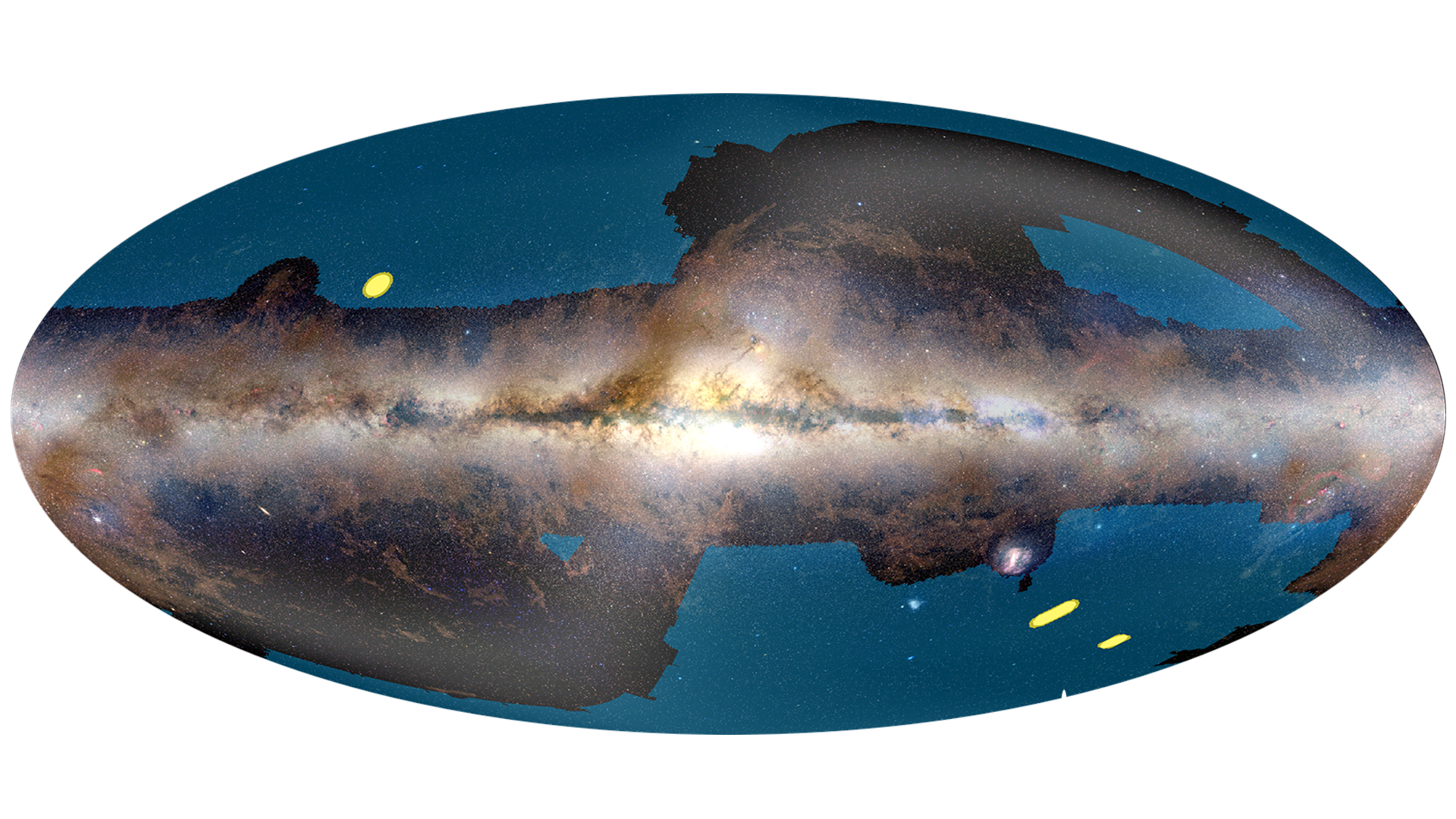 This figure shows Euclid’s wide and deep fields. The wide field is in blue, while the deep fields are in yellow. Euclid found C/2026 S1 (Euclid) in its Deep Field North, the yellow region near the image’s top left. Euclid avoids observing along the plane of the Milky Way due to the presence of so much problematic dust. Image Credit: ESA/Euclid/Euclid Consortium/NASA/Planck Collaboration/A. Mellinger – Acknowledgment: Jean-Charles Cuillandre, João Dinis and Euclid Consortium Survey Group. Licence: CC BY-SA 3.0 IGO
“Very few comets are expected to be discovered by Euclid so it was a happy coincidence that the combination of the comet’s orbit and Euclid’s scanning over those days captured the object in multiple images,” said Bruno Altieri, Euclid Archive Scientist, and part of the discovery team.
“While this particular comet is not a suitable candidate for Comet Interceptor, the process of discovery and alert gives us a real test case for how our two mission teams will coordinate in the future. And we are of course happy to have discovered a previously unknown comet for the Solar System community to follow-up on,” added Valeria Pettorino, Euclid Project Scientist.

