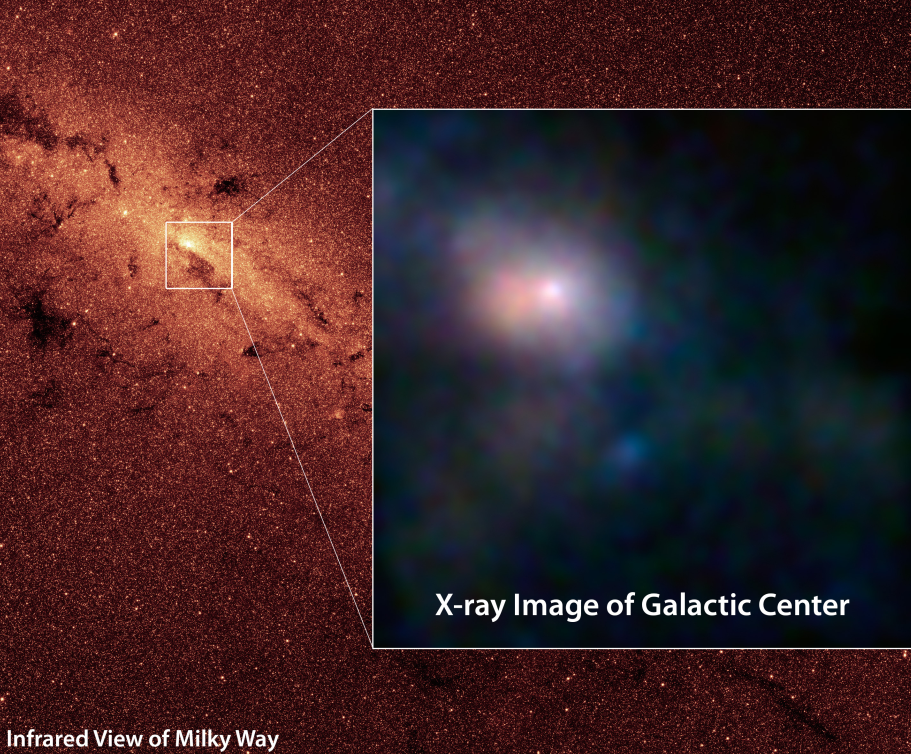
Жэймс Вэбб сансрын дуран авайг ашиглан хийсэн шинэ судалгаагаар манай галактикийн төв дэх хар нүхний эргэн тойрон дахь хийн найрлагад нарны системээс илүү өндөр түвшний металл агуулагдаж байгааг илрүүлэв.
Сүүн зам галактикийн төвд орших “Sagittarius A” (Sgr A) нь 4 сая нарны масстай, асар их таталцал бүхий хар нүх юм. Бусад идэвхтэй галактикийн төвүүдээс ялгаатай нь Sgr A* нь харьцангуй тайван төлөвтэй бөгөөд хүрээлэн буй орчноосоо бага хэмжээний бодисыг өөртөө татаж байна. Макгиллийн их сургуулийн судлаач Николь Форд болон түүний баг “The Astronomical Journal” сэтгүүлд нийтлүүлсэн судалгаандаа Жэймс Вэбб дуран алайн MIRI спектрографийн өгөгдлийг ашиглан галактикийн төвийн “Minispiral” хэмээх молекулан тоос, ионжсон хийн бүтэцтэй хэсгийг судалжээ.
Судалгаагаар Minispiral орчмын хийд агуулагдах металлын хэмжээ нарны системээс ойролцоогоор 1.8 дахин их байгааг тогтоов. Одон орон судлалд устөрөгч болон гелигээс бусад бүх элементийг “металл” гэж нэрлэдэг бөгөөд эдгээр нь оддын дотор синтезлэгдэн үүсдэг. Энэхүү баялаг найрлага нь өнгөрсөн хугацаанд болж өнгөрсөн супернова дэлбэрэлтүүдтэй холбоотой байх магадлалтай гэж эрдэмтэд үзэж байна.
“Sgr A East” хэмээх суперновагийн үлдэгдэл нь уг бүс нутагт энерги ялгаруулж, хийг халуун, үймээн ихтэй байлгах нөхцөлийг бүрдүүлдэг болохыг өөр нэгэн судалгаагаар баталжээ. Энэхүү өндөр температур нь хар нүх рүү орох бодисын урсгалыг удаашруулж, түүнийг идэвх багатай байлгахад нөлөөлдөг байна. Хэдийгээр металл ихтэй хий нь хурдан хөрч, хар нүх рүү илүү хурдан татагдах боломжтой ч Sgr A*-ийн хувьд энэ өсөлт нь хангалтгүй байгаа нь тус хар нүх яагаад бусдаас удаан хооллож байгаагийн нэг шалтгаан байж болох юм.
Дэлгэрэнгүйг эх сурвалжаас харах
Эх сурвалжийг нээх ↓
The heart of the Milky Way is dominated by—even defined by—its supermassive black hole (SMBH). It’s named Sagittarius A-star (Sgr A*), and it has about 4 million solar masses. Its gargantuan gravitational pull, powerful radiation, and complex magnetic fields shape its surroundings.
Sgr A* is a quiescent SMBH rather than an active galactic nuclei (AGN). It still has an accretion ring, but it’s fed by a trickle of material rather than a gluttonous flow. So it doesn’t host the type of bright accretion ring characteristic of an actively feeding SMBH.
Astrophysicists can’t take their eyes off Sgr A*, and they observe it across multiple wavelengths and probe it and its environment in every way they can. Its proximity to Earth compared to SMBH in other massive galaxies gives researchers an opportunity to study SMBH in greater detail. Astronomers have found stars and gas clouds orbiting Sgr A* and have mapped its complex magnetic fields.
In new work, researchers studied the gas near Sgr A* to determine its properties and found that it’s enriched in astronomical metals. The work is titled “Ionization Structure and Metal Enrichment of the Galactic Center Minispiral Observed with JWST,” and it’s published in The Astronomical Journal. The lead author is Nicole Ford, a PhD student in Professor Daryl Haggard’s research group in the Department of Physics at McGill University, Montreal, Canada.
“Sagittarius A* (Sgr A*) is the nearest quiescent supermassive black hole, and its proximity offers a unique opportunity to study its surrounding fuel supply,” the authors write. They studied the central 0.1 parsec of the Milky Way using data from the JWST’s MIRI Medium Resolution Spectrograph. This let them “disentangle mid-infrared ionized gas structures” there. The feature they were most interested in is called the Galactic Center Minispiral, and it lies inside the circumnuclear disk (CND). The Minispiral is made of molecular dust and warm ionized gas.
“The Minispiral’s dynamics are governed by the gravitational and radiative effects of Sgr A*, the Nuclear Star Cluster, and their interactions,” the researchers write.
“The Minispiral follows a three-pronged “triskelion” shape composed of the Northern Arm, Eastern Arm, and the Western Arc,” the authors explain. These filamentary arms serve as conduits, linking the cold molecular gas in the CND with the NSC’s hotter plasma.
These panels show the center of the Milky Way in infrared, and they zoom in from left to right. The white star in each panel shows the location of Sgr A. In the middle panel and right panel, grey crosses show Wolf-Rayet stars, while grey circles mark various other compact structures. The left panel also shows the North Arm and Eastern Arm. Image Credit: Nicole M. Ford et al 2026 AJ 172 267.*
Universe Today readers probably know that astronomical metals aren’t the same as what are normally called metals in a standard Earth context. Astronomical metals are any element heavier than hydrogen and helium. This is an important distinction, since these elements didn’t appear until they were synthesized by stars.
The research shows that the gas in the Minispiral near Sgr A* is enriched in metals compared to the Sun.
“This study constrains the composition and ionization state of three Minispiral gas features distinguished by radial velocity: the Bar, Northern Arm, and fast-moving gas parcels that we call BC (Blue-shifted Compact) structures,” the researchers write. “At subparsec scales in the Minispiral, we infer metal abundances of ∼1.8 × solar.”
Overall, the work shows how the gas near Sgr A* is shaped by conditions in the region. The higher metallicity is probably due to supernovae explosions in the past. Sgr A East is a SNR in the region that overlaps Sgr A* in the sky.
Another recent paper published in The Astrophysical Journal isolated that SNR from the SMBH itself, providing evidence for supernova metallicity enrichment of the gas near Sgr A*. It also showed that the supernova has helped keep the gas near the SMBH hot, which has contributed to the slow trickle of material that feeds it. “Together, these results identify Sgr A East as a major agent of energy injection that has kept the circumnuclear environment of Sgr A* hot and dynamically turbulent over its ∼104 yr lifetime,” those researchers concluded.
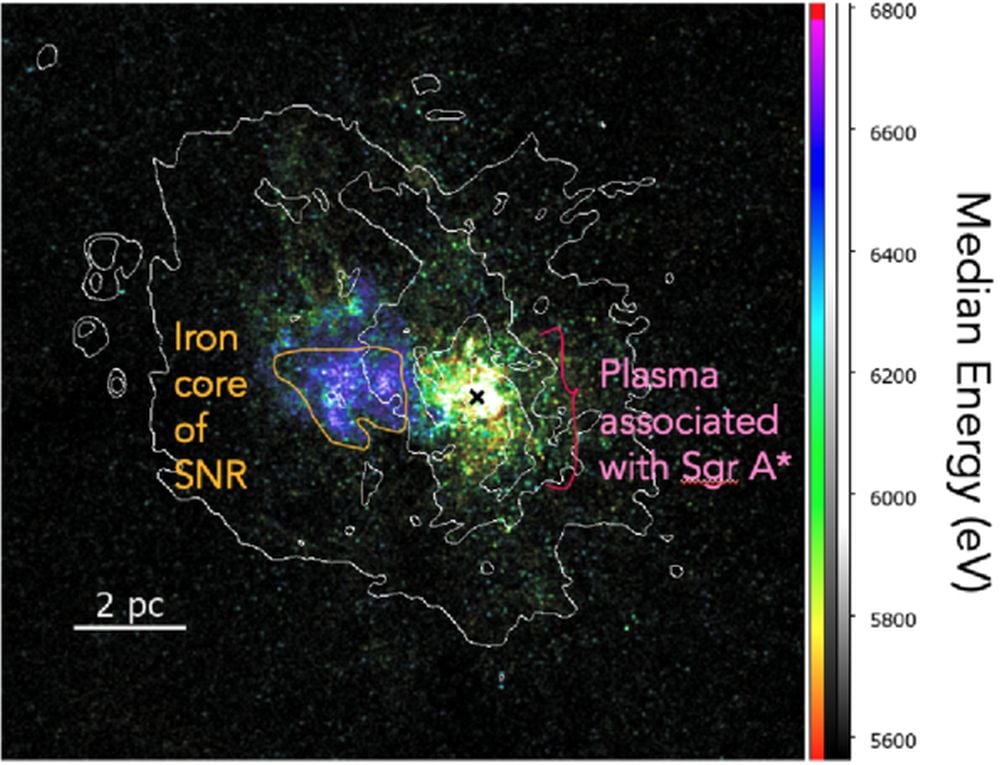 This figure shows how a supernova remnant named Sgr A East overlaps in the sky with the Sgr A, the Milky Way’s SMBH. The SNR has raised the metallicity of the gas in the region, and has also injected heat into the gas in the region. Both things serve to slow material flowing into the SMBH. Image Credit: Mayura Balakrishnan et al 2026 ApJ 1003 128.*
Metal-rich gas cools faster, and that speeds the flow of gas into the SMBH, because the gas can only fall into Sgr A* if it’s cool and compressed. Yet Sgr A* only receives a trickle of material because a metallicity of 1.8 x solar is only modest and can’t really drive faster cooling and flow into the SMBH.
“We know there’s a black hole at the centre of our galaxy pulling material into itself, but we see that it’s eating a lot less material than other supermassive black holes, and more slowly,” lead author Ford said in a press release. “Part of understanding why this is happening means looking at the properties of the materials available for it to consume, including gas, dust and the stars orbiting around it.”

