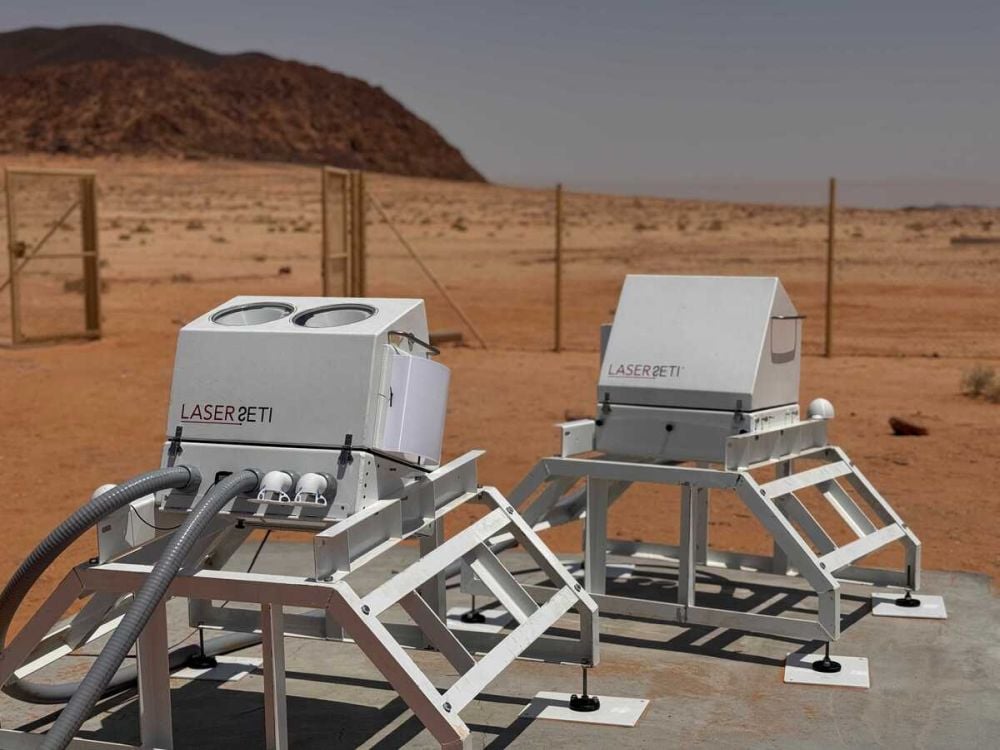
Ази тивд анх удаа Саудын Арабын Аль-Ула хотод суурилуулсан LaserSETI оптик илрүүлэгч төхөөрөмжүүд сансрын уудмыг тасралтгүй ажиглаж эхэллээ.
Саудын Арабын Хаант Улс харь гарагийн иргэншлийн дохиог илрүүлэх зорилготой SETI (Search for Extraterrestrial Intelligence) хүрээлэнгийн технологийн судалгаанд нэгдлээ. Тус хүрээлэн нь АНУ-ын Калифорни, Хавай, Пуэрто-Рико болон Аризона мужуудад байрлах сүлжээгээрээ дамжуулан сансрын дохиог судалдаг бөгөөд Саудын Арабын Аль-Ула хотод байрлах тав дахь талбар нь Ази тив дэх анхны цэг болж байна. 2026 оны наймдугаар сарын 19-нд суурилуулсан хоёр илрүүлэгч төхөөрөмж нь бүрэн ажиллагаанд орж, дэлхийн өнцөг булан бүрт тархсан ажиглалтын сүлжээг өргөжүүлж байна.
LaserSETI төхөөрөмжүүд нь ердийн телескопоос ялгаатай нь сансрын уудмыг тасралтгүй хянах чадвартай бөгөөд ховор тохиолддог түр зуурын үзэгдлүүдийг бүртгэх зориулалттай. Эдгээр төхөөрөмж нь арилжааны зориулалттай камерын линз болон 3D хэвлэгчээр бүтээсэн эд ангиудыг ашигладаг тул өртөг багатайгаараа онцлог юм. Линзний ард байрлах дифракцийн тор нь одны гэрлийн спектрийг лазерын гэрлийн шинж чанартай долгионы урттай ялгах боломжийг олгодог бөгөөд ирж буй өгөгдлийг хүчирхэг компьютер бодит цаг хугацаанд шинжилдэг.
Аль-Ула Manara одон орон судлалын төвд байрлуулсан энэхүү төхөөрөмж нь тус бүс нутгийн одон орон судлалын ирээдүйн хөгжилд чухал алхам болж байна. ЮНЕСКО-гийн Дэлхийн өвд бүртгэгдсэн Аль-Ула нь “Dark Sky Park” буюу гэрлийн бохирдолгүй бүсэд тооцогддог тул одон орон судлалд нэн тохиромжтой байршил юм. Саудын Араб улс сүүлийн жилүүдэд шинжлэх ухааны салбарт ихээхэн хөрөнгө оруулалт хийж, олон улсын хамтын ажиллагааг эрчимжүүлж байгаа бөгөөд энэхүү төсөл нь тус улсын шинжлэх ухааны чадавхыг дэлхийн тавцанд гаргаж ирэх зорилгыг агуулж байна.
Энэхүү судалгааны үндсэн зорилго нь сансрын уудмаас ирэх лазерын дохиог олж илрүүлэх явдал юм. Хэдийгээр ихэнх илрүүлэлт нь сансарт тохиолдох гэрлийн гялбаа байх төлөвтэй ч, дэлхий даяар тархсан сүлжээ нь ажиглалтын талбайг нэмэгдүүлснээр харь гарагийн иргэншлийн дохиог илрүүлэх боломжийг улам бүр нэмэгдүүлж байна. Эрдэмтдийн зүгээс энэхүү сүлжээгээр дамжуулан дэлхийн өөр өөр хэсгээс ажиглагдсан ер бусын үзэгдлүүдийг харьцуулан судлах нь шинжлэх ухааны нээлтэд чухал хувь нэмэр оруулна гэж үзэж байна.
Дэлгэрэнгүйг эх сурвалжаас харах
Эх сурвалжийг нээх ↓
The Kingdom of Saudi Arabia is joining in the technological effort to detect signals from other civilizations, called SETI. The SETI (Search for Extraterrestrial Intelligence) Institute, a non-profit body, uses the Allen Telescope Array and other ground-based facilities to search for alien signals. They’ve also used the Hubble and other space telescopes.
LaserSETI is a new network of optical detectors under development since 2024. AlUla, in Saudi Arabia’s northwestern region, is the fifth LaserSETI site, and the first one in Asia. The others are in California, Hawaii, Puerto Rico, and Arizona.
LaserSETI brings new capabilities to the SETI endeavour. It can watch the entire sky continuously, catching rare transient events. Most of SETI’s other efforts are slower, or target specific targets in the sky.
Most of what LaserSETI detects will just be flashes of light from events in the cosmos. But, the hope is, it will one day detect a laser originating from another ETI. The chances of it doing that increase with sky coverage, which is why LaserSETI is expanding. As the first one in Asia, Saudi Arabia’s two detectors are important.
“AlUla gives LaserSETI an important new geographic vantage point and connects this remarkable astronomical site to a growing global network.” – Dr. Franck Marchis, SETI.
They’re placed in Alula Manara, which is being developed as Saudi Arabia’s first major astronomical observatory. Alula is also the kingdom’s first UNESCO World Heritage Site, and has hosted multiple civilizations from the Neolithic through the Roman times and the Ottoman times. Alula is also a Dark Sky Park, and will eventually host a 4-meter telescope and a pair of 2-meter telescopes, if plans are successful.
Alula is about 380 kilometers from the holy city Medina (Madinah). Alula Manara, the astronomical site where the LaserSETI devices are situated is on a remote plateau about 74 km north of Alula. Image Credit: Google Earth/LandSat/Copernicus. Data SIO, NOAA, US Navy, NGA, GEBCO, Mapa GISrael.
“Two years ago, we announced our intention to bring LaserSETI to AlUla. Today, the instruments are installed, commissioned and observing the sky,” said Dr. Franck Marchis, Senior Planetary Astronomer and Director of Citizen Science at the SETI Institute. “AlUla gives LaserSETI an important new geographic vantage point and connects this remarkable astronomical site to a growing global network. This is exactly what LaserSETI needs: instruments distributed around the world, observing continuously and together.”
The LaserSETI detectors are not overly-complicated devices. They use cameras with commercially-available lenses that can image about 75 degrees of the sky. The solid-state detectors are also off-the-shelf units. A grating behind the lens will differentiate between starlight—which produces a complete light spectrum from blue to red—and lasers, which only show up as a characteristic wavelength, like laser pointers do.
Cost is a critical factor in LaserSETI, and along with using commercially available components, parts of the detectors are also 3-D printed.
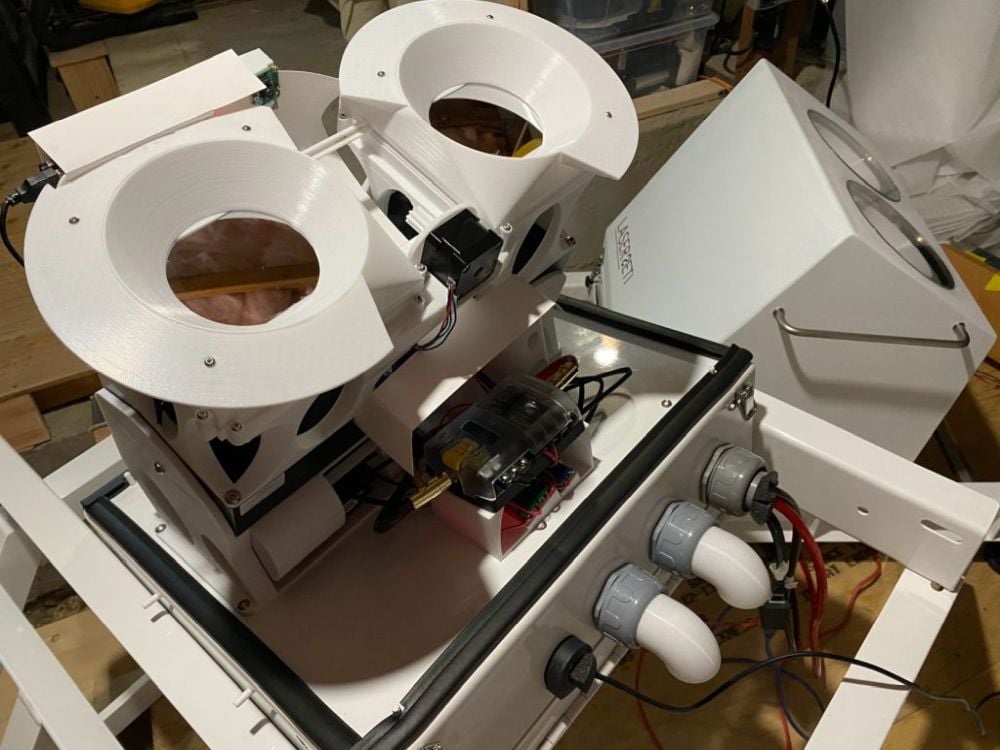 Only LaserSETI’s transmission grating and stainless-steel enclosure are custom made, as shown in this image. Image Credit: SETI/LaserSETI
Each LaserSETI will also have a powerful computer that will analyze incoming data in real-time. Not only will that eliminate expensive data storage, it will allow real-time alerts.
The pair of detectors in AlUla were installed August 19, 2026 and are now fully operational.
“LaserSETI was designed from the beginning as a global observatory rather than a single telescope,” said Eliot Gillum, Director of LaserSETI at the SETI Institute. Gillum also designed and builds the LaserSETI units. “Adding AlUla extends the network into an entirely new geographic region. Every new location improves our ability to monitor the sky continuously and to compare observations of unusual events from different parts of the world.”
“The commissioning of LaserSETI at AlUla Manara marks an important milestone in our collaboration with SETI Institute, translating our shared ambition into scientific capability on the ground,” said Naif Al Malik, AlUla Manara Executive Program Head. “By connecting AlUla’s exceptional dark skies to a global observation network, we are creating new opportunities for scientific research, international collaboration and knowledge exchange, while strengthening AlUla’s growing role in astronomy and scientific discovery.”
For most of its history, Saudi Arabia has been known as a closed, conservative society with no separation between church and state. A place where science took a backseat to pretty much everything else. It hosts Islam’s two holiest cities, Mecca and Medina, the site of pilgrimages by the Islamic faithful. Its weath, and its influence, comes entirely from oil.
But in recent decades and years, the desert kingdom has made a number of changes. It’s sought to host international sporting and cultural events. It’s also moved to use some of its extraordinary wealth in scientific endeavours. In 2009, it founded the King Abdullah University of Science and Technology (KAUST). Among other things, it hosted the fastest supercomputer in the Middle East. KAUST is also the highest-ranked university in the Arab World.
Hosting LaserSETI is part of a new direction for Saudi Arabia, and the upcoming telescopes that will join it at Alula will be part of its scientific future. As Universe Today readers likely agree, more science can only be good for Saudi Arabia. If, one day, Alula’s LaserSETI were to play a role in detecting an ETI, that would be a culture-changing triumph.
Interested readers can check out the live status of each LaserSETI observatory here.

