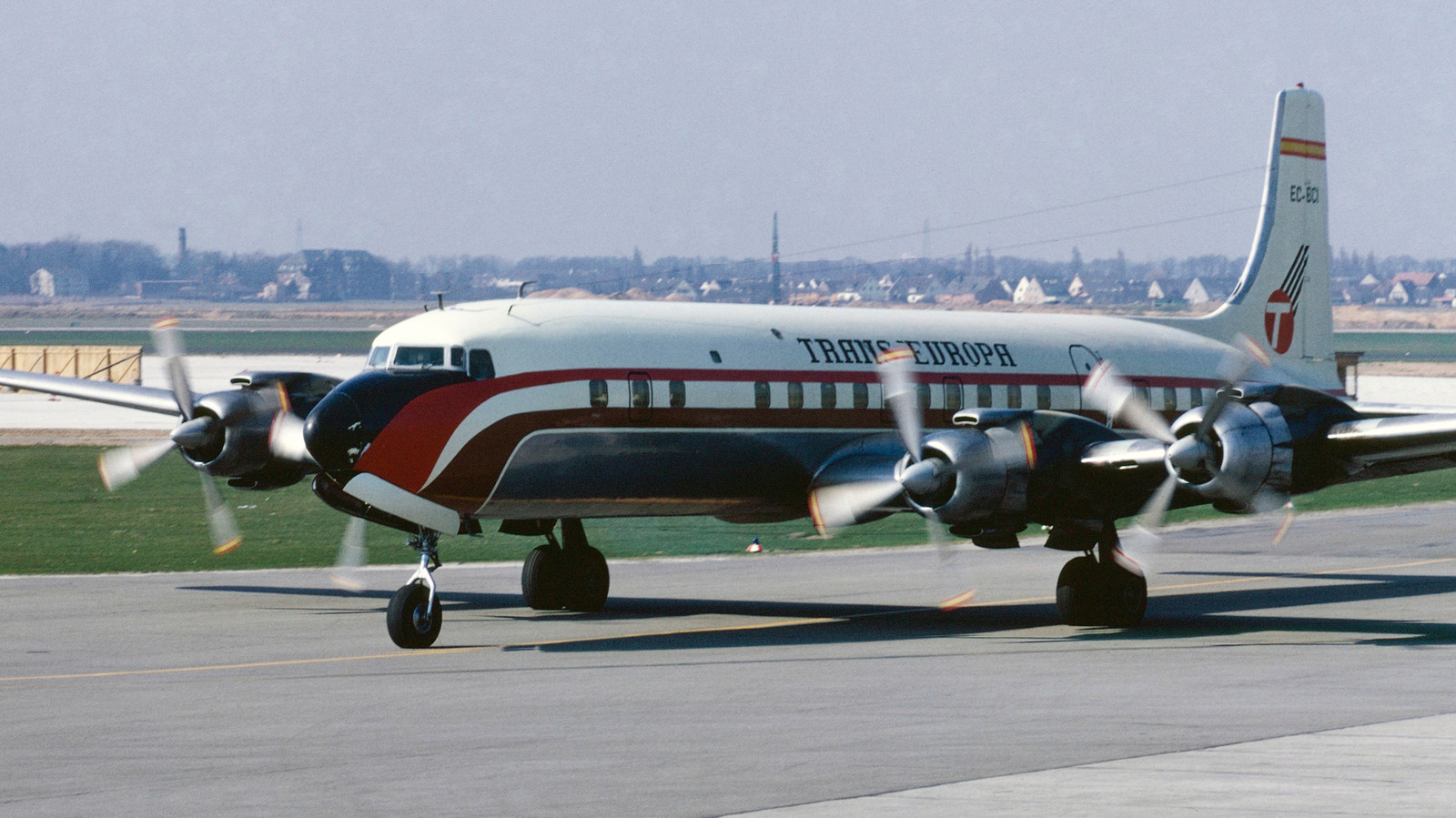
Агаарын тээврийн салбарт томоохон байр суурь эзэлдэг Douglas DC-7 онгоц нь тийрэлтэт хөдөлгүүрийн эрин үе эхлэхээс өмнөх хамгийн сүүлийн үеийн дэвшилтэт хөлөг байв.
1950-аад оны дунд үед Douglas DC-7 нь АНУ-ын агаарын тээврийн зах зээлд хамгийн эрэлттэй онгоцнуудын нэг байсан юм. Энэхүү агаарын хөлөг нь АНУ-ын эх газрыг дамнан, зогсолтгүйгээр баруун зүгт нисэх боломжтой анхны арилжааны онгоц болсон нь түүний гол давуу тал байв. Өмнөх загвар болох DC-6-аас илүү урт их биетэй, зорчигчдын тав тухыг дээшлүүлсэн нь тухайн үеийн агаарын тээврийн компаниудын анхаарлыг татаж байлаа.
American Airlines компанийн захиалгаар хөгжүүлэгдсэн уг онгоцны анхны загвар 1953 оны тавдугаар сард анхны нислэгээ үйлдэж, тухайн оны арваннэгдүгээр сараас үйлчилгээнд нэвтэрчээ. DC-7, DC-7B болон DC-7C гэсэн үндсэн хувилбарууд үйлдвэрлэгдсэн бөгөөд 1956 онд танилцуулагдсан DC-7C хувилбар нь далавч болон их биеийн уртасгасан хийцээрээ “Seven Seas” хэмээн алдаршиж, Атлантын далайг дамнан нисэх чадвартай болсон юм. Нийтдээ 338 ширхэг DC-7 онгоц үйлдвэрлэгдсэн байна.
Гэвч 1950-иад оны сүүлчээр тийрэлтэт хөдөлгүүрт онгоцууд гарч ирснээр DC-7-ийн ашиглалтын хугацаа богиноссон юм. Boeing 707 зэрэг тийрэлтэт онгоцууд нь поршений хөдөлгүүрт онгоцноос хоёр дахин хурдан нисэж, зорчигч тээвэрлэх хүчин чадлаараа илүү байсан нь салбарын хөгжлийг эрс өөрчилсөн билээ. Үүнтэй холбогдуулан Douglas компани өөрийн тийрэлтэт хөдөлгүүрт DC-8 онгоцыг хөгжүүлж эхэлсэн түүхтэй.
Дэлгэрэнгүйг эх сурвалжаас харах
Эх сурвалжийг нээх ↓
The Douglas DC-7 may not be the first aircraft that comes to mind for most people when they think of the most iconic planes in aviation history. However, in the mid-’50s, the DC-7 was among the most sought-after passenger planes in the U.S. Its popularity centered around two key reasons: The DC-7 was the first commercial aircraft that could travel westbound across the entire length of the continental United States without having to refuel (eastbound travel without refueling was already possible because planes were aided by coasting through the jet stream). Second, its cabin was a step up from its predecessors and competitors, and the plane was also substantially longer than the Douglas DC-6, its predecessor. This added length gave airlines extra room to experiment with premium cabin layouts.
Combined, these factors made the long 8-hour non-stop transcontinental journeys a little bit more comfortable. As one of the last piston-engined, propeller-toting passenger aircraft to be sold in considerable numbers, aviation enthusiasts often rank the Douglas DC-7 among the greatest planes of its type.
While the DC-7 is a celebrated aircraft today, it almost did not make it to production. The aircraft owes its existence to the insistence of American Airlines, which wanted Douglas to make a piston-engined aircraft. Then American Airlines CEO C.R. Smith placed a $40 million order for the DC-7, which covered the aircraft’s development costs. Emboldened by American Airlines’ commitment, Douglas quickly developed the DC-7, with the first prototype flying in May 1953. Later that year, in November, American Airlines inducted the first DC-7 into service, thereby becoming the first airline company to offer non-stop transcontinental service in both directions.
DC-7 variants and operating history
Underwood Archives/Getty Images
For an aircraft as popular as the Douglas DC-7, its production run was rather short. After the first-generation DC-7 arrived in 1953, production only lasted until 1958, giving the aircraft a production run of just five years, with a total of338 DC-7smanufactured. The company even developed improved variants of the aircraft, starting with the DC-7B in 1955, and the DC-7C variant in 1956. American Airlines was the launch customer for the ‘original’ DC-7 variant, with 34 DC-7s under its ownership. The largest fleet of original DC-7s, however, was with United Airlines, which owned 57 units of the aircraft. Other notable operators of the baseline DC-7 included Delta Airlines and National Airlines.
The DC-7B variant offered more range with (optional) additional fuel tanks, but had a higher gross weight. A total of 112 DC-7B variants were manufactured, with the major operators of this variant being Eastern Airlines, American Airlines, Delta Airlines, and Pan Am.
In 1956, Douglas started producing the last and final version of the Douglas DC-7 in the form of the DC-7C variant. This variant would become the largest of the DC-7 series, thanks to its longer wings (extended by 5 feet) and fuselage (extended by 42 inches). These changes gave the DC-7C room for an additional 1,000 gallons of fuel, which in turn gave it a range of around 5,600 miles. This also made the aircraft capable of making transatlantic trips in both directions, thereby earning it the synonym “Seven Seas”. A total of 121 Douglas DC-7C’s were produced in all, with the aircraft being lapped up by major operators like PanAm, KLM Royal Dutch Airlines, BOAC, and Scandinavian Airlines System (SAS).
The dawn of the jet age, and the DC-7’s sudden demise
Joseph Creamer/Shutterstock
Given that more than 300 units of the DC-7 were built between 1953 and 1958, the popularity of the aircraft was unmistakable. However, the DC-7’s dream run came to a rather abrupt end — not because of a competitor, but due to the arrival of the jet engine. The first passenger aircraft powered by a jet engine arrived in 1949 when theDe Havilland Comettook its maiden flight, but its careerwas marred by a series of accidents. By the late 50s, the Boeing 707 arrived and quickly transformed passenger aviation.
The average Boeing 707 could carry nearly twice as many passengers as the DC-7, and with cruising speeds of up to 600 mph, it was almost twice as fast as the Douglas DC-7C. This meant that the Boeing 707 could cut travel times by half on long routes. A flight that took nearly 8 hours on the DC-7 could be completed in around the right hours on the Boeing 707. These numbers meant that the 707 offered a generational leap in capacity, speed and overall comfort over the piston-engined DC-7.
With the dawn of the jet age, Douglas itself committed to the development of its own jet engine-powered passenger aircraft: the Douglas DC-8. It arrived on the scene just 11 months after the Boeing 707 and was sold a total of 556 units over its lifetime, making it a very successful aircraft in its own right.

