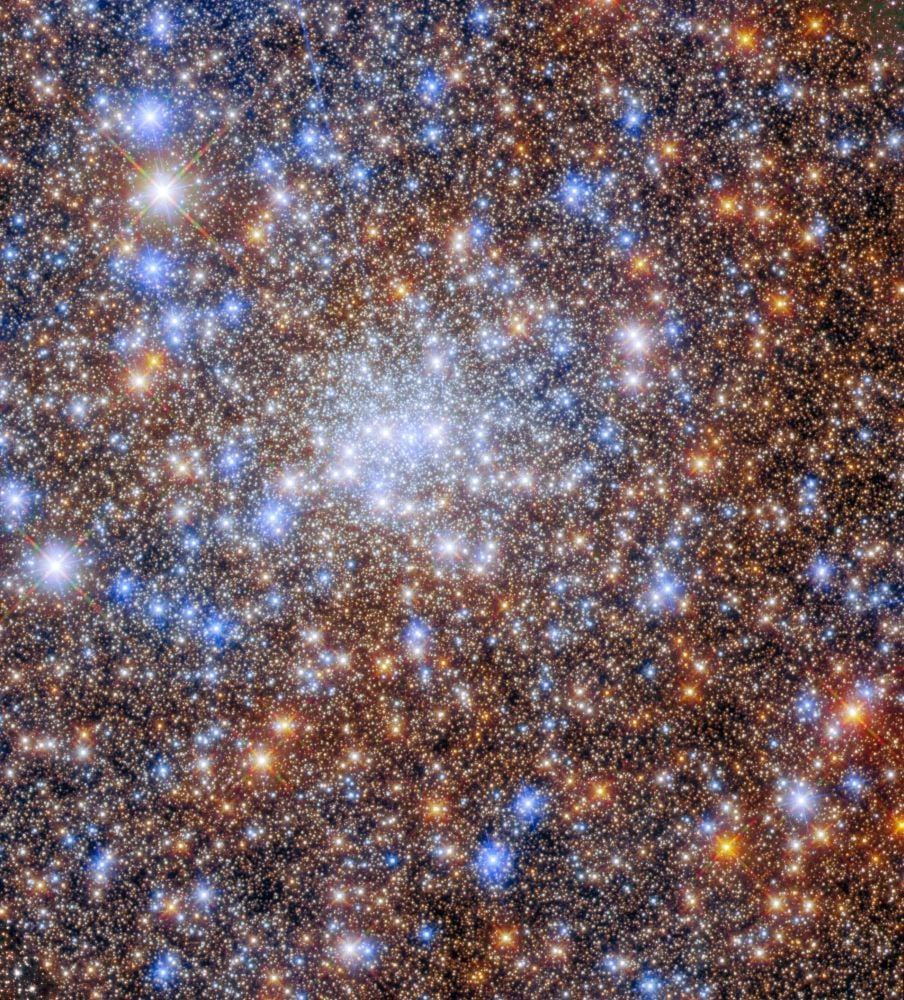
Эрдэмтэд Жэймс Вэбб сансрын дурангаар илрүүлсэн, орчлон ертөнцийн эхэн үед үүссэн хэт том хар нүхнүүдийн нууцыг оддын мөргөлдөөний загвараар тайлбарлахыг зорьж байна.
Жэймс Вэбб сансрын дурангийн ажиглалтаар Их тэсрэлтээс хойш ердөө 400-500 сая жилийн дараа хэт том хар нүхнүүд (SMBH) оршин байсныг илрүүлсэн нь одоогийн онолоор тайлбарлахад хүндрэлтэй байна. UCLA-ийн судлаач Клэр Уильямс тэргүүтэй баг “The Astrophysical Journal” сэтгүүлд нийтлүүлсэн судалгаандаа эртний орчлон ертөнцийн нягт оддын бөөгнөрөл дэх мөргөлдөөнүүд нь хар нүх үүсэх эх үүсвэр болсон байж магадгүй гэж үзжээ. Судлаачид AREPO сансар судлалын загварчлал болон Жэймс Вэбб дурангийн өгөгдлийг ашиглан оддын динамик үйл явцыг судалсан байна.
Тус судалгаагаар нягт бөөгнөрөл дотор одд хоорондоо давтамжтайгаар мөргөлдөж, улмаар асар их масстай оддыг бий болгодог болохыг тогтоожээ. Ийм асар том масстай одд амьдралынхаа төгсгөлд өөрөө өөртөө нуран унаж, хар нүх үүсгэх магадлалтай юм. Мөн мөргөлдөөний явцад одд бүрмөсөн сүйрч хийн үүл үүсгэх нь хар нүхийг хүрээлэн, түүнийг түргэн хугацаанд өсөхөд шаардлагатай “хоол” болж, улмаар Жэймс Вэбб дурангийн ажигласан “бяцхан улаан цэгүүд” (Little Red Dots) хэмээх сонирхолтой биетүүдийг бүрдүүлж байж болох талтай.
Энэхүү загвар нь дунд зэргийн масстай хар нүхнүүд (IMBH) хэрхэн үүсэж, цаашлаад хэт том хар нүхнүүд болж өргөжсөнийг тайлбарлах боломжийг олгож байна. Гэсэн хэдий ч энэ нь онолын нэгэн таамаглал бөгөөд эртний орчлон ертөнцийн нарийн төвөгтэй орчныг бүрэн дүүрэн тодорхойлоход цаашдын судалгаа шаардлагатай юм. Судлаачдын үзэж буйгаар эртний галактикуудын ихэнхэд нь цөмийн оддын бөөгнөрөл байсан нь ийм төрлийн мөргөлдөөн түгээмэл байсныг гэрчилж байна.
Дэлгэрэнгүйг эх сурвалжаас харах
Эх сурвалжийг нээх ↓
Astronomers are in an ongoing scientific wrestling match with some of the JWST’s observations. The telescope can gaze back in time by sensing red-shifted light from the early Universe. One of its surprising findings is that supermassive black holes (SMBH) existed long before theory says they should. Some of the SMBHs it detected were found only 400 million and 500 million years after the Big Bang.
So far, there’s no solid, widely-held explanation for this. But one contender involves stellar mergers.
New research suggests that in the dense stellar environment in the early Universe, repeated stellar mergers could’ve lead to eventual SMBHs. It’s titled “A Cosmological Framework for Stellar Collisions at High Redshift in Proto-globular Clusters, Nuclear Star Clusters, and Little Red Dots,” and it’s published in The Astrophysical Journal. The lead author is Claire Williams, a doctoral student in the Department of Physics and Astronomy at UCLA.
“Observations and cosmological simulations indicate that the early Universe hosted numerous compact, high-density stellar systems, where close encounters and physical collisions between stars were likely common,” the authors write. “We develop a bottom-up framework for stellar dynamics in such environments, spanning systems with and without intermediate-mass and supermassive black holes, and covering regimes where stellar collisions may or may not dominate the evolution.”
The work connects stellar collisions in dense environments with different outcomes. In this work, the researchers started with initial conditions from the AREPO cosmological simulations. They used these to set the parameters for early star clusters, along with the JWST’s observations of early star clusters and high-redshift galaxies.
The authors note that these clusters are very similar to Nuclear Star Clusters (NSC) like the one found near Sgr A*, the Milky Way’s SMBH. “There, collisions can lead to unusual outcomes, such as the apparent regeneration of an old population with merger products that appear as young massive stars,” the authors write.
The researchers point out that almost all galaxies host a SMBH and about 80% of early galaxies also host an NSC. That “suggests that collision-rich environments exist across the Universe,” they explain. “As massive black holes and their host star clusters formed, collisions shaped their dynamical and physical evolution.”
The team ran simulations to try to understand all of this. The simulations included a variety of different cluster environments with different parameters like velocity dispersions and mass density profiles. “We initialize 1000 stars for each test case, located within 1 pc of the center,” they write. This is fewer stars than are within 1 parsec of the Milky Way’s black hole. Estimates for that stellar population vary, but some sources say there are more than 6,000.
The results show that stellar collisions are prevalent in a range of star cluster and NSC environments. Not only that, but runaway sequential collisions can eventually create very massive stars (VMS) very early in the Universe. There’s no universal definition for VMSs, but something above 100 solar masses is often used.
“Perhaps the strangest outcome of our simulations is that stars can merge repeatedly within the cluster until they form one gigantic star with a mass equal to that of an entire cluster,” said Williams. Universe Today readers know what that means. “When a star this huge reaches the end of its life, models suggest that it may have no option but to collapse into itself and form a massive black hole.”
“One place in the nearby universe where collisions between stars are common is the galactic center,” Williams said. “In our model, once these very massive stars turn into intermediate-mass black holes, the system resembles our own galactic center, which is a black hole surrounded by a dense star cluster.”
This isn’t the first time that astrophysicists have wondered if stellar collisions could be behind the early SMBH. In fact, this idea precedes the JWST by several decades. But this research takes it a step further by showing how the JWST’s intriguing Little Red Dots could be connected.
Little Red Dots are compact objects that appear to be black holes surrounded by ample gas. The black hole is rapidly feeding on this gas and growing very quickly, perhaps at a super-Eddington rate.
This image has become famous in astronomical circles. It shows the JWST’s famous Little Red Dots, of which hundreds have been observed in the early Universe. They could be ancient black holes surrounded by gas, which masks the x-rays that would give away their nature. If they are black holes, they could be growing quickly due to super-Eddington accretion. This research supports that idea, by showing that plentiful stellar collisions could be generating all the gas, which is fuel for the black hole’s growth, but also masks x-rays. Image Credit: NASA, ESA, CSA, STScI, D. Kocevski (Colby College)
Not all of the stellar collisions in the simulations resulted in more massive, merged stars that were doomed to explode as supernovae, leading to black holes. In some of the collisions, both stars were destroyed, and reduced to gas. This could have created a situation where a black hole is surrounded by not only a dense stellar population, but also a dense gas environment.
“Finally, we show that high rates of destructive collisions can rapidly build up extremely dense gaseous environments around massive black holes, potentially providing an analog to the observed population of Little Red Dots,” they write.
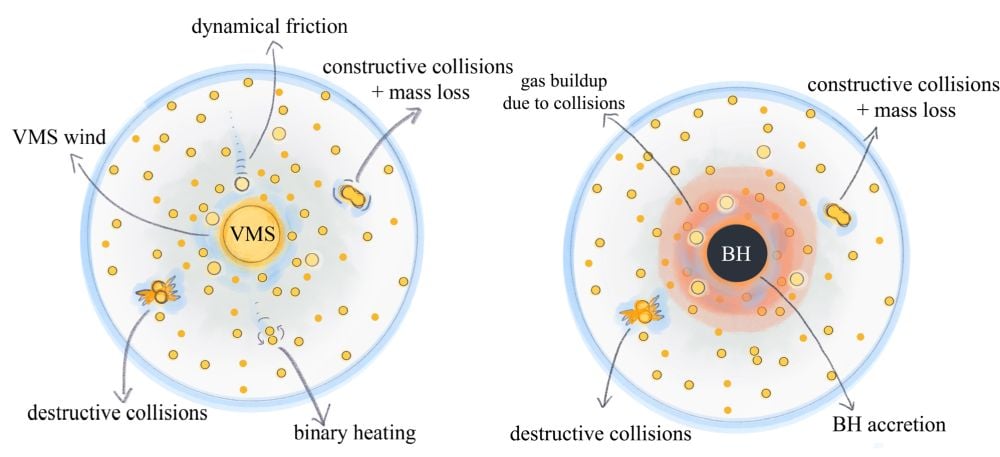
These simple schematics show two separate pathways in the dense clusters. The left shows how stellar collisions in a cluster without a black hole are constructive and lead to very massive stars. The right shows how collisions in a cluster with a black hole are generally destructive, leading to the build-up of thick gas near the black hole, which is then accreted. This could be how Little Red Dots are created. Image Credit: Claire E. Williams et al 2026 ApJ 1012 1
“Little red dots are a hot topic in astronomy. You can compare studies of people trying to understand LRDs to the tale of blind people who are trying to describe an elephant by touching it, and each person describes it differently based on what part they’re touching,” UCLA astrophysicist and co-author Smadar Naoz said. “Our research connects several of those perspectives together and may help us see more of the elephant.”
Intermediate-Mass Black Holes (IMBH), an elusive type of object predicted by the theory of hierarchical black hole growth, is also part of this. IMBH are more massive than stellar-mass black holes, but less massive than SMBH. There are some firm IMBH candidates, but none that everybody agrees are IMBH. The best example might be in the Omega Centauri globular cluster. Others have been detected via gravitational waves emitted during the mergers that created them.
This work shows that the dense clusters common in the early Universe could be the environment that spawned early IMBH. These could have merged, and in the past, those mergers would’ve been more common, generating the SMBH we see around us today.
“Dense star clusters provide a natural birthplace for massive black-hole seeds in our model,” Williams said. “The same environment that forms the black hole can also provide stars and gas that influence its subsequent growth.”

