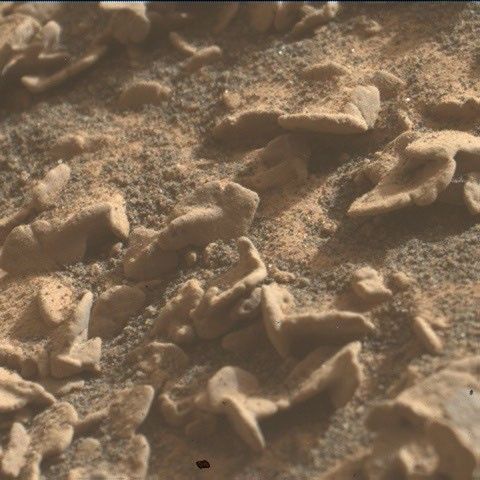
Space Science Institute-ийн ахлах эрдэм шинжилгээний ажилтан Уильям Фаррандын мэдээлснээр, Curiosity хөлөг Ангараг гарагийн “Nazca” хэмээх цооногийн орчимд өрөмдлөгийн ажлаа дуусгаж байна.
Тус бүс нутгийн үндсэн чулуулагт диск эсвэл төмсний чипс мэт хэлбэртэй талстууд агуулагддаг бөгөөд эрдэмтдийн гол зорилго нь эдгээр өвөрмөц тогтцыг нарийвчлан шинжлэхэд чиглэж байна. Өрөмдлөгийн дээжийг Mars (SAM) багажид шилжүүлэн өгсөн бөгөөд үүнтэй зэрэгцэн “Ahi Veremos”, “Colca”, “Bermejo” зэрэг талстын бүтэцтэй байгууламжуудад ChemCam LIBS багажаар гүнзгийрүүлсэн ажиглалт хийжээ.
Төлөвлөгөөний дагуу хөлөг нь “Nazca” цооногийн хажуугийн хэсэгт MAHLI багажаар мозайк зураглал хийхээс гадна, шөнийн цагаар цагаан гэрэл болон хэт ягаан туяаны LED ашиглан талстын дүрсийг буулгахаар ажиллаж байна. Мөн Ангараг гарагийн дагуул Фобос Нарыг хиртэх үйл явцыг дүрслэхийг нэн тэргүүнд тавьж, “Cordillera” болон “Mishe Mokwa” нурууны орчмын алсын зайн ажиглалтыг хийлээ.
Баасан гарагт хийсэн төлөвлөгөө ёсоор хөлөг “Nazca” цооногийн бүсээс хөдөлж, урагш чиглэсэн аяллаа үргэлжлүүлэн шинэ нээлтүүд хийхээр төлөвлөв. Энэхүү судалгааны явцад тоосны шуурганы судалгаа болон агаар мандлын хэвтээ, босоо чиглэлийн ажиглалтуудыг тогтмол гүйцэтгэж байна.
Дэлгэрэнгүйг эх сурвалжаас харах
Эх сурвалжийг нээх ↓
Written by William Farrand, Senior Research Scientist, Space Science Institute
Earth planning date: Friday, Nov. 6, 2026
This week Curiosity has been completing its drill campaign at the “Nazca” drill hole. This is an area characterized by bedrock containing disk-shaped (or in a liberal interpretation, potato chip shaped … see linked image) crystal forms. A key objective has been to better characterize these chip-shaped features. Drill samples were delivered to the Sample Analysis for Mars (SAM) instrument. While the SAM analysis was on-going, Monday’s plan included a ChemCam LIBS observation of another crystal-form, “Ahi Veremos,” more Mastcam frames to fill out a mosaic of the Nazca near to mid-field, and environmental observations includinga large dust devil survey, and horizon and atmospheric zenith movies.
Wednesday’s plan included two targetedscienceblockswith a LIBS depth profile of the “Colca”crystal-form and LIBS of the“Bermejo”target. A long distance Remote Micro-Imager (RMI) mosaic of rock clusters below the “Cordillera” ridge was also collected. Mastcam collected more frames of its Nazca mosaic, and more environmental observations were made.
Friday’s planning was for three sols with three targeted science blocks and a drive away from the Nazca drill site. A MAHLI mosaic of the side of the block that hosts the Nazca drill hole was planned. It was also planned to use MAHLI’s nighttime white-light and ultraviolet LED lamps for nighttime imaging of the crystal-forms. Mars’ moon, Phobos, was eclipsing the Sun and imaging of that event was prioritized. ChemCam LIBS observations were planned for each sol including a cluster of crystal forms, a resistant layer in the side of the Nazca block and a dark float rock. A long distance RMI mosaic ofdark lenses beneath a planar surface on the “Mishe Mokwa” ridge was to be made. Another round of environmental observation was also planned. Finally, Friday’s drive was to take the rover back towards its southerly trending route where Curiosity would continue its trek of exploration and discovery.

