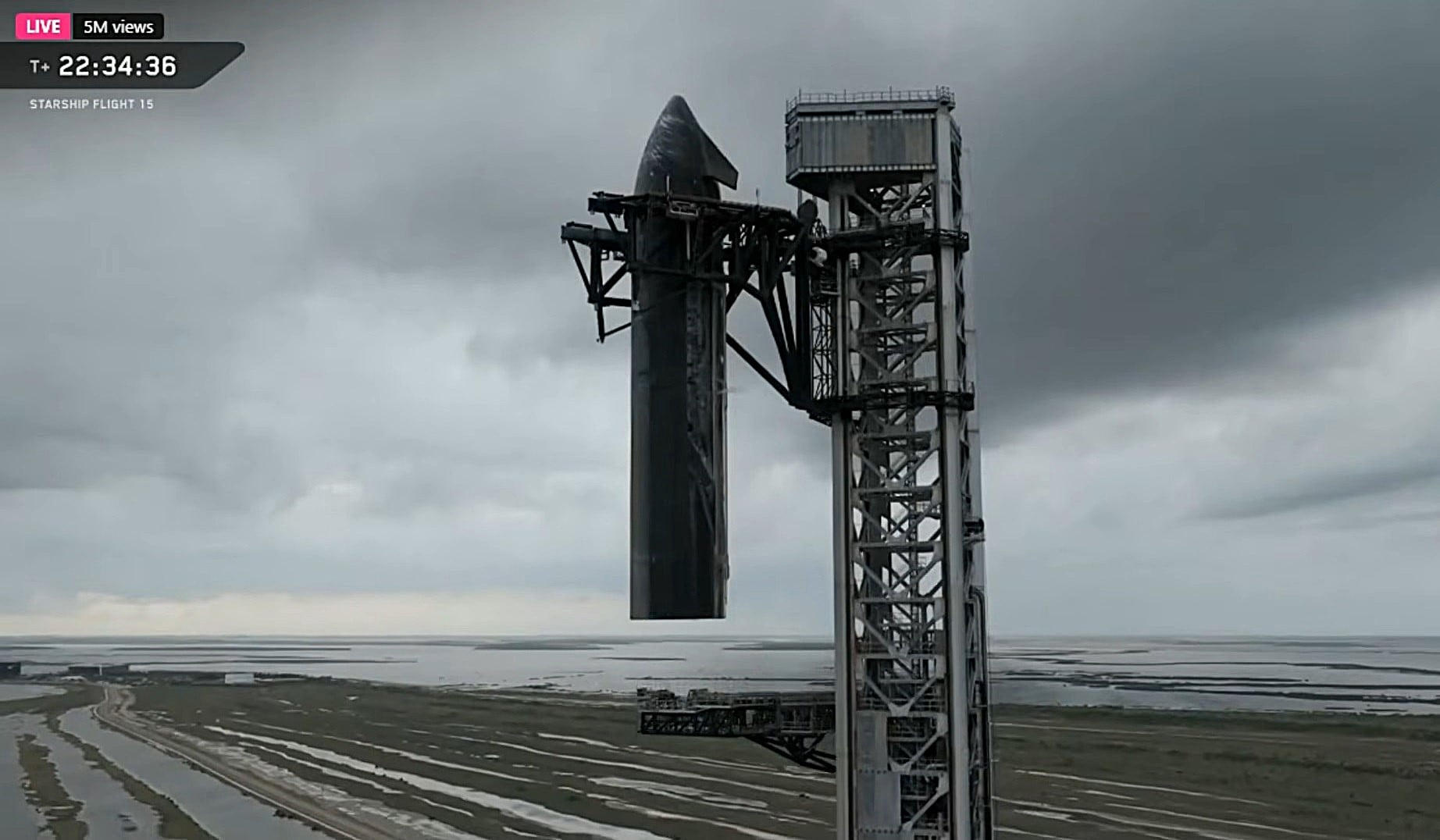
Энэхүү амжилт нь бүрэн дахин ашиглах боломжтой сансрын тээврийн системийг бүтээх компанийн томоохон зорилгыг бодит болгоход нэг алхам ойртож байна.
SpaceX компани Starship пуужингийн хоёрдугаар шатны хөлгийг тойрог замаас эргэн ирэхэд нь хөөргөх талбай дээр байрлах механик гарууд ашиглан анх удаа агаарт амжилттай барьж авлаа. 52 метр өндөр “Ship 42” хөлөг нь 22.5 цагийн өмнө хөөрсөн Өмнөд Техас дахь хөөргөх цамхаг дээрээ ийнхүү газардсан байна. “Mechazilla” хэмээх энэхүү барих систем нь өмнө нь Starship-ийн Super Heavy хурдасгуурыг барихад ашиглагдаж байсан ч тойрог замаас ирж буй хөлгийг барьсан анхны тохиолдол энэ боллоо.
Энэхүү 15 дахь удаагийн нислэгийн туршилт нь амжилттай болж, нислэгийн эхний цагуудад Starlink сүлжээний 26 шинэ үеийн хиймэл дагуулыг тойрог замд байршуулжээ. Хэдийгээр өмнөх өдөр нь түлшний систем дэх дохиоллын улмаас хурдасгуурыг барих төлөвлөгөөг цуцалсан ч энэ удаагийн амжилт нь сансрын нислэгийн технологийн хувьд чухал ахиц болсон гэж SpaceX-ийн төлөөлөгчид онцолсон байна.
NASA-гийн удирдагч Жаред Айзекмэн энэхүү амжилтыг баяр хүргэж, Америкийн сансрын хөтөлбөр саран дээр дахин туг хатгахад нэг алхам ойртсоныг тэмдэглэв. SpaceX компани ирээдүйд Starship хөлгийг NASA-гийн сар руу чиглэсэн хүнтэй нислэгт ашиглахаар төлөвлөж байгаа бөгөөд одоо цуглуулсан мэдээлэлдээ үндэслэн хөлгийн дулааны хамгаалалтын бүрхүүл болон бусад үзүүлэлтийг шинжлэх юм.
Элон Маскын алсын хараагаар бол энэхүү бүрэн дахин ашиглах боломжтой систем нь дэлхийн хотуудын хооронд болон Ангараг гараг руу хүн тээвэрлэхэд чухал үүрэг гүйцэтгэх юм. Одоогоор тус компани Флорида дахь Kennedy Space Center болон Луизиана мужид хөөргөх талбайг өргөжүүлэхээр ажиллаж байна.
Дэлгэрэнгүйг эх сурвалжаас харах
Эх сурвалжийг нээх ↓
SpaceX today brought back its Starship rocket’s second stage for a first-ever midair capture at its launch pad, capping off a record-setting orbital flight test.
The 171-foot-tall (52-meter-tall) space vehicle, known as Ship 42, settled between a giant pair of mechanical arms extended from the South Texas launch tower where its journey began 22.5 hours earlier. The arm-capture system, nicknamed “Mechazilla,” had been used three times previously to capture Starship Super Heavy boosters during suborbital flight tests, but this was the first time for a second stage coming in hot from orbit.
“Mechazilla has caught the Starship — we’ve been waiting to hear that for a long time,” SpaceX launch commentator Dan Huot said.
SpaceX employees around the country and hundreds of onlookers near the Texas launch site cheered as the Ship descended, with “Baby, Come Back” playing as the soundtrack for the webcast. “Baby, she’s back,” Huot joked.
Years of development — including 15 full-scale flight tests since 2023 — led up to today’s orbital catch, which Huot called “the Holy Grail of spaceflight.” The achievement took the sting out of the previous day’s aborted effort to catch the rocket’s booster using the same system. SpaceX said that the booster was diverted when its onboard system detected a fuel-system alarm, and that the root cause of the alarm was being investigated.
SpaceX plans to use the launch-pad arms to recover Starship’s boosters and second stages on a routine basis, achieving company founder Elon Musk’s goal of creating a fully reusable, orbital-class launch system.
This 15th flight test proceeded almost in textbook fashion, except for the offshore splashdown. During the first hours of its 14-orbit flight, Starship deployed 26 more next-generation satellites for SpaceX’s Starlink broadband internet network. All of the satellites were in good health and beginning the process of raising their orbits to their operational altitude, the company said.
Bringing Starship into full operation is expected to speed up deployment of Starlink satellites. More importantly, Starship is due to be used as a landing system for NASA’s crewed missions to the moon by as early as 2028. Starship and Blue Origin’s Blue Moon landing system are scheduled for testing in low Earth orbit next year during NASA’s Artemis III mission.
In a post to X, NASA Administrator Jared Isaacman congratulated Musk and the SpaceX team on today’s successful catch. “It was almost magic … Making more believers by the day,” he wrote. Using emojis, Isaacman said the achievement brought America’s space effort “one step closer” to putting an American flag once more on the moon.
SpaceX’s team will analyze the data gathered about Starship’s performance, including the ability of Ship 42’s heatshield to stand up to the rigors of atmospheric re-entry. The company is gearing up to expand Starship operations to NASA’s Kennedy Space Center in Florida, and yet another Starship launch site is in the works for Louisiana.
In the long term, Musk envisions creating a fleet of Starships that could offer point-to-point rocket travel to earthly destinations — and serve as a mass-transit system for carrying travelers to Mars and other off-earth destinations. Cryptocurrency investor Chun Wang has already announced his intention to take Starship trips around the moon and Mars.
“I don’t think you guys understand,” software engineer Will DePue wrote in a post to X. “You will get the chance to go to space in your lifetime. New era.”
“Yes,” Musk replied.

