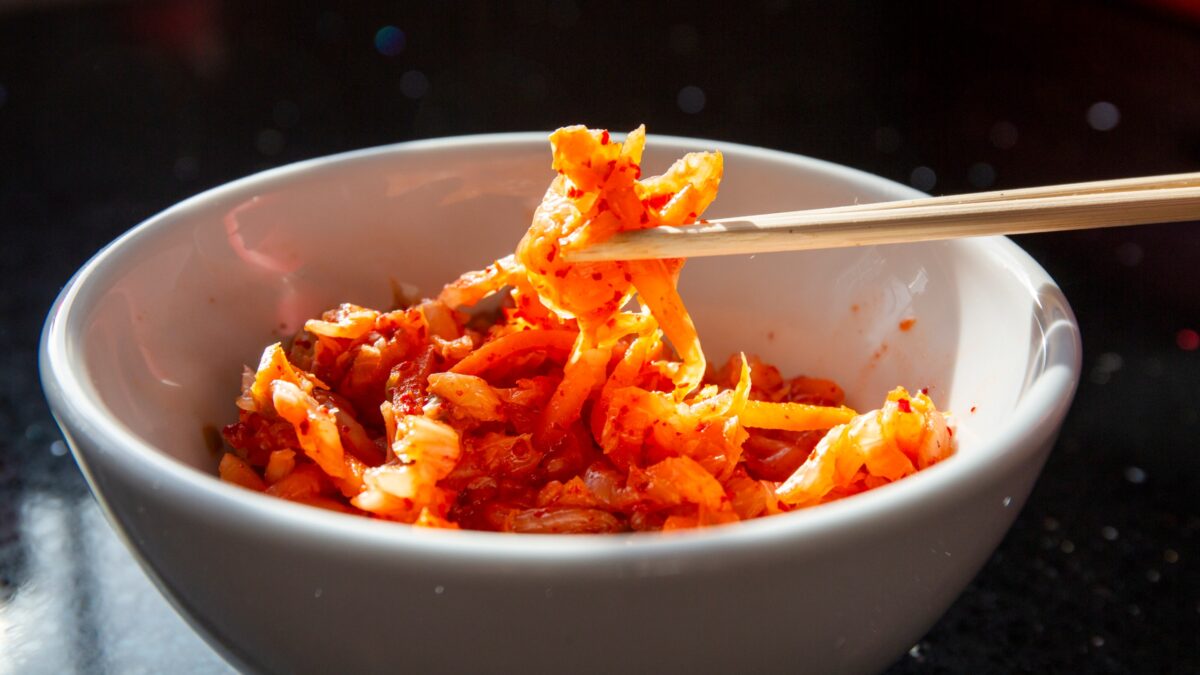
Лабораторийн туршилт болон хулганад хийсэн эхний судалгаагаар кимчигээс гарган авсан нян нанопластиктай холбогдсон байна.
Өмнөд Солонгосын эрдэмтэд кимчигээс Leuconostoc mesenteroides CBA3656 хэмээх сүүн хүчлийн нян илрүүлжээ. World Institute of Kimchi-ийн микробиологич Сэ Хи Ли, Тэ Ун Вон нарын удирдсан судалгаа энэ оны эхээр Bioresource Technology сэтгүүлд нийтлэгджээ.
Полистиролын жижиг хэсгүүдтэй усанд нянг нэмэхэд нанопластикийн 87 хувийг өөртөө барьсан бол хүний гэдсийг дуурайлгасан шингэнд 57 хувийг холбожээ. Мөн нянгүй орчинд өсгөсөн хулганад уг нянг өгсний дараа өтгөн дэх нанопластикийн хэмжээ нэмэгдсэн байна.
Эдгээр үр дүн нь нанопластик нянгийн гадаргууд наалдаж, биеэс гадагшлах боломжтойг харуулж байгаа ч амьд хүний гэдсэнд үр дүнтэйг нотлоогүй. Нянгүй орчинд өсгөсөн хулганын гэдэсний бичил биетний бүрдэл хүнийхээс ялгаатай тул бусад нянтай харилцан үйлчлэл нь үр дүнд хэрхэн нөлөөлөх нь тодорхойгүй; хуванцар ихээр гадагшлах нь гэдэсний эрүүл мэндийг сайжруулна гэсэн баталгаа ч биш.
Микро болон нанопластик хүний биед өвчин, гэмтэл үүсгэдгийг нотлох найдвартай баримт одоогоор байхгүй бөгөөд тэдгээр нь биед хэр удаан үлддэг нь ч тодорхой бус; ихэнх нь биеэр дамжин гадагшилдаг бололтой. Тиймээс кимчигийн энэ нянг нанопластикийг бууруулах арга гэж үзэхэд нэмэлт судалгаа, тэр дундаа хүний гэдсэнд хийх судалгаа шаардлагатай.
Дэлгэрэнгүйг эх сурвалжаас харах
↓Эх сурвалжийг нээх ↓
Scientists in South Korea have discovered a bacterium in kimchi that could theoretically help flush microplastics out of the gut.
It’s called Leuconostoc mesenteroides CBA3656, and it ferments sugars into lactic acid.
When mixed into water with tiny polystyrene particles, this lactic acid bacterium trapped 87 percent of all nanoplastics.
Meanwhile, in a fluid designed to mimic the human intestine, the bacterium bound 57 percent of the nanoplastics present.
These are encouraging findings, though they do not demonstrate success in a living human gut.
In initial animal experiments, however, when researchers in South Korea fed germ-free mice the kimchi-derived microbe, their poop contained more nanoplastics.
The discovery, published in Bioresource Technology earlier this year, comes straight from the World Institute of Kimchi (WiKim) – a government-funded scientific research institute in South Korea that is dedicated to investigating the health benefits of salted and fermented vegetables.
Kimchi is a traditional Korean dish that delivers a plethora of microorganisms to the gut, including lactic acid bacteria.
But similar to other fermented foods, like yogurt or kombucha, scientists are still uncertain if these microbes significantly alter the makeup of the microbiome or improve gut health.
Some human trials suggest they might, but research is still scarce.
At WiKim, researchers are trying to uncover exactly what the microbes in kimchi might be doing in the gut.
The recent study was led by microbiologists Se Hee Lee and Tae Woong Whon, and it suggests that nanoplastics can stick to the surface of some gut bacteria, thereby following their passage out of the body.
This could potentially stop the plastic from being absorbed into the body.
“Plastic pollution is increasingly recognized not only as an environmental issue but also as a public health concern,” said Se Hee Lee.
“Our findings suggest that microorganisms derived from traditional fermented foods could represent a new biological approach to address this emerging challenge.”
This isn’t the first time that scientists have found a bacterium in fermented food that can increase plastic excretion in mice.
In 2025, for instance, a study found that certain probiotics can help mice excrete more microplastics in their poop.
Two bacterial strains in particular were shown to increase microplastic excretion by 35 percent in animal models.
Feeding mice these microbes also decreased the amount of plastic remaining in their intestines by 67 percent.
But such experiments are not realistic.
In these trials, mice are often bred to have guts free of certain microbes and pathogens, and yet in reality, their microbiome and ours are incredibly diverse.
It’s unknown how interactions with other intestinal microbes might change these results.
Besides, even if some bacteria promote plastic excretion, there’s no guarantee that will improve gut health.
While microplastics and their even smaller counterparts, nanoplastics, have been linked to numerous health repercussions, there is no reliable evidence that they can cause damage or disease in humans.
It’s not even clear how long they naturally stick around in the body. Most seem to pass right through us.
In mice, however, there is some research to suggest that bacteria in fermented foods could protect the gut.
Another study published this year, for instance, found that a bacterium in yogurtdoes something similar to the bacterium in kimchi.
In an exploratory experiment, mice fed this yogurt-based microbe excreted 12 times as many microplastics in their poop.
Their guts also showed fewer signs of intestinal damage.
“In summary, this study reports for the first time the role of Lactobacillus delbrueckii subsp. bulgaricus in adsorbing microplastics, promoting their intestinal excretion, and regulating intestinal permeability,” the authors of the study write.
“These findings provide a theoretical basis for further developing this strain as a probiotic formulation to enhance microplastic excretion.”
The new research on kimchi microbes is similarly theoretical, but it demonstrates potential to mitigate plastic exposure in the gut.
“Although further field-scale and microbiota-integrated studies are necessary to confirm its applicability in natural ecosystems and the human gut, these findings establish a strong foundation,” the authors concluded.
“Collectively, this work not only highlights microbial biosorption as a promising and practical approach to address nanoplastic contamination but also provides new insights into microbe-based strategies for nanoplastic removal in environmental and health contexts.”
The research has been published in Bioresource Technology.
This article was fact-checked by Fiona MacDonald and edited by Fiona MacDonald. While we pride ourselves on our process, we are only human. If you spot a mistake, please let us know.

