Неандертальчуудаас өвлөгдсөн ДНХ-ийн нэг хувилбар дагзны дэлбээний эзлэхүүн болон шизофренитэй байх магадлалын багахан ялгаатай холбоотой байна.
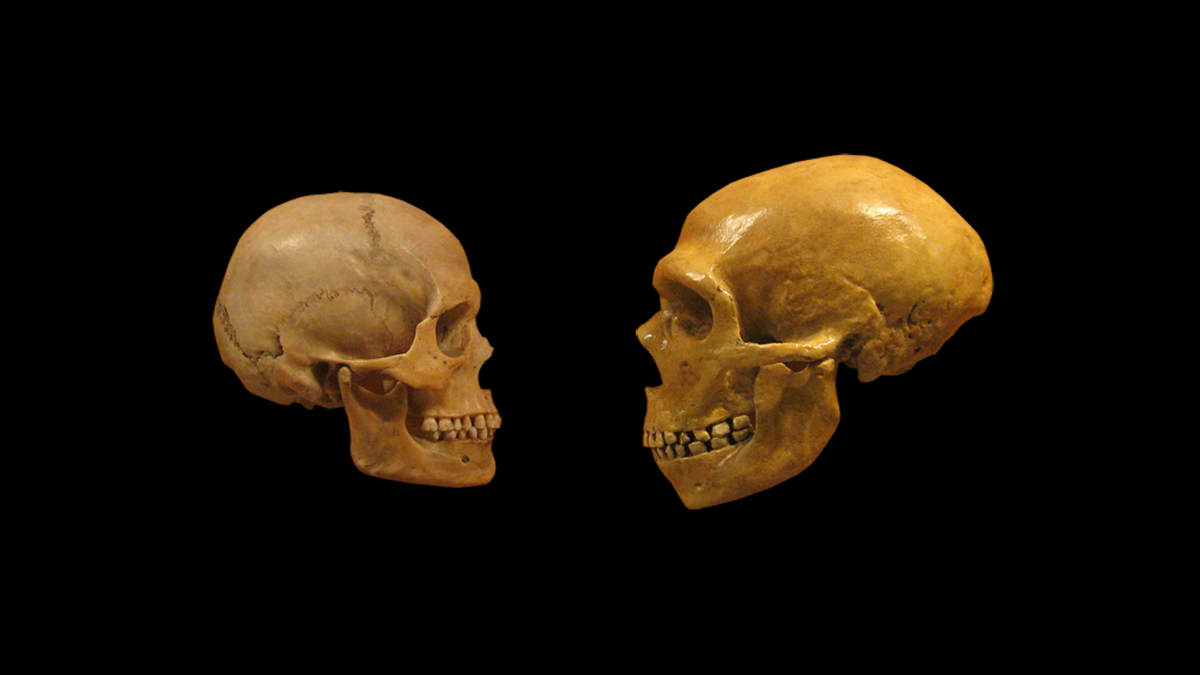
Неандертальчуудын тархи орчин үеийн хүнийхтэй ойролцоо, заримдаа бүр том хэмжээтэй байсан ч гавлын хэлбэр нь илүү урт байжээ. Чулуужсан гавлын ясны судалгаагаар тэдний тархины ар хэсэгт байрлах дагзны дэлбээ харьцангуй том байсан байж болзошгүй гэж үздэг.
Макс Планкийн Хувьслын антропологийн хүрээлэнгийн Уго Зеберг, Сванте Паабо нар тархины энэ хэсгийн эзлэхүүнтэй холбоотой генетикийн хувилбаруудыг судалжээ. Тэд 14-р хромосом дахь дөрвөн ДНХ-ийн суурь хасагдсан хувилбар Сахарын цөлөөс урагш орших Африкийн хүн амд илрээгүйг тогтоож, эртний таван неандерталь хүний ДНХ-д байсан ч Денисовагийн хоёр хүнийхэд байгаагүйг харьцуулан ажигласан байна. Хувилбарын орчмын ДНХ-ийн хэсэг ойролцоогоор 60 мянган суурь урт байсан нь уг хувилбар эртний нийтлэг өвгөөс бус, неандертальчуудтай эрлийзжсэний дараа орчин үеийн хүний геномд орсныг хүчтэй илтгэжээ.
Энэ хувилбарыг тээгч орчин үеийн хүмүүсийн дагзны дэлбээний эзлэхүүн нэг хувь тутамд дунджаар 0.85 куб сантиметрээр бага байв. Уг хасалт тархины хөгжилд оролцдог DAAM1 генийн ойролцоо байрладаг ч ганц генетикийн хувилбараар неандертальчуудын тархины бүтцийг тайлбарлах боломжгүй гэж судлаачид тэмдэглэжээ.
Мөн уг хувилбарын нэг хувьтай хүмүүст шизофренитэй байх магадлал ойролцоогоор таван хувиар, хоёр хувьтай хүмүүст бараг 10 хувиар бага байжээ. Гэхдээ энэ холбоо дагзны дэлбээний эзлэхүүнтэй холбоотой эсэх нь тодорхойгүй бөгөөд ерөнхий оюуны чадвартай мэдэгдэхүйц хамаарал илрээгүй, боловсролын түвшинтэй холбоо нь ч бага эсвэл байхгүй байв. Судалгааг Proceedings of the National Academy of Sciences сэтгүүлд нийтэлжээ.
Дэлгэрэнгүйг эх сурвалжаас харах
↓Эх сурвалжийг нээх ↓
Tens of thousands of years ago, the last Neanderthal disappeared from our world.
But the ghost of this ancient human relative lives on – its lingering traces haunting the Homo sapiens genetic code.
It manifests in some curious ways – certain hair textures, for example, or how the body stores fat, may be influenced by DNA inherited from ancestors that mingled with their Neanderthal neighbors.
That inheritance may be shaping more than what we look like. A new study has found a tiny stretch of Neanderthal DNA associated with a measurable difference in the size of the occipital lobes – the region that occupies the back of the brain.
And intriguingly, the same genetic variant is also linked to a slightly lower risk of schizophrenia – but no association with general cognitive ability.
“Differences in the occipital region of the brain between Neanderthals and modern humans have long been inferred from the fossil record,” write anthropologists Hugo Zeberg and Svante Pääbo of the Max Planck Institute for Evolutionary Anthropology in a paper published in PNAS.
“Here, we show that a common genetic variant influencing occipital brain volume in present-day people was inherited from Neanderthals.”
History used to paint Neanderthals as closer to apes than humans in terms of cognitive ability; more recently, anthropologists have begun to discover that our hominid cousins may have had complex social and symbolic lives, artistic abilities, engineering ingenuity, and other traits once considered uniquely human.
Likewise, too, their brains were not small. In fact, they were comparable in size to the brains of modern humans – sometimes even larger.
Where they differed was in shape. The skulls of modern humans are relatively rounded, or globular; Neanderthal skulls were more elongated, extending farther from front to back.
This suggests that, although our brains were similar in overall size, the tissue inside may have been distributed differently.
One region of particular interest is the occipital lobe, which sits at the back of the brain and contains the visual cortex, responsible for processing information received from the eyes (yes, you ‘see’ things in the back of your head).
Previous research examining the internal shapes of fossil skulls suggests that Neanderthals may have had proportionally larger occipital lobes than modern humans.
But fossil skulls can only tell us so much about the soft tissue they once contained. To learn more about the evolutionary history of our brains, scientists need to look deeper – into the genetic instructions that help build them in the first place.
This is where Zeberg and Pääbo enter the story. They specifically wanted to know whether humans had inherited any Neanderthal genetic variants associated with the size of the occipital lobe.
Previous genome studies had identified four locations on the genome of living humans associated with this trait. That was the easy part.
The hard part was showing any of them were related to a long-extinct human ancestor.
First, the researchers looked at where the four genetic variants appeared in modern human populations.
Three were found in populations in sub-Saharan Africa. But the fourth, a tiny deletion of just four DNA letters on chromosome 14, was found only outside that region.
The deletion sits near a gene called DAAM1, which plays a role in brain development. The researchers suspect the inherited DNA may influence how this gene is expressed, potentially helping explain its association with brain structure.
This was a promising clue. Neanderthals interbred with the ancestors of modern humans after those humans migrated out of Africa.
That means traces of their DNA can be found in populations across much of the world – but at significantly lower levels in sub-Saharan Africa, where most ancestors of present-day populations had not encountered Neanderthals.
The researchers then compared the variant with ancient DNA from five Neanderthals and two Denisovans, another extinct group of ancient humans.
All five Neanderthals carried the deletion. The two Denisovans did not.
But this does not mean that the deletion necessarily came from Neanderthals. Another possibility was that both Neanderthals and modern humans inherited it from an even earlier common ancestor.
One way to learn more is by looking at the region of the genome around the variant.
Over successive generations, inherited stretches of DNA are gradually broken up and rearranged through a process called recombination – so if the deletion were inherited from a common ancestor hundreds of thousands of years ago, the surrounding DNA should be much more fragmented.
The stretch the researchers found was nearly 60,000 DNA letters long – much longer than would be expected if it had been passed down from such a distant ancestor.
This provided strong evidence that the DNA had entered the modern human genome much more recently, through interbreeding with Neanderthals.
That’s a satisfying conclusion to some clever anthropological detective work, but the variant’s association with brain anatomy raised even more questions.
Because although Neanderthals are thought to have had proportionally larger occipital lobes than modern humans, modern humans with the deletion have smaller occipital lobe volumes – about 0.85 cubic centimeters per copy of the variant.
The researchers suggest that this apparent contradiction may not be a contradiction at all.
The shape of the brain is influenced by many different genes, as well as other factors such as the size of the eyes and body. A single genetic variant is just one part of a much more complex interplay, and without a detailed understanding of that interplay, it can’t tell us much about the Neanderthal brain.
The researchers also found that the deletion wasn’t just associated with anatomy. As with any aspect of an organ as complicated as the brain, it’s natural to wonder whether a difference in its structure might be reflected in how it functions.
The researchers dug into existing genetic data from the Psychiatric Genomics Consortium, which studies the genetic contributions to psychiatric disorders, to look for associations with the Neanderthal variant.
They found that people carrying the variant had slightly lower odds of schizophrenia – around 5 percent lower per copy, or nearly 10 percent for people with two copies.
But they did not establish whether this was linked to the volume of the occipital lobe, or an independent association.
And, intriguingly, the researchers found no significant association with general intelligence, and little or no meaningful association with educational attainment.
“These findings caution against equating the size of a brain region with cognitive abilities,” they write.
The research has been published in Proceedings of the National Academy of Sciences.
This article was fact-checked by Fiona MacDonald and edited by Fiona MacDonald. While we pride ourselves on our process, we are only human. If you spot a mistake, please let us know.

