
Бүх биеийн хөдөлгөөнийг шинжилсэн хиймэл оюуны загвар нойр, чихрийн шижин, элэгний үзүүлэлттэй хамаарал илрүүлжээ.
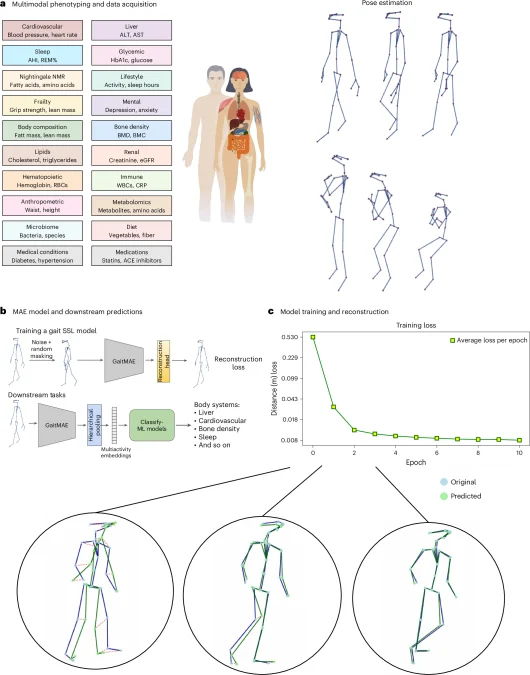
Nature Medicine сэтгүүлд нийтлэгдсэн судалгаанд Израилийн Weizmann Institute of Science-ийн эрдэмтэд 3,328 насанд хүрэгчийн хөдөлгөөний бичлэгийг шинжилжээ. Оролцогчид гүйлтийн зам дээр удаан болон өөрийн сонгосон хурдаар алхах, байрандаа алхах, сандлаас босох, тэнцвэрээ шалган хөдөлгөөнгүй зогсох таван даалгавар гүйцэтгэсэн байна. Гүний мэдрэгчтэй камераар үе мөчний 3D байрлалыг бүртгэж, хиймэл оюуны загварыг бичлэгийн хэсгүүдийг сэргээн таамаглах замаар сургасан байна.
Загвар 3,210 эрүүл мэндийн үзүүлэлтийн 1,887-той статистикийн ач холбогдолтой холбоо илрүүлж, алхалтын хурд, алхмын уртаас гадна хөдөлгөөний нэмэлт мэдээлэл гаргажээ. Хөдөлгөөний хэв маяг элэгний хөшүүн чанарыг таамаглахад тусалсан бөгөөд судлаачдын мэдээлснээр таамаглал нь элэгний цусны шинжилгээтэй дүйцэхүйц мэдээлэлтэй байв. Мөн их биеийн хөдөлгөөн нойр, дасгал хөдөлгөөнтэй холбоотой мэдээлэл агуулж, загвар нойрны апноэтой холбоотой үзүүлэлт, нойргүйдэл болон өмнөх шөнийн унтсан хугацаатай хамаарал илрүүлсэн байна.
Нас, биеийн жингийн индекс, дотор эрхтний орчмын өөх, өндрийг тооцсон загварт хөдөлгөөний өгөгдөл нэмэхэд чихрийн шижин, сэтгэл гутрал, нойргүйдэл болон эмийн хэрэглээтэй холбоотой таамаглал сайжирчээ. Гэвч судалгаа нэг цаг хугацаанд оролцогчдыг үнэлсэн тул өвчин эсвэл нойрны асуудал тодорхой хөдөлгөөний хэв маягийг үүсгэдэг эсэхийг тогтоох боломжгүй. Оролцогчид ерөнхийдөө эрүүл, ихэнх нь Израилд амьдардаг ашкенази еврей хүмүүс байсан тул үр дүн бусад хүн амд адил хамаарах эсэх тодорхойгүй.
Судалгаанд ашигласан камер, программ хангамжид тулгуурласан загварыг бие даан шалгах шаардлагатай бөгөөд камерыг үйлдвэрлэдэг Newton Tech судалгааны хамтран зохиогчоор оролцжээ. Анагаах ухаанд ашиглахаас өмнө оношилгооны ялган таних чадварыг тодорхой харуулсан эмнэлзүйн судалгаа шаардлагатай гэж судлаач Адам Габет хэлсэн байна. Судлаачид хөдөлгөөний өөрчлөлт өвчний шинж тэмдгээс өмнө илэрч болох эсэхийг цаашид судлахаар төлөвлөжээ.
Дэлгэрэнгүйг эх сурвалжаас харах
↓Эх сурвалжийг нээх ↓
Before you’ve said a word about why you came in, your doctor may already have noticed something about your health. The way you walk across the room can offer an early clue.
Scientists have now developed an AI system that examines how the whole body moves, and it found links to health that go well beyond the legs. Some involve sleep, diabetes, and even the liver.
In a new study published in Nature Medicine, researchers at the Weizmann Institute of Science in Israel analyzed movement recordings from 3,328 adults to see what those movements might reveal.
Doctors have long watched for changes in walking speed, balance, and posture. Researchers have even described walking speed as a“sixth vital sign”.
“When we started this project, we believed that movement could tell a lot about your health,” study author Adam Gabet, a computer scientist at the Weizmann Institute of Science, told ScienceAlert.
The team wanted to find out whether a computer could recognize some of the subtle signs doctors notice.
In a controlled setting, participants completed five movement tasks: walking on a treadmill at 3 kilometers (about 1.9 miles) per hour and at their preferred pace, walking in place, rising from a chair, and standing still to test their balance.
A depth-sensing camera recorded the positions of their joints in three dimensions. The researchers then trained an AI model by hiding parts of the movement recordings and asking it to reconstruct what was missing.
To fill in the gaps, the system had to learn how different parts of the body move together.
It converted those movements into numerical patterns, which the researchers compared with detailed health information, including laboratory results, body measurements, medical conditions, and lifestyle characteristics.
The model identified statistically significant associations with 1,887 of the 3,210 health characteristics examined. Movement patterns also provided information beyond familiar measurements such as walking speed and stride length.
Some connections involved age and body fat. Others pointed to health characteristics that might seem unrelated to walking.
One involved the liver. Doctors can assess liver scarring by measuring how stiff the organ has become. The researchers found that movement patterns could predict liver stiffness, and they report that the predictions were as informative as liver blood tests.
Sleep was another surprise: Movement of the torso, the area between the shoulders and hips, carried information associated with sleep and exercise.
“A finding that stood out to me was how much sleep quality affects our body,” Gabet said.
The model could predict measures linked tosleep apnea, a condition in which breathing repeatedly stops or becomes restricted during sleep. It also found associations with insomnia and the amount of sleep participants got the previous night.
These findings suggest that sleep health is reflected in patterns of movement, although the study does not establish that the system can diagnose sleep disorders.
Gabet said conventional walking research has often concentrated on the legs, leaving movements of the upper body relatively unexplored.
The team’s findings suggest that looking at the whole body could reveal information that traditional walking measurements miss.
Adding movement patterns to a model that already accounted for age, body mass index, fat around the internal organs, and height improved predictions of conditions such as diabetes, depression, and insomnia, as well as medication use.
The researchers hope movement analysis could eventually complement routine health assessments. A brief test, requiring no blood samples or invasive procedures, might help doctors identify changes worth investigating further.
However, the findings don’t establish that sleep problems or diseases cause particular walking patterns. The analysis was cross-sectional, meaning it captured participants at a single point in time, so the researchers can’t tell which changes came first.
The participants were generally healthy and mostly Ashkenazi Jewish adults living in Israel, so the findings may not apply equally to other populations. The system also relied on a particular depth camera and its software. Newton Tech, which makes the depth-camera system used, co-authored the study.
Gabet noted that related research from the laboratory has produced results that held up in other groups, but this model still needs independent testing.
“Clinical studies that show clear separation with good specificity would be needed before medical deployment,” Gabet said.
The researchers now want to investigate whether changes in movement can appear before signs of disease, potentially revealing health problems earlier.
The study was published inNature Medicine.
This article was fact-checked by Rebecca Dyer and edited by Rebecca Dyer. While we pride ourselves on our process, we are only human. If you spot a mistake, please let us know.

