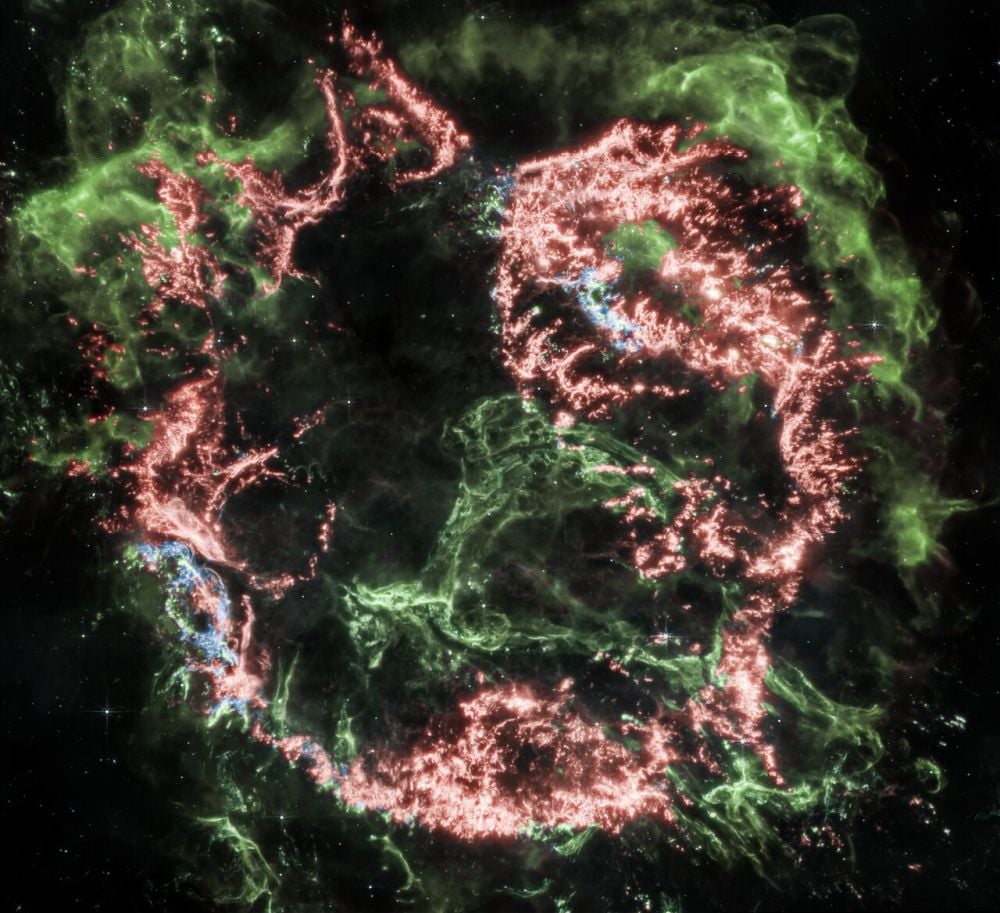
Шинэ судалгаагаар суперновагийн үлдэгдэл болох Cassiopeia A-г нарийвчлан судалж, одны дэлбэрэлтийн өмнөх үйл явцыг илрүүллээ.
Жэймс Вэбб сансрын дуран авай (JWST)-н MIRI багаж болон дунд давтамжийн спектрометр (MRS) ашиглан судлаачид 11,000 гэрлийн жилийн зайд орших Cassiopeia A (Cas A) суперновагийн үлдэгдлийн химийн бүтцийг анх удаа нарийвчлан тогтоожээ. Энэхүү судалгаа нь дэлбэрэлтийн үр дүнд үүссэн тоосонцрын найрлага болон одны бүтэц хэрхэн өөрчлөгдсөнийг танихад чухал ач холбогдолтой юм. Астрофизикчид оддын дотоод бүтцийг шууд харах боломжгүй тул дэлбэрэлтийн дараах үлдэгдлийг шинжлэх замаар одны түүхийг нөхөн сэргээдэг.
Судлаачид Cas A-гийн тоосонцрын бөөгнөрөл тус бүрийг ялган шинжилж, тухайн од дэлбэрэхийнхээ өмнөхөн гаднах давхаргууд нь хоорондоо нэгдсэн болохыг тогтоожээ. Жишээлбэл, хүчилтөрөгч болон нүүрстөрөгчийн бүрхүүлүүд холилдож, одны химийн найрлагад томоохон өөрчлөлт оруулсан байна. Энэхүү үйл явц нь дэлбэрэлтийн дараа сансарт ялгарсан химийн элементүүдийн харьцаанд шууд нөлөөлдөг бөгөөд ирээдүйн од, гариг эрхсийн бүрэлдэхүүнийг тодорхойлдог.
Судалгааны баг MRS спектрометрийн тусламжтайгаар үлдэгдлийн гурван өөр хэсгийг нарийвчлан судалжээ. Эдгээр хэсэг нь өөр өөр химийн шинж чанартай тоосонцруудаас бүрдэж байгаа нь тогтоогдсон бөгөөд үүнийг JAXA-гийн XRISM болон NASA-гийн Chandra X-ray Observatory-ийн өмнөх ажиглалтын мэдээлэлтэй нэгтгэн дүгнэв. Энэхүү амжилт нь суперновагийн дэлбэрэлтээс ялгарсан тоосонцор хэрхэн сансрын уудамд тархаж, дараагийн үеийн одод үүсэхэд хэрхэн хувь нэмэр оруулдгийг ойлгоход шинэ гарц нээж байна.
Дэлгэрэнгүйг эх сурвалжаас харах
Эх сурвалжийг нээх ↓
Finding order in the chaotic aftermath of a supernova explosion isn’t easy. But the JWST has the tools to do it. Its Mid-Infrared Instrument (MIRI) and its Medium-resolution Spectrometer (MRS) were built for situations like this.
Massive stars play an important role in the evolution of the cosmos. They’re responsible for synthesizing astronomical metals, the elements heavier than hydrogen and helium that are necessary to form everything from rocky planets to living organisms. Without massive stars, the cosmos would look much different. It would be a simple mixture of hydrogen, with a little helium mixed in, and trace amounts of lithium. Nature can’t build planets or create life with that limited palette.
Astrophysicists can’t see inside stars to learn more about this process, so they have to wait until they turn themselves inside out and then examine the results.
Massive stars live fast and die young, then explode as supernovae. When that happens, the explosion sends their contents, including their astronomical metals, out into the interstellar medium. Once there, it’s available not only for planets and life, but for the next generation of stars.
When a supernova explodes, it leaves behind a supernova remnant, the matter ejected by the explosion in an expanding shockwave. The shockwave heats up the expanding shell, creating some of Nature’s most stunning displays. The shocks can also rebound, creating an inward shock wave. It can create a real mess, but there are still patterns to be discerned. Within the exanding shell, molecules come form that tell astrophysicists what happened inside the star prior to its explosion.
One of the most well-known supernova remnants is Cassiopeia A (Cas A). It’s about 11,000 light years away, and it was observed by Earthlings around 1667. Astronomers are interested in it because they can learn a lot about the exploding star that created it—the progenitor—by analyzing its contents.
The JWST was built for just such an endeavour. In new research in The Astrophysical Journal Letters, a team of researchers used the JWST’s MIRI and MRS to determine Cas A’s chemical makeup. The research is “JWST Resolves Dust Emission from Individual Ejecta Clumps in Cassiopeia A: Dominant Grain Compositions Point to a Shell Merger in the Progenitor,” and the lead author is Tea Temim, a research scientist from Columbia University.
“We present a study of dust emission in the supernova remnant (SNR) Cassiopeia A (Cas A) observed with the MIRI Medium-resolution Spectrometer (MRS) on board JWST,” the authors write. “The unprecedented spatial resolution at mid-IR wavelengths allows us to isolate dust emission from individual arcsecond-scale clumps of supernova (SN) ejecta and circumstellar material (CSM) and identify the dominant dust species in each chemically distinct region.”
Massive stars fuse different elements in layers, and that’s reflected in the remnants they leave behind when they explode. Increasingly heavier elements are forged in the core, up until iron is reached. Lighter elements are fused together in the surrounding layers. These layers tell the star’s history, but it all gets blown into space when the star explodes as a supernovae. To make matters more complicated, these shock waves can bounce back as reverse shocks.
The clumps in the supernova ejecta that the authors refer to are huge, as large as our Solar System. In studying these clumps with the MRS, the researchers were able to identify different dust species region by region, rather than as one mixed up jumble of spectra. They learned that the progenitor star underwent a shell merger.
“Material within these shells churns and circulates, which can cause the shells to merge shortly before the supernova explosion,” lead author Temim said in a press release. “So, for example, this would be something like the oxygen- and carbon-burning shells in a star merging together and changing the structure of the star significantly. And that would then change the chemical abundances that you would see after a supernova explosion in the ejecta of a supernova remnant.”
Before they turned to the JWST, they used Spitzer images to identify regions to focus on with the JWST.
This figure shows Spitzer images on the left and JWST images on the right. The JWST obviously has a much higher resolution, and the researchers used it to map Cas A’s dust chemistry all across the remnant. The observations led to a better understanding of the shell mergers the remnant went through right before it exploded, and a better understanding of the progenitor’s overall structure. Since astrophysicists can’t see inside stars, they have to wait until they turn themselves inside out. Image Credit: NASA, ESA, CSA, JPL-Caltech, T. Temim (Columbia University), R. Arendt (UMBC), D. Milisavljevic (Purdue University). Image Processing: A. Pagan (STScI).
The Spitzer identified regions with different dust properties. The researchers focused on three of them with MRS.
“The MRS spectra extracted at positions P1, P2, and P3 … all exhibit significant emission from warm dust, but with spectral shapes that differ considerably between the three regions,” the authors write.
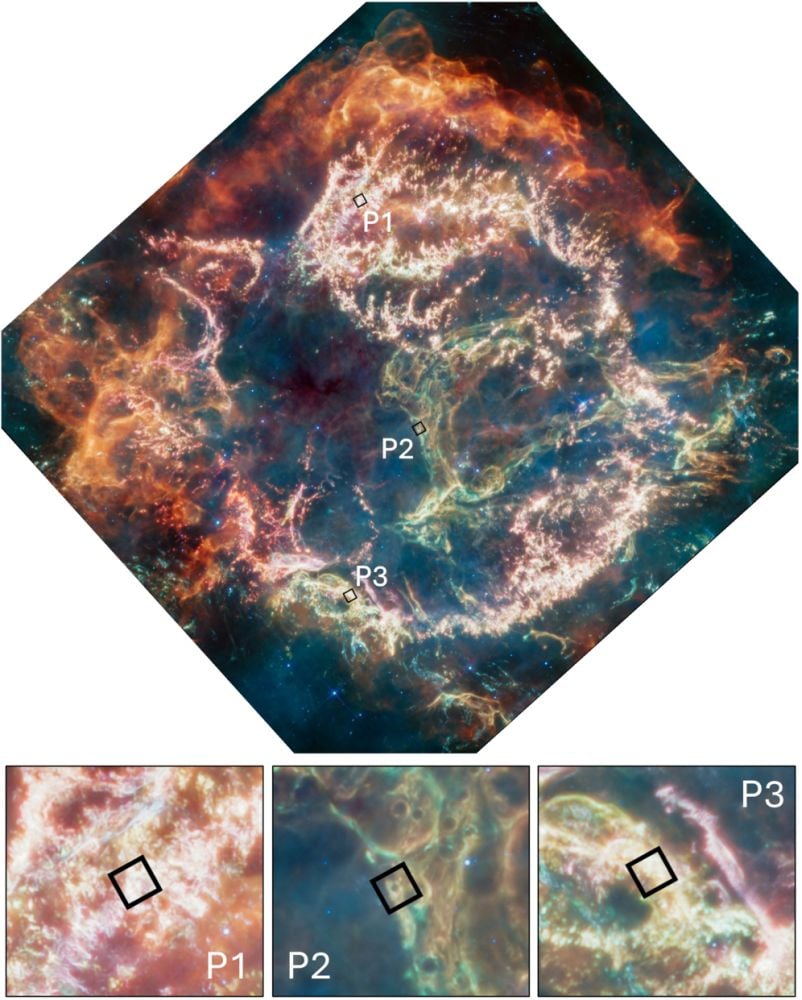 This image shows the overall supernova remnant and the locations of three regions with distinctly different dust properties first identified with the Spitzer Space Telescope. The researchers examined these regions more closely with the JWST’s MRS, seen as P1, P2 and P3. Image Credit: NASA, ESA, CSA, Danny Milisavljevic (Purdue University), Tea Temim (Princeton University), Ilse De Looze (UGhent); Image Processing: Joseph DePasquale (STScI).
P1 samples reverse-shocked ejecta that has bright argon emissions dominate by grains of SiO2 (silica). It helps the researchers track the outer layers of the supernova’s ejecta. Finding it supports the idea that the progenitor underwent a carbon–oxygen shell merger.
P2 is centered on what astronomers call Cas A’s “Green Monster” structure, which is the green structure near the center. It’s emissions are attributed to circumstellar matter emissions on Cas A’s near side, not material from Cas A’s progenitor. It’s likely made of mostly Mg2SiO4, which helps astronomers determine that the progenitor’s dust and the CSM dust are distinct from one another.
P3 is another reverse-shocked region. It has very bright neon emissions compared to P1. That favours another shell merger, this time between a carbon shell and an oxygen shell.
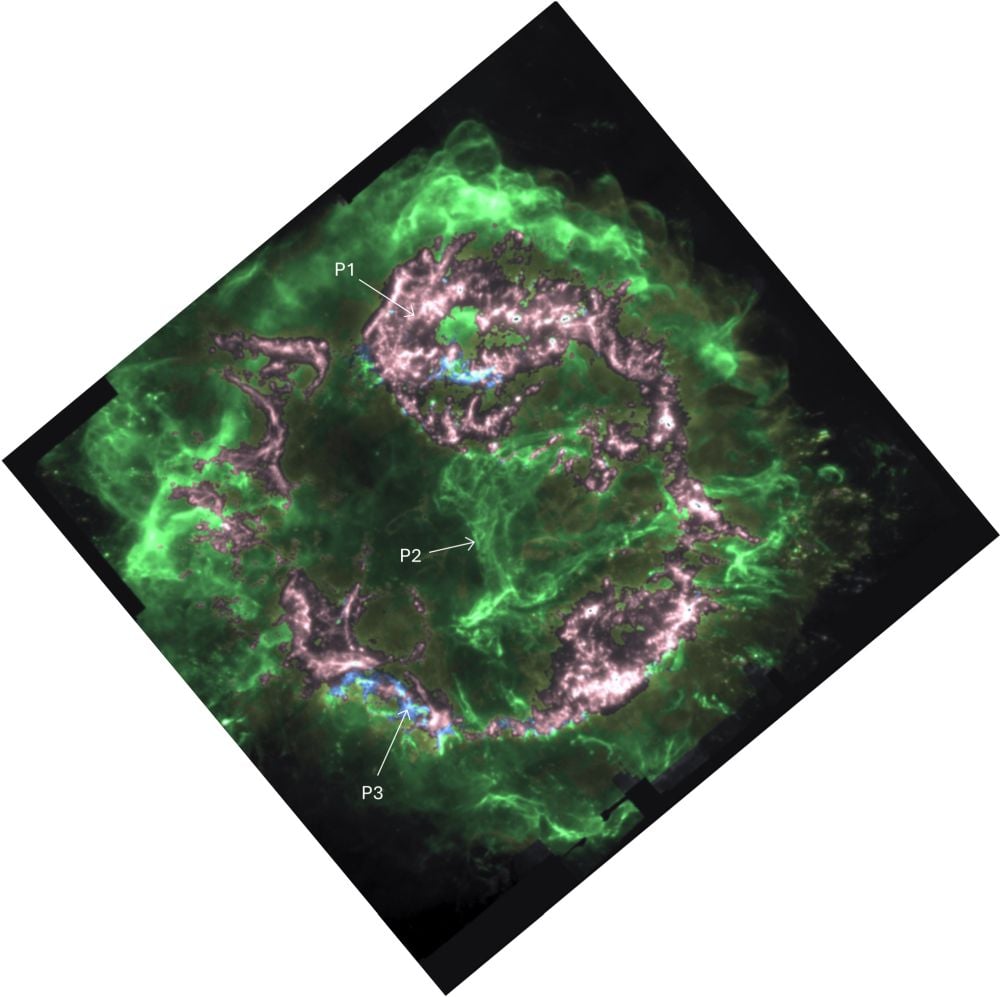 This image of Cas A is from the JWST’s MIRI F2100W filter. The P1, P2, and P3 regions are indicated by the white arrows. “The spatial distribution of the P2-like emission associated with Mg2SiO4 CSM dust is shown in green, P1-like emission associated with SiO2 dust is shown in magenta, and P3-like Ne-rich emission associated with carbon dust is shown in blue,” the authors write. Image Credit: Tea Temim et al 2026 ApJL 1012 L26
“Identifying the different types of dust grains formed in the chemically distinct layers of a supernova brings us one step closer to understanding how much dust supernovae contribute to the interstellar dust reservoir in our galaxy,” said co-author Ilse De Looze, associate professor at Ghent University in Belgium. “By revealing the composition of this newly formed supernova dust, JWST also provides crucial insights into how well these grains can survive the powerful reverse shocks that sweep through the supernova debris, ultimately determining how much dust can escape into the interstellar medium.”
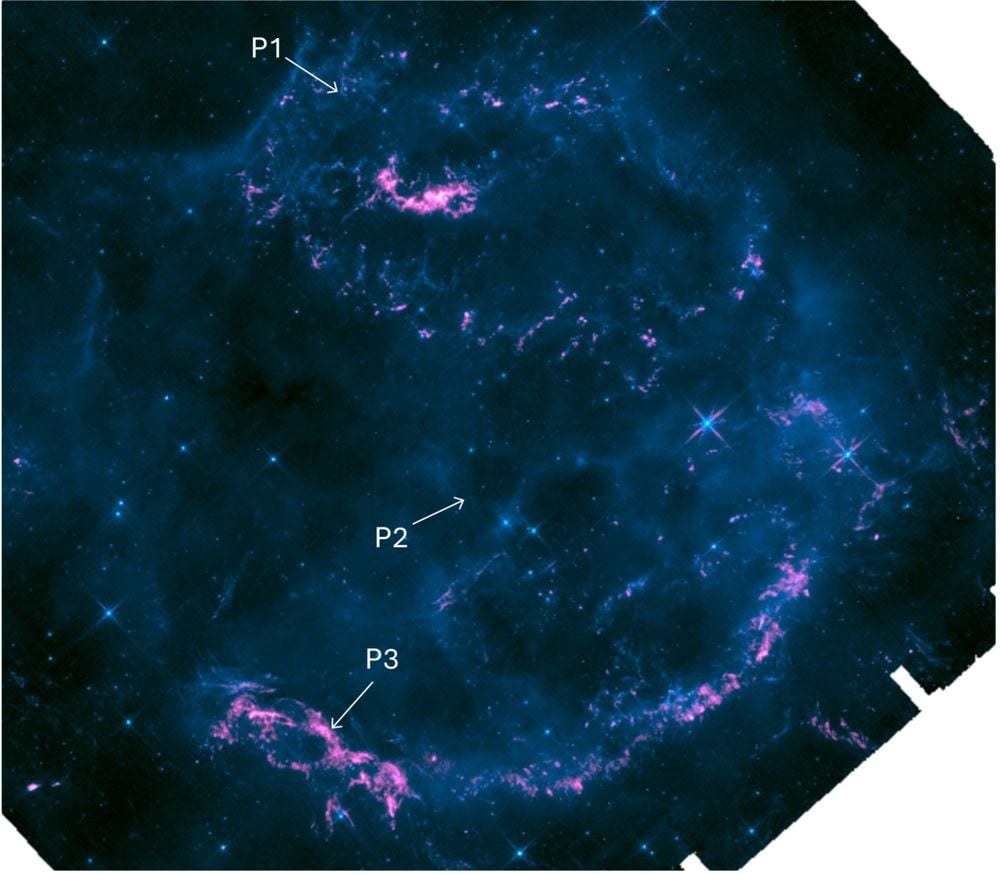 This JWST image of Cas A has the synchrotron emissions subtracted. Since synchrotron emissions are non-thermal, and since their emission lines overlap the lines from thermal dust, removing them helps to isolate the signal from the ejecta, which is what the researchers are interested in. So this image basically tracks the thermal emissions from carbon dust. Image Credit: Tea Temim et al 2026 ApJL 1012 L26
The JWST played a leading role in this effort to piece together what happened to Cas A’s progenitor. But it’s observations added to an existing observational base from JAXA’s XRISM x-ray satellite and NASA’s own Chandra X-ray Observatory. Taken together, the more complete picture shows that the progenitor’s shell mergers were underway prior to its explosion as a supernova.
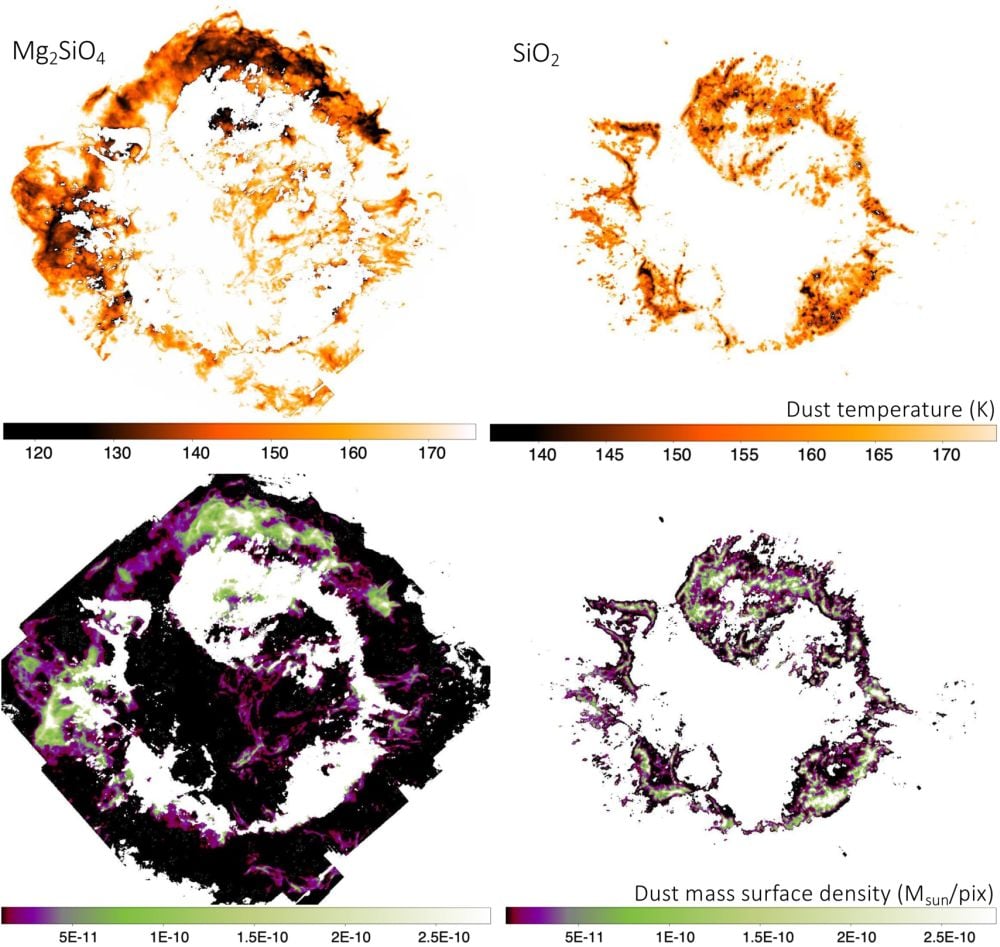 After all the imaging, processing, and fitting to models, this is the overall result. This figure shows which parts of the Cas A ejecta are from the existing circumstellar medium (left: Mg2SiO4 grains) and which parts are actually form the progenitor star (right: SiO2 grains.) Image Credit: Tea Temim et al 2026 ApJL 1012 L26
“With Webb, the vast improvement in being able to resolve at the individual clump level helps us do more sophisticated dust chemistry,” said Dan Milisavljevic, associate professor and co-author of the study from Purdue University in the United States. “As a result, we can tie the explosion back to the makeup of the progenitor star hundreds of years afterward. It’s telling us about what was happening, we think, in the hours leading up to core collapse. Understanding this process is essential to explaining which elements the supernova explosion will release into the galaxy and how those elements enrich future generations of stars and planets.”
These results will also help build better model for understanding other supernova remnants.
The authors say this work shows how important the JWST’s high-resolution images are for understanding dust ejecta in supernova remnants and how it was formed. (But smart Universe Today readers already know how important the JWST is.)
“It also demonstrates that spatially resolved dust compositions in young SNRs can serve as a powerful probe of the chemical structure and explosion properties of core-collapse SNe,” they conclude.

