Радиокарбоны шинжилгээ болон эртний ДНХ-ийн судалгаагаар мамонтын үлдэгдэл гэж үзэж байсан яс далайн халимд хамаарах нь тогтоогджээ.
Археологич Отто Гейст 1951 онд Аляскийн дотоод нутгаас олсон нурууны ясыг хэмжээ, хэлбэр болон олдсон газарт нь тулгуурлан ноост мамонтынх гэж үзсэн байна. Ясыг Аляскийн их сургуулийн North Museum-д хадгалснаас хойш 70 гаруй жилийн дараа радиокарбоны шинжилгээ хийжээ.
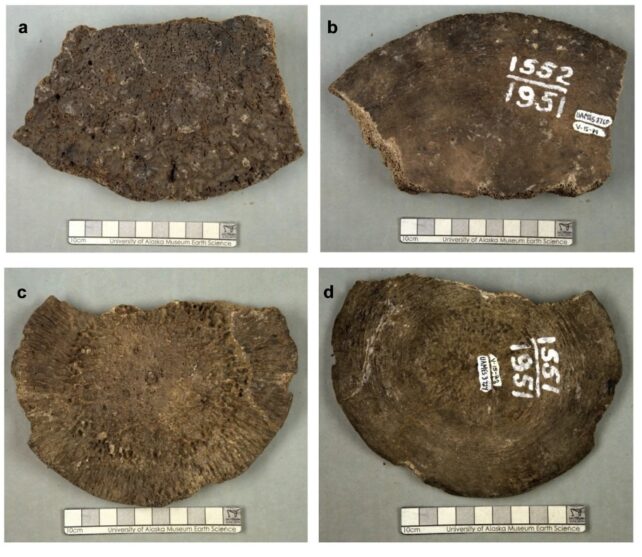
Шинжилгээгээр ясны нас ойролцоогоор 1,200–1,900 жил гэж гарсан нь мамонтын мөхлийн хугацаанаас хэт хожуу байв. Мамонтуудын ихэнх нь 13,000 орчим жилийн өмнө мөхсөн бөгөөд зарим тусгаарлагдсан бүлэг нь 4,000 орчим жилийн өмнө хүртэл амьдарч байсан гэж үздэг. Мөн ясанд агуулагдах азот-15, нүүрстөрөгч-13-ын изотопын хэмжээ хуурай газрын өвсөн тэжээлт амьтнаас илүү далайн амьтанд нийтлэг үзүүлэлт байжээ.
Судлаачид яснаас гаргаж авсан митохондрийн ДНХ-г Номхон далайн хойд хэсгийн баруун халим болон энгийн минки халимны ДНХ-тэй харьцуулж, үлдэгдэл халимных болохыг тогтоосон байна. Харин 1,000 гаруй жилийн настай халимны яс далайн эргээс 400 гаруй километрийн зайд орших Аляскийн дотоод нутагт хэрхэн хүрснийг одоогоор тайлбарлаж чадаагүй байна. Халим гол мөрнөөр дотогш орсон, хүмүүс яс тээвэрлэсэн эсвэл музейд бүртгэх явцад андуурал гарсан байж болох ч судлаачид эдгээр боломжийг баталж чадаагүй; харин олдворууд мамонтын хамгийн сүүлчийн үлдэгдэл биш гэдгийг тогтоожээ. Судалгааг Journal of Quaternary Science сэтгүүлд нийтэлсэн байна.
Дэлгэрэнгүйг эх сурвалжаас харах
↓Эх сурвалжийг нээх ↓
The fossilized backbones of what appeared to be woolly mammoths have turned out to come from an entirely different and unexpected animal.
Archaeologist Otto Geist first discovered the bones on an expedition in 1951 through the Alaskan interior, in a prehistoric geographic region known as Beringia.
Based on the bones’ appearance and location, Geist concluded the bones belonged to woolly mammoths (Mammuthus primigenius).
At the time, this made a lot of sense.
After all, late Pleistocene megafauna bones were common in the region, and the sheer size of the backbones was decidedly elephantid.
After the discovery, Geist brought the bones to the University of Alaska’s Museum of the North, where they were archived for more than 70 years.
Learn more about this and other strange discoveries in the video below:
Decades later, the museum’s Adopt-a-Mammoth project, which lets members of the public sponsor the radiocarbon dating of its roughly 1,500 mammoth fossils, finally dated the bones, an undertaking that appears to have raised far more questions than it solved.
That’s because the bones, it turns out, are far too young to belong to a woolly mammoth.
The carbon isotopes locked within the ancient bones first suggested an age of around 2,000 to 3,000 years. That was later revised to roughly 1,200 to 1,900 years.
Mammoths, on the other hand, are believed to have gone extinct around 13,000 years ago, except for a few isolated populations that struggled on until about 4,000 years ago.
“Mammoth fossils dating to the Late Holocene from interior Alaska would have been an astounding finding: the youngest mammoth fossil ever recorded,” University of Alaska Fairbanks biogeochemist Matthew Wooller and team explain in a study published in the Journal of Quaternary Science.
“If accurate, these results would be several thousand years younger than the latest [sedimentary ancient DNA] evidence for mammoth in eastern Beringia.”
Before entirely rewriting the timeline of mammoth extinction, the researchers decided they’d better make sure the species had actually been identified correctly.
It’s a good thing they did.
“The radiocarbon data and their associated stable isotope data were the first signs that something was amiss,” the team writes.
The bones contained much higher levels of nitrogen-15 and carbon-13 isotopes than you’d expect for a grass-munching landlubber like the woolly mammoth.
Though these isotopes can turn up in land animals, they are far more common in the ocean and so tend to accumulate in the bodies of marine creatures.
No eastern Beringian mammoth has ever been found with such a chemical signal, because the deep Alaskan interior isn’t exactly known for its seafood.
“This was our first indication that the specimens were likely from a marine environment,” the researchers write.
Both mammoth and whale experts agreed it was impossible to identify the specimens based on physical appearance alone: Ancient DNA would be essential to “secure the specimens’ true identity.”
Though the specimens didn’t look likely to hold well-preserved DNA of the kind stored in our cell nucleus, the team was able to extract mitochondrial DNA to compare with that of a Northern Pacific Right whale (Eubalaena japonica) and a Common Minke whale (Balaenoptera acutorostrata).
“Although the mysterious radiocarbon dates of these two specimens have been resolved with the finding that the presumed mammoth fossils were in fact whales, an equally puzzling mystery then came into focus,” Wooller and team explain in their paper.
“How did the remains of two whales that are more than 1,000 years old come to be found in interior Alaska, more than 400 km (250 miles) from the nearest coastline?”
They came up with a few possible explanations.
The first is an “inland whale incursion” through ancient inlets and rivers, which seems very unlikely given the vast size of these whale species and the very small size of the creek near Fairbanks where the bones were reportedly found (let alone their dearth of appropriate whale food).
The authors note “wayward cetaceans” are not entirely unheard of, however.
Related: Bizarre ‘Vampire Camel’ Discovered in Museum Fossils Collected Decades Ago
Perhaps the bones were instead transported from a distant coastline by ancient humans. This has been documented in other regions, but never in interior Alaska.
Lastly, they can’t rule out scientific error. Otto Geist’s collections came from all corners of Alaska, and he donated many specimens to the university during the early 1950s.
Could there have been a mix-up at the museum?
One clue points that way. On the same day the bones were cataloged, the museum reportedly also processed fossils Geist had gathered at Norton Bay on Alaska’s west coast, where whales are common.
We may never know the answer, but it’s a mind-boggling reminder of the physical similarities still shared by our marine mammal kin.
“Ultimately, this may never be completely resolved,” Wooller and team write.
“However… this effort has successfully ruled these specimens out as contenders for the last mammoths.”
The research was published in the Journal of Quaternary Science.

