Эрдэмтэд ертөнцийн үүслээс 1.5 тэрбум жилийн дараах үед зургаан галактик нэгдэн томоохон бүтэц үүсгэж буй ховор үзэгдлийг илрүүлжээ.
Жэймс Вэбб (JWST) сансрын дуран авайг ашиглан хийсэн судалгаагаар “протокластер” буюу олон жижиг галактик нэгдэн аварга том галактик болон хувирч буй эртний цогцолборыг олж тогтоов. Энэхүү нээлтийг “The Open Journal of Astrophysics” сэтгүүлд Оксфордын их сургуулийн судлаач Ааюш Саксена тэргүүтэй баг нийтлүүлсэн бол, уг галактикийн бүсийн өндөр нарийвчлалтай радио зураглалыг Будапешт хотын ELTE Eötvös Loránd их сургуулийн судлаач Кристина Габанигийн баг “Astronomy and Astrophysics” сэтгүүлд тус тус хэвлүүлжээ.
Өмнө нь радио ажиглалтаар илэрсэн “TGSS J1530+1049” хэмээх идэвхтэй супермассив хар нүх бүхий энэхүү галактикийн бүс нь эрдэмтдийн анхаарлыг ихэд татсан юм. Радио долгионы хүчтэй цацраг нь галактикийн оддын гэрлийг халхалдаг тул судлаачид Жэймс Вэбб болон Европын VLBI сүлжээ, e-MERLIN зэрэг радио дурангуудыг хослуулан ажиглалт хийжээ. Үр дүнд нь энэ нь ганц галактик бус, наад зах нь зургаан тусдаа галактикаас бүрдсэн цогцолбор болох нь тодорхой болов.
Судлаачдын үзэж буйгаар эдгээр зургаан галактик нийтдээ хэдэн зуун тэрбум нарны масстай тэнцэх ододтой бөгөөд одоогийн бидний харж буй аварга том галактикуудын өвөг дээдэс болж байна. Энэхүү “сансрын барилгын талбай” нь хар нүх болон галактикийн хөгжил хоорондоо хэрхэн холбоотой болохыг ойлгоход чухал ач холбогдолтой юм. Цаашид эдгээр галактик нэгдэн хэдэн тэрбум жилийн дотор нэгэн аварга том галактикийг бүрдүүлэх төлөвтэй байна.
https://astro.theoj.org/article/159461-jwst-observes-the-assembly-of-a-massive-galaxy-at-z-sim4
https://www.aanda.org/articles/aa/full_html/2026/06/aa58162-25/aa58162-25.html#top_full
Дэлгэрэнгүйг эх сурвалжаас харах
Эх сурвалжийг нээх ↓
The JWST has captured a kind of ancestral galactic portrait that highlights how modern galaxies and their black holes grew to be so massive. The infrared space telescope observed what astronomers call a protocluster, a group of smaller galaxies merging into one massive one about 1.5 billion years after the Big Bang. This step-by-step assembly of galaxies created the Universe we see around us today.
The same merging galaxies were also observed in high-resolution radio, and the results of both observing campaigns are presented in two separate papers.
The first paper is “JWST OBSERVES THE ASSEMBLY OF A MASSIVE GALAXY AT 𝑍 ∼ 4,” and is published in The Open Journal of Astrophysics. The lead author is Aayush Saxena from the Department of Physics at the University of Oxford.
The second paper is “High-resolution radio imaging of TGSS J1530+1049, a radio galaxy in a dense environment at z = 4,” and is published in Astronomy and Astrophysics. The lead author is Kristina Gabány from the Department of Astronomy, Institute of Physics and Astronomy, at ELTE Eötvös Loránd University in Budapest, Hungary.
Earlier observations of the region piqued the interest of astronomers and astrophysicists. Those radio observations detected an active supermassive black hole (SMBH). High-redshift radio galaxies (HzRGs) like this one are desirable targets for astronomers and astrophysicists. Their radio emissions come from jets of plasma rather than from an active galactic nucleus (AGN). AGN emissions are extremely bright and can drown out the light from a galaxy’s stars. But HzRGs offer observers a better look at a galaxy’s stars, gas, and dust. By examining HzRGs, researchers can learn more about the relationship between a SMBH and the formation and evolution of the galaxies that host them.
This is the radio image of the radio galaxy TGSS J1530+1049 that was first detected in 2018. When it was found, the astronomers thought it could be a radio galaxy in an early phase of evolution. Image Credit: Saxena et al. 2018a. MNRAS.
Astronomers wanted to know more about the SMBH and its surrounding galaxy, and separate teams of researchers used different telescopes to study it. One used the JWST, and the other used the European VLBI Network (EVN) and the Multi-Element Remotely Linked Interferometer Network (e-MERLIN). But instead of finding one galaxy, researchers found six separate ones.
‘We didn’t find a single galaxy, but an entire complex of at least six galaxies,’ said Aayush Saxena, lead author of the first paper.
The group of galaxies is called a protocluster, and HzRGs are known to be found in the center of protoclusters like this one. The observations of the HzRG, called TGSS J1530+1049, provide a rare opportunity to see how galaxies merge.
‘We call structures like this protoclusters: the precursors of the vast collections of galaxies we see today,” said co-author of the first study, Roderik Overzier of Leiden Observatory. “These are places where matter came together very early on. We think we are seeing a rare moment when several massive galaxies still exist separately, but are already in the process of forming one much larger galaxy.”
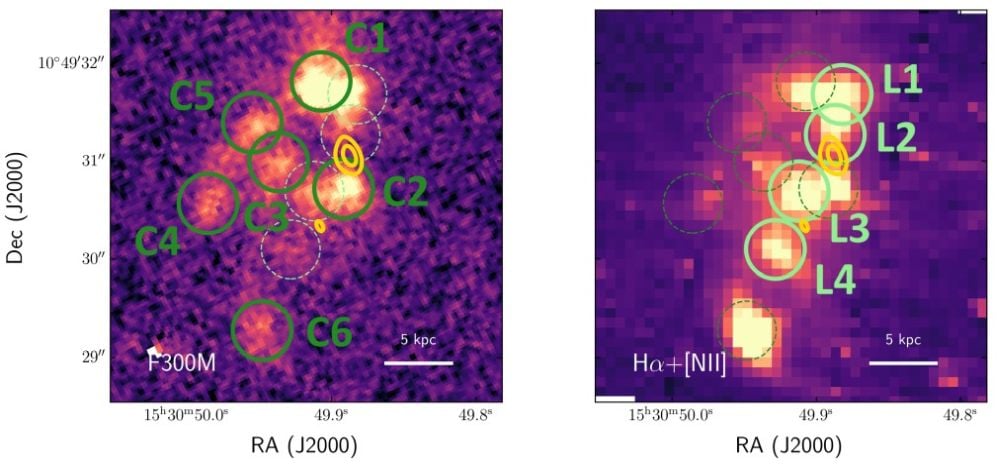 *The JWST image on the left shows continuum sources, meaning the six members of the protocluster. The JWST image on the right shows line emission regions, which may be AGN feedback. Image Credit: Saxena et al. 2026. OJA*
The galaxies in the protocluster are not small dwarf galaxies. Four of them are already massive, and all six combined contain hundreds of billions of solar masses in stars. The growth of black holes and galaxies is linked, but the details aren’t clear. It’s a very active area of research, and one of the main questions the JWST was built to address.
The JWST may have been built to study galaxy and SMBH growth, but the telescope can’t cover all observational bases. Radio astronomy is still a powerful tool, and in the second paper, the team captured high-resolution radio images.
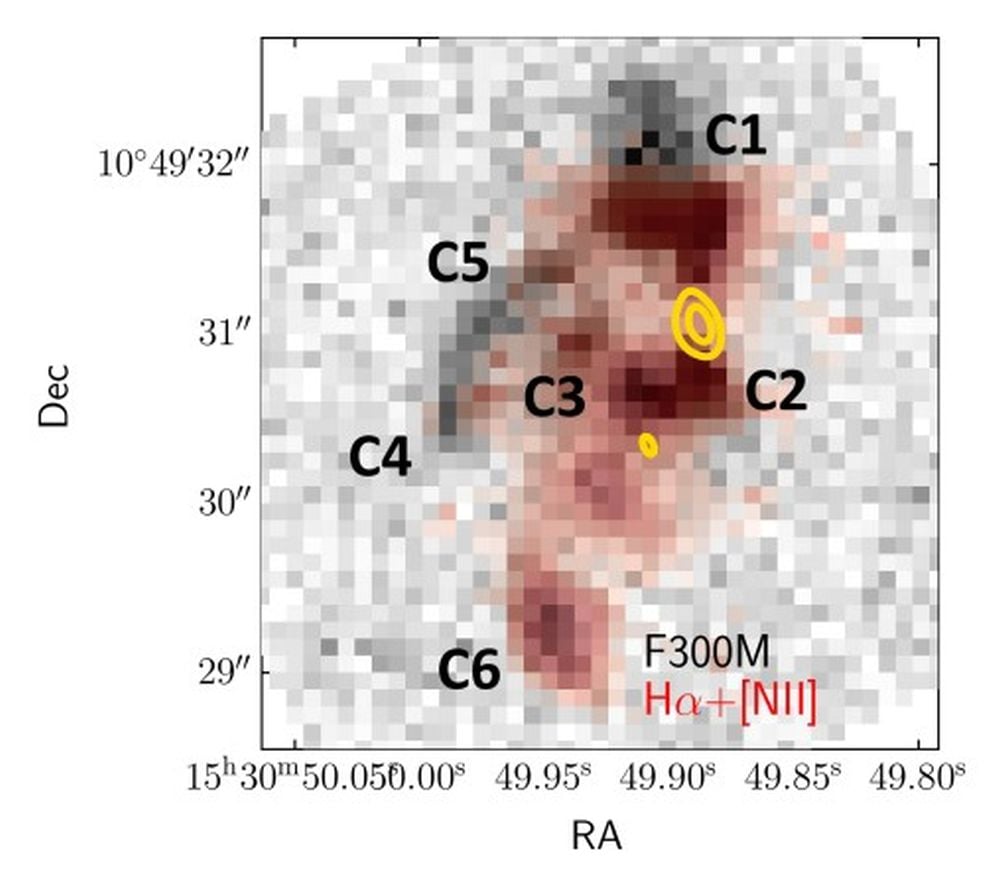 *This composite image combines JWST and radio data. The continuum source C2, one of the galaxies, is likely the host of the radio AGN. Image Credit: Saxena et al. 2026. OJA*
‘Using a network of connected radio telescopes, we were able to produce a very sharp image of TGSSJ1530+1049,’ said lead author of the second paper Krisztina Gabányi. ‘The radio emission is produced as material falls into the black hole, while some of it is expelled again at high speed.’
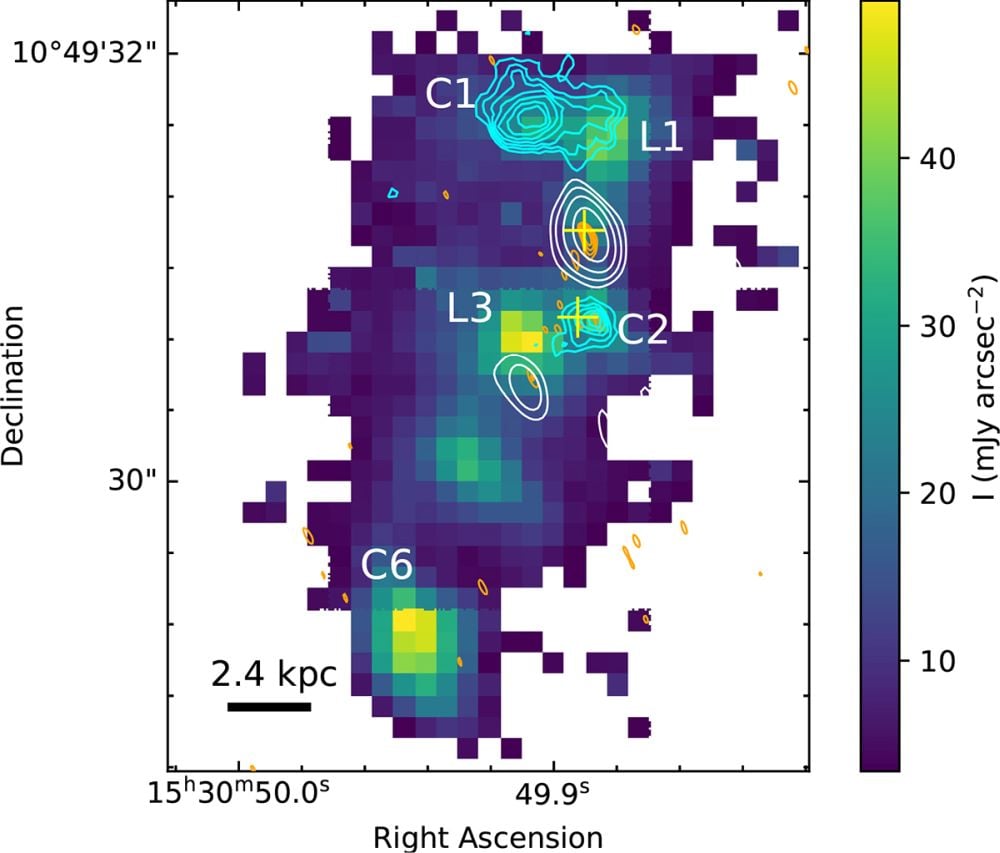 *This image combines the JWST images with radio data. The two yellow crosses are radio features. Neither of them can be the AGN; they’re most likely AGN-related hot spots or lobes where the AGN is interacting with the surroundings. The image makes it clear that the AGN is embedded in “a very dense region of merging galaxies,” the authors write. Image Credit: Gabány et al. 2026. A&A*
The observations show that the galaxies are merging, and as a bonus, the protocluster resembles simulations. “Based on the physical separations and velocity differences between the galaxies, it is expected that these galaxies will merge to form a massive galaxy within a few Gyr,” the authors of the first paper write. “The system qualitatively resembles the forming brightest cluster galaxies in cosmological simulations that form early through a rapid succession of mergers.”
Finding multiple galaxies in the process of merging is a rare feat. Not only can the researchers see the galaxies merging, they can see the SMBH growing. This discovery also shows the power of radio observations even in the age of the JWST.
“This work has shown that the identification of candidate HzRGs from purely radio-selected samples continues to deliver interesting probes of cosmology, massive galaxy formation and supermassive black holes,” the authors of the first paper conclude.
“These data point to a picture of a massive, forming galaxy that hosts at least one active supermassive black hole interacting with the surrounding gas through its (compact) radio jets,” the second paper concludes.
There’s much more detail to be untangled in this protocluster. The nature of the AGN and its jets is still unclear. Regardless, the observations are still significant as researchers try to understand how galaxies and their SMBH grew to be so massive in the local Universe.
“What makes this special is that we can follow both the build-up of a giant galaxy and the growth of the black hole at its centre,” said Huub Röttgering, co-author of the second paper. “The observations therefore offer a rare look at a cosmic construction site in the young universe, where the ancestors of today’s largest galaxies are taking shape.”