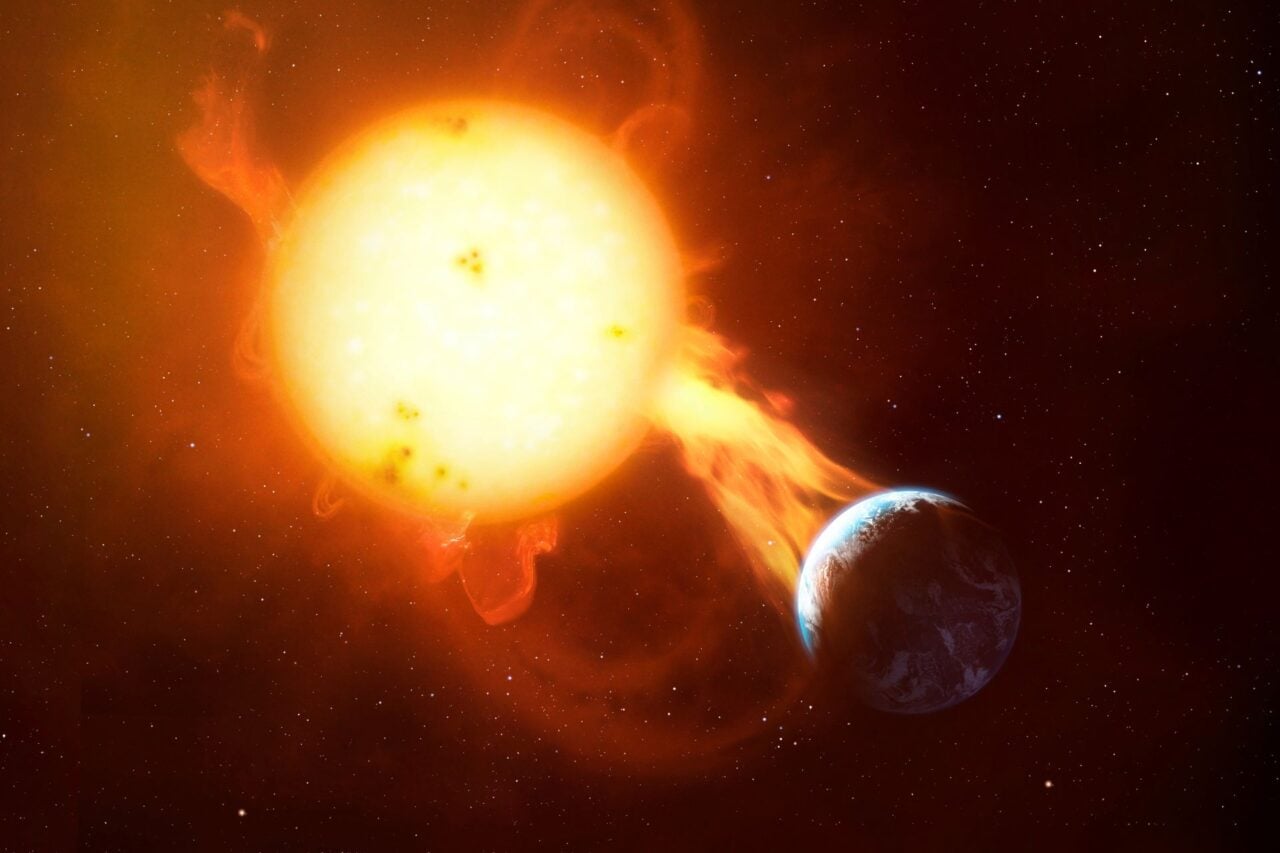
Геосоронзон шуурга нь хэдхэн цаг болон хэдэн өдрийн дотор дэлхийн цаг агаарын төлөв байдалд томоохон өөрчлөлт авчирдаг болохыг шинэ судалгаагаар нотоллоо.
Geophysical Research Letters сэтгүүлд нийтлэгдсэн судалгаагаар Нарны идэвхжил, ялангуяа хүчтэй геосоронзон шуурга нь дэлхийн агаар мандалд богино хугацаанд нөлөөлдөг болохыг тогтоожээ. Нью-Хэмпширийн их сургуулийн физикийн профессор асан Жоахим Раедер нарны 11 жилийн мөчлөгийн нөлөөлөл удаан хугацаанд үргэлжилдэг бол, одоо илэрсэн энэхүү нөлөөлөл нь тухайн өдөртөө л цаг агаарын өөрчлөлтийг үүсгэж буйгаараа онцлогтой гэж тайлбарлав.
Судлаач 67 жилийн турш цуглуулсан сансрын цаг агаарын мэдээлэл болон агаар мандлын шинэ өгөгдлүүдийг дэвшилтэт компьютерын загварчлалаар шинжилжээ. Үр дүнд нь хүчтэй геосоронзон шуурганы дараа Канадын Хадсоны булан болон АНУ-ын Роки уулын бүс нутагт хур тунадас эрс багасдаг болохыг илрүүлсэн байна. Мөн шуурганы эрчим ихсэх тусам агаар мандлын гажиг илүү тод ажиглагджээ.
https://agupubs.onlinelibrary.wiley.com/doi/10.1029/2025GL121097
Жоахим Раедер нарны дэлбэрэлтээс ялгарах цахилгаан соронзон цацраг нь туйлын хуй салхиар дамжин дэлхийн доод агаар мандалд нэвтэрч, хур тунадасны хэмжээнд нөлөөлдөг байж болзошгүй гэсэн таамаглал дэвшүүлж байна. Хэдийгээр энэхүү судалгаа нь шууд шалтгаант холбоог бүрэн нотлоогүй ч цаг агаарын урьдчилсан мэдээний загварчлалыг сайжруулах, нарны идэвхжил ба дэлхийн цаг уурын уялдаа холбоог тайлбарлахад чухал алхам болж байна.
https://www.unh.edu/news/powerful-solar-storms-may-change-weather-patterns-across-north-america
Дэлгэрэнгүйг эх сурвалжаас харах
Эх сурвалжийг нээх ↓
The surface of the Sun is a tempestuous place, spewing bursts of plasma and gusts of solar wind that frequently collide with our planet. Research has shown that long-term shifts in solar activity can influence Earth’s atmosphere, but a new study suggests that powerful solar storms can alter weather patterns almost immediately.
The findings, published in the journal Geophysical Research Letters, show that geomagnetic storms—major disturbances of Earth’s magnetosphere caused by onslaughts of solar energy—can produce profound weather changes within hours to days. What’s more, the magnitude of these weather anomalies appears to increase with the intensity of the storms.
“We’ve long understood that the Sun influences our atmosphere over its roughly 11-year cycle—it’s subtle, but it’s there,” study author Joachim Raeder, a professor emeritus of physics at the University of New Hampshire, said in a statement. “What’s exciting is that we’re now seeing a much stronger, short-term impact—happening within a single day of a solar storm.”
Solar and terrestrial weather intertwined
Every 11 years or so, the Sun’s magnetic field flips. During the lead-up to that event, solar activity builds to a maximum, when there is a dramatic increase in sunspots, solar flares, and coronal mass ejections (CMEs). Once the magnetic field flips, solar activity drops back down to a minimum, and the cycle starts over again.
Previous studies have shown that several climatic conditions, such as surface temperature and rainfall, exhibit correlations with the phases of the solar cycle. The trouble is, nearly all measurable atmospheric variables are intertwined, so it’s difficult to parse the physical mechanisms of these correlations.
Raeder’s findings offer new insights into how solar activity may drive weather changes on Earth. He combined 67 years of space weather records with newly available atmospheric data, then analyzed them using advanced computer models and anomaly mapping techniques. This revealed patterns that were not visible before.
According to Raeder’s analysis, geomagnetic storms can trigger immediate weather anomalies that vary regionally and seasonally. For example, regions such as Canada’s Hudson Bay and the Rocky Mountains in the western U.S. exhibited significant declines in precipitation in the hours or days after a geomagnetic storm. What’s more, large storms that struck in summer or winter were more likely to suppress precipitation than those occurring in spring or fall. And across the board, stronger geomagnetic storms produced more dramatic weather anomalies.
Raeder also identified changes in wind speed, temperature, radiation, and surface pressure, though these effects were localized and scattered across North America, making it difficult to draw conclusions about them.
Unraveling a complex relationship
While this study shows strong correlations between geomagnetic storms and near-term weather changes, it does not prove causation. With that said, these findings could help scientists understand the physical mechanisms that underlie the relationship between solar weather and terrestrial weather.
For example, Raeder hypothesizes that solar storms may suppress precipitation because the electromagnetic radiation from the solar flares penetrates down to Earth’s lower atmosphere via the polar vortex, the mass of frigid air and low pressure that circulates each of the poles. In his view, this is a more likely explanation for the observed precipitation anomalies than competing hypotheses.
“Like many other studies on the same topic, I cannot provide the ultimate answer, but my results narrow down the list of possible physical processes, and in particular, challenge the atmosphere models to reproduce these solar effects on weather,” Raeder said.
Gaining a clearer understanding of how solar activity influences Earth’s weather could help improve forecasting and climate models, which are currently unable to accurately reproduce the effects of geomagnetic storms on atmospheric conditions, according to Raeder. These new findings have brought researchers a step closer to untangling this complex relationship.

