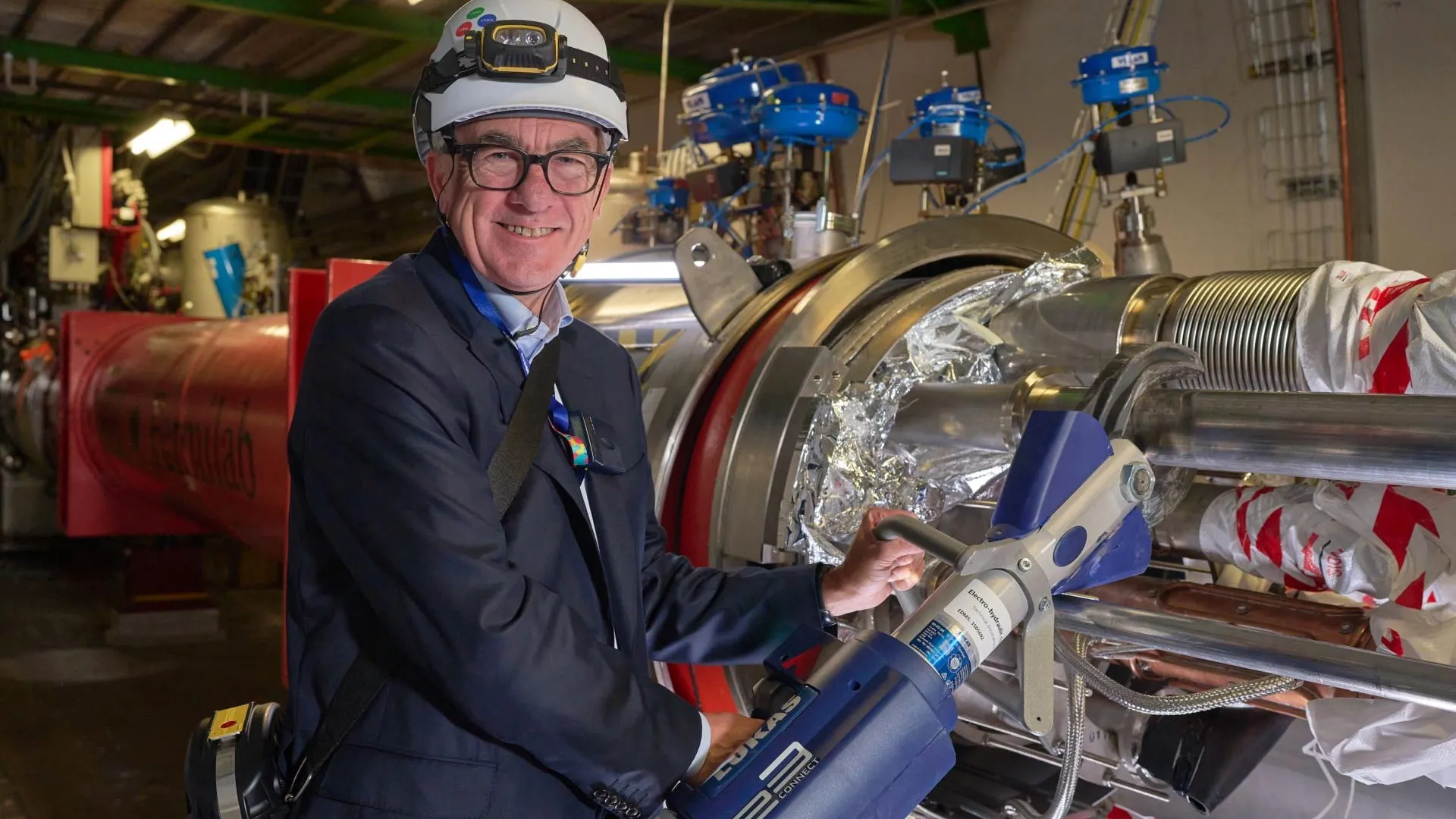
Тус байгууллага бөөмийн мөргөлдөөний давтамжийг нэмэгдүүлэх зорилгоор хурдасгуурын гол соронзон системүүдийг илүү хүчирхэг төхөөрөмжөөр солих ажлыг эхлүүлжээ.
Их хадрон хурдасгуур (LHC) нь 27 км урт тойрог замд бөөмийн цацрагийг чиглүүлж, удирдах зориулалттай олон мянган соронзонгоос бүрддэг. Эдгээрээс “дотоод триплет” буюу гурвалсан квадруполь соронзнууд нь бөөмсийг мөргөлдөх цэгт хамгийн нягт төвлөрүүлэх чухал үүрэгтэй. Цацрагийг илүү нягтруулснаар мөргөлдөөний тоо нэмэгдэж, судлаачдад шинжилгээ хийх илүү их өгөгдөл хуримтлагддаг байна.
HiLumi LHC төслийн хүрээнд есдүгээр сарын 7-ноос эхлэн CERN-ийн баг ATLAS болон CMS туршилтын талбайн ойролцоох 28 хэт дамжуулагч соронзыг буулгаж эхэлжээ. Эдгээр хуучин тоног төхөөрөмж нь 2005-2007 оны хооронд суурилагдсан бөгөөд бараг хорин жил ажилласны эцэст илүү дэвшилтэт технологиор солигдож байна. Шинэ соронзнууд нь ниобий-цагаан тугалганы ороомог ашиглах бөгөөд одоогийн төхөөрөмжөөс 40 хувиар илүү хүчтэй буюу 11.3 теслагийн соронзон орон үүсгэх чадвартай юм.
Энэхүү томоохон шинэчлэл нь хурдасгуурын ажиллагааг дараагийн шатанд гаргах зорилготой бөгөөд эхний шинэ квадруполь соронзыг 2029 оны эхээр туннельд суурилуулахаар төлөвлөж байна. ALICE болон LHCb туршилтуудын хувьд мөргөлдөөний нягтралыг өмнөх шиг хэвээр хадгалах боловч тэдгээрийн соронзон системийг ч мөн шинэчилж, ерөнхий гэрэлтэлтийн өсөлтөөс үр шимийг нь хүртэхээр төлөвлөжээ. Энэхүү үйл явц нь CERN-ийн түүхэн дэх нэгэн үеийн инновацийг дараагийн үеийн технологиор солих чухал үе шат болж байна.
Дэлгэрэнгүйг эх сурвалжаас харах
↓Эх сурвалжийг нээх ↓
The Large Hadron Collider (LHC) stretches 27 km around and relies on thousands of magnets of different types – dipoles, quadrupoles, sextupoles, octupoles, decapoles, etc. – to steer and control its particle beams. Each type performs a specialized task.
Some of the most important are known as inner triplets. These groups of three quadrupole magnets (hence the name) sit on both sides of the LHC’s four main experiments. Their job is to focus the particle beams as tightly as possible just before the particles collide inside the detectors.
The tighter the beams are “compressed,” the greater the chance that particles will collide. That makes the inner triplets essential for increasing the LHC’s luminosity, i.e. the number of collisions that occur in a given period of time. More luminosity means more collisions, giving researchers more data to analyze.
Preparing the LHC for a New Era
A major part of the future High-Luminosity LHC (HiLumi LHC) project involves replacing the existing inner triplets with a much more powerful generation of magnets.
The work is taking place during the third long shutdown (LS3). Reently, crews cut the first magnet interconnection, formally beginning the replacement operation. CERN Director-General Mark Thomson also visited LHC Point 1 (the ATLAS experiment) to mark the milestone.
“The replacement of these magnets with the new HiLumi LHC inner triplets is crucial for the coming high-luminosity years. The first quadrupole of the new triplets should arrive in the tunnel at the start of 2029. In total, 16 cryostats and 28 cryo-assemblies will be installed – a major undertaking,” explains Jean-Philippe Tock, Head of the LS3 Coordination Team.
Magnets About 40% Stronger
The new inner triplets are the product of years of research and development. They represent a major technological advance over the niobium-titanium magnets currently operating inside the LHC.
Instead of niobium-titanium, the upgraded magnets use niobium-tin superconducting coils. This allows them to generate magnetic fields reaching 11.3 tesla, about 40% stronger than the fields produced by the current magnets.
The new equipment will be installed around the ATLAS and CMS experiments, where the increased collision rate will be especially important.
ALICE and LHCb operate differently and pursue different physics programs, so they do not need the same increase in instantaneous luminosity. Their existing inner triplets can therefore remain in place. However, those magnets will still be upgraded so that both experiments can benefit from the overall increase in luminosity.
Removing 28 Superconducting Magnets
Since September 7, CERN teams have been dismantling sections of the collider on either side of ATLAS and CMS. The goal is to remove 28 superconducting magnets (including the inner triplets) that are scheduled to be replaced.
The operation marks the end of an era for hardware that has been part of the LHC since its construction.
“Today’s event is a major milestone for CERN, especially for the HiLumi LHC project team. The current inner triplets date back to the LHC construction phase and were installed in the machine between 2005 and 2007. After nearly twenty years of operation, they will give way to a new generation of even more powerful magnets. It’s truly remarkable to witness such a handover from one generation of innovation to the next,” says Markus Zerlauth, the HiLumi LHC Project Leader.

