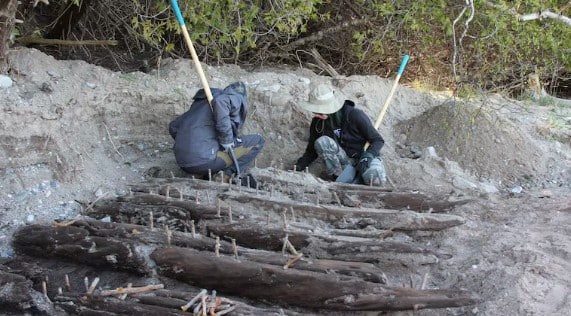
Найман настай хүү металл илрүүлэгч ашиглан Онтарио муж дахь байгалийн цогцолборт газарт малтлага хийх явцдаа түүхийн үнэ цэнтэй олдвор илрүүлжээ.
Онтарио мужийн Пойнт Фармс байгалийн цогцолборт хүрээлэнд 2023 онд гэр бүлийн хамт аялж явсан Лукас Атчисон хүү металл илрүүлэгчээр ган хадаас илрүүлснээр археологийн судалгааны ажил эхэлсэн байна. Уг олдвор нь энгийн хадаас биш, эртний хөлөг онгоцны их биеийн нэг хэсэг болохыг тогтоожээ. Уг үйл явдлын дараа Онтариогийн далайн өвийн хорооны сайн дурынхан болон мэргэжлийн археологичид талбайд үзлэг хийсэн байна.
Судалгааны багийн ахлагч, далайн археологич Скарлетт Жанусас уг олдвор нь хоёр шураг бүхий, бат бөх хийцтэй “schooner” буюу хоёр давхар дарвуулт хөлөг онгоц байх магадлалтай гэж үзжээ. Судлаачид тус хөлөг онгоцыг 1856 онд баригдсан “St. Anthony” хөлөг байж болзошгүй хэмээн таамаглаж байна. Түүхэн баримтаас үзэхэд, 1856 онд Чикагогоос Буффало руу улаан буудай тээвэрлэж явсан ийм нэртэй хөлөг онгоц Хьюрон нуурын ойролцоо осолдож байжээ.
Археологичид хөлөг онгоцны бүтцийг бүрэн баримтжуулахын тулд хэмжилтийн зураг төсөл гаргаж, 19-р зууны үеийн хөлөг онгоцны даатгал болон хийцийн стандартыг харьцуулан судалж байна. Олдворыг хамгаалах зорилгоор малтлага дууссаны дараа хөрсөөр дахин булж, хүчилтөрөгчгүй орчинг бүрдүүлэхээр төлөвлөжээ. Энэхүү арга нь шимэгч хорхой болон бусад бичил биетнээс хамгаалж, хөлөг онгоцны бүтцийг дахин 50 орчим жил хадгалах боломж олгоно гэж мэргэжилтнүүд тайлбарлалаа.
Дэлгэрэнгүйг эх сурвалжаас харах
↓Эх сурвалжийг нээх ↓
An 8-year-old with a new metal detector has led volunteers to the remains of what is thought to be the shipwreck St. Anthony, buried in a Canadian park.The ship was built and wrecked in the same year, 1856. Now that it has been examined, the plan is to bury it again.
Most kids who unwrap a metal detector picture themselves stumbling onto a treasure chest, or the hulk of some ancient ship. In 2023, Lucas Atchison, then 8, brought his birthday present along on a family trip to Point Farms Provincial Park, near Goderich, Ontario.
The first ping seemed to deliver something far humbler. That humble object, a steel spike, has since drawn in park staff, a volunteer heritage group and specialists in marine archaeology and history.
A Tiny Discovery That Revealed A Lost Shipwreck
What Lucas pulled from the ground was a steel spike. His father, Jason, figured it was the kind used to tie up local boats and was ready to move on. Lucas wasn’t. CBC reported the now-10-year-old insisted there was more to it, and the two dug further. The spike turned out to be attached to a piece of wood carrying several more. That’s when, as Lucas remembers it:
“Then Dad told me, ‘Lucas this is a shipwreck. When I woke up that morning I did not expect to find a shipwreck!”
Jason reported the find to park staff and contacted the Ontario Marine Heritage Committee (OMHC), a non-profit volunteer group, to investigate. As with any excavation, a good deal of time went into seeking approval and preparing before anyone could dig.
What The Volunteers Found?
Earlier this month, OMHC volunteers finally took shovels to the site and uncovered further remnants of the ship. Marine archeologist Scarlett Janusas pointed to double frames, which suggest a more strongly built vessel, and said the team believes it is a schooner, usually a wooden, two-masted sailing ship.
The work now runs on two tracks. At the site, volunteers will make scale drawings of the wreck, including a plan view from above and a side profile. Elsewhere, experts will look into 19th-century insurance requirements for ships.

As reported by marine historian Patrick Folkes, those rules would specify how many fasteners, or spikes, belong in the frames and at what distance, which would make it easier to pin down the general period when the ship was built.
The Shipwreck Found, Then Reburied
Nobody has confirmed exactly which vessel Lucas found, but there is a leading theory: the St. Anthony, a schooner built in Erie, Pennsylvania. It was carrying wheat from Chicago to Buffalo when it wrecked in Lake Huron off the coast of Goderich. According to an October 30, 1856 item in the Buffalo Daily Republic, the Erie schooner, loaded with wheat, was ashore near Goderich.
The same paper reported on November 26 that the tug steamer Fashion, which had been heading to help the St. Anthony, was driven by heavy weather into Bayfield and struck a sand bar. The shipwreck was being stripped and would be abandoned.
The schooner, meanwhile, was still aground, her wheat cargo having run through her bottom, though the paper said it was thought she could be got off. She never was, and at least part of her stayed buried until Lucas came along with his detector. Having been uncovered, the shipwreck is going back underground. Janusas explained that:
“We fill the hole back in, bury it and create an anaerobic environment, i.e. without oxygen, so you don’t have any kind of parasites in there or any other organisms that will eat or destroy the wreckage,” she added.“It’s not a perfect solution but it does maintain the structure of that ship probably for at least another 50 years.”
Enjoyed this article? Subscribe to our free newsletter for engaging stories, exclusive content, and the latest news.

